Updates from the Western Ghats
Restoration season
For Nature Conservation Foundation teams in the Western Ghats, the onset of the Asian southwest monsoon around early June marks the beginning of the rainforest restoration season. Or more precisely, the restoration planting season, because restoring rainforests is a year-round (and lifelong) activity. Planting during this relatively cool and moist season helps young rainforest trees best prepare for the subsequent dry season and other hardships that follow. Our maximum diversity mixed-native species planting strategy aims to introduce 500-1000 saplings of 60-80 native tree species per hectare of restored forest. By planting several species that are endemic (unique to the Western Ghats), rare and classified by the IUCN as globally threatened, and important food plants for native wildlife, our goal is to conserve and revive refuges for rainforest biodiversity in landscapes increasingly dominated by plantation crops such as tea, coffee, and cashewnut.

This year, we worked with village communities, private landowners, coffee planters, tea plantation companies, and State Forest Departments to initiate rainforest restoration in 21 ha of abandoned coffee and tea plantations, deforested and repeatedly burned lands, and degraded sacred groves and Reserved Forests across the Anamalai Hills (Tamil Nadu), Malenadu (Karnataka), and Sahyadri (Maharashtra). We planted 13,633 saplings of 194 native species overall. The more open and disturbed sites were planted with hardy and disturbance-tolerant native species such as Red cedar (Toona ciliata) and wild cinnamon (Cinnamomum malabatrum). In sites that had some preexisting canopy cover (e.g., abandoned coffee plantation), we planted more shade-tolerant rainforest specialists such as the endangered Palaquium ravii and hornbill favourites Myristica beddomei and Dysoxylum malabaricum. All plants came from local seeds, sourced from roadsides, forest edges, and coffee plantations, and raised in restoration nurseries operated by NCF and a few of our local partners in the project landscapes.
With the monsoon now receding, our focus shifts to maintenance and monitoring. Previous experiences have taught us that keeping a close eye on planted sites for at least an initial year or two and maintaining firelines, controlling weeds, and protecting and watering saplings can increase early survival and growth and improve chances of long-term recovery. The good news this year is that over 95% of the planted saplings have survived so far despite the weak and erratic monsoon. The imminent ‘Super’ El Niño is a cause for uncertainty and concern, but perhaps also an unwanted opportunity to learn how rainforests respond and restoration projects must adapt to a rapidly changing climate.
New book on trees!
The Trees of My Country: A Natural History of India in 50 Trees
This new book is a collaboration between NCF scientist T R Shankar Raman and artist Manali Patil is a celebration of trees of India—from the mundane to the magnificent—through evocative word portraits and beautiful botanical art.
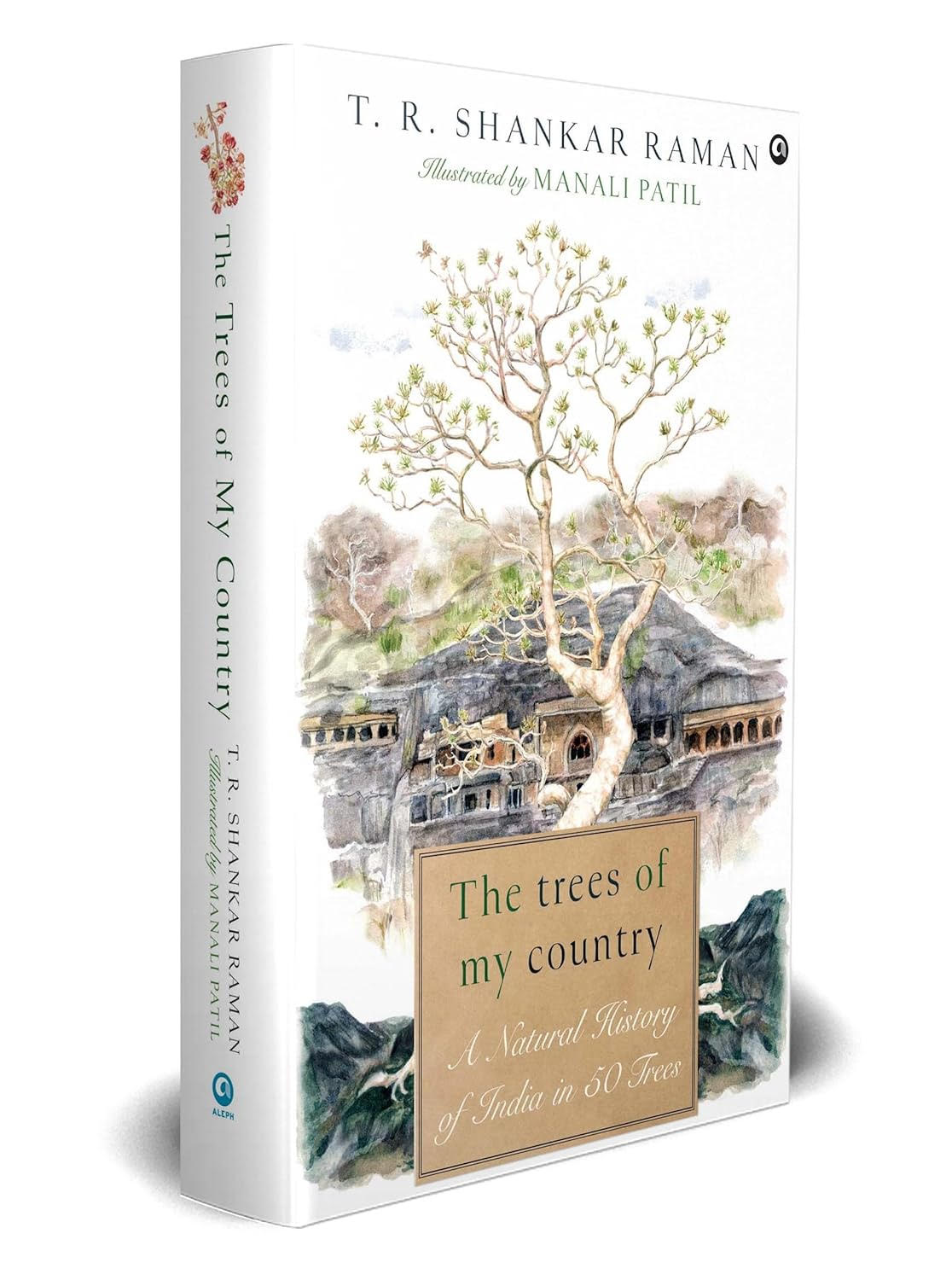
Stimulating wonder, this eloquent call to arms both informs and impels us to act on behalf of trees, recognizing them as living beings whose lives and futures are entangled with our own. Now available in bookstores and online. Watch the authors chat about trees and their book at the Some Like it Wild podcast, Books and Authors podcast, and Greenlitfest.
Training programs for forest officers

NCF scientists working in the Western Ghats conducted two courses on restoration for Indian Forest Service (IFS) officers at different career stages. We led a three-day course on “Ecological Restoration” that was offered as an elective to IFS probationers at the Indira Gandhi National Forest Academy, Dehradun from July 2 to 11, 2026. The course combined conceptual sessions and group discussions led by NCF scientists with practitioner perspectives led by distinguished former officers. Twenty one probationers attended the course. Second, we contributed to a three-day residential workshop on the “Principles and Practice of Ecological Restoration” held for 32 serving IFS officers at the Keystone Foundation campus in Kotagiri, Nilgiris, from September 9 to 11, 2026. This mid-career training and capacity-building initiative was led by the National Centre for Biological Sciences (NCBS), in collaboration with Keystone Foundation, Ecological Restoration Alliance-India (ERA-India), Nature Conservation Foundation (NCF), and Adavi Trust. The course combined interactive lectures, case studies, and field visits to develop key concepts on ecosystem degradation, restoration monitoring, policy, and community participation. Both courses underscore growing collaborative efforts between forest officials and civil society to advance science-based, community-inclusive landscape restoration across India.
Some of our recent scientific publications
-
Madhavan, A. P., Bhat, K., Kasinathan, S., Mudappa, D., Page, N., and Raman, T. R. S. 2026. Distribution models predict climate-related range alteration or extinction of eleven threatened tropical rainforest trees in the Western Ghats Journal of Biosciences 51: 43. Client Challenge
-
Surendra, A. and Raman, T. R. S. 2026. Fragment area and habitat quality underlie temporal decline and community changes in rainforest birds within long-isolated fragments, Ornithological Applications 128:1-13. https://doi.org/10.1093/ornithapp/duag040
-
Krishnan, A., Nag, J., Arun, S., Mudappa, D., Raman, T.R.S., Sankaran, M. and Osuri, A.M. 2026. Partial recovery of large seed arrival following ecological restoration in fragmented tropical rainforests. Oikos e11945. https://doi.org/10.1002/oik.11945
-
Karthick, V., Dass, S., Sadekar, V., Naniwadekar, R., and Osuri, A. M. 2026. Land use and climate shape amphibian multidimensional diversity and conservation in a coffee agroforestry landscape, Western Ghats. Biological Conservation, 322, 112057. Redirecting
-
Chethana, A., Naniwadekar, R., and Osuri, A. M. 2026. Multifaceted but understudied potential impacts of alien coffee on tropical forest regeneration. Journal of Tropical Ecology, 42, e29. Multifaceted but understudied potential impacts of alien coffee on tropical forest regeneration | Journal of Tropical Ecology | Cambridge Core
-
Madhu, N., Sadekar, V., Jayapal, R., and Naniwadekar, R. 2026. Effects of Land‐Use Intensification on Floral Resources, Bird Assemblages and Bird‐Flower Interaction Networks in the Western Ghats, India. Biotropica, 58, e70262. https://doi.org/10.1111/btp.70262
-
Biswas, N., Biniwale, S., Sadekar, V., Taneja, Y. V., Suryawanshi, K., Osuri, A., and Naniwadekar, R. 2026. Securing lowland forests is critical for bird conservation in the Western Ghats biodiversity hotspot. Oryx, 1-11. Securing lowland forests is critical for bird conservation in the Western Ghats biodiversity hotspot | Oryx | Cambridge Core
-
Gosavi, N., Lad, H., Jithin, V., and Naniwadekar, R. (2026). Effects of tree plantations on population and roosting ecology of an endemic agamid lizard in the Western Ghats Biodiversity Hotspot. Journal of Zoology, 328, 67-75. https://doi.org/10.1111/jzo.70070Digital%20Object%20Identifier%20(DOI)