Celebrating and Learning from a Legacy towards Resilient Rural Futures Convening of Stakeholders
30 November – 2 December 2025
Thank you for accepting our invitation and being with us in Mohuda. Your wholehearted participation, curiosity, and openness shaped the spirit of the Convening. This gathering marked fifty years since work began in Mohuda in 1976, leading to the formation of Gram Vikas and its long journey of working with rural communities to understand their realities and act collectively.
The reflections at Mohuda@50 reminded us that building resilient futures requires looking inward and outward. Inward, to examine our institutions, values, and systems. Outward, to understand youth aspirations, celebrate community voices, nurture leadership, and create enabling frameworks that allow ideas to become action. These shared insights point toward a future where communities strengthen their ability to dream and act together.
1.Learning from the Ground
Participants visited partner villages in Rudhapadar, Kankia, Mohana, and Koinpur to see how communities organise around water, institutions, and local governance, and their priorities. The groups engaged with a wide range of stakeholders in the villages.
Gram Panchayat Coordination Committees, elected representatives of Panchayati Raj Institutions on convergence and local decision-making. Village Development Committees and women self-help groups on community-led planning and water management system, and various activities undertaken in the villages. The groups visited Gram Vikas residential schools, and in Koinpur, met the VIKALP learning group for insights into youth aspirations. This day enabled participants to gain first hand understanding of the lived
Village meeting in Laxmipur

Meeting at Chudangapur GP

Meeting at Samiapali

2. Museum of Experience: Citizen Institutions & Responsive Local Governance
Participants explored an immersive walkthrough showing how Village Development Committees (VDC), Gram Panchayat Coordination Committees (GPCC), and Gram Panchayats plan and prioritise local needs through the VPRP and convergence processes. Community leaders explained how demands are collected, negotiated, and followed up across departments.
Viewed how VPRP tools and convergence platforms are used in community planning.
Spoke about approaches to water sustainability, aquifer planning, migration, and FRA processes. Explored the digital applications that support planning, monitoring, and follow-up.
Listened to community members describe their growing confidence and ownership in governance processes. The walkthrough highlighted the strength of community-led systems in shaping responsive and resilient local development.
3.Museum of Experience: Citizen Institutions & Responsive Local Governance:
Participants explored an immersive walkthrough showing how Village Development Committees (VDC), Gram Panchayat Coordination Committees (GPCC), and Gram Panchayats plan and prioritise local needs through the VPRP and convergence processes. Community leaders explained how demands are collected, negotiated, and followed up across departments.
• Viewed how VPRP tools and convergence platforms are used in community planning.
• Spoke about approaches to water sustainability, aquifer planning, migration, and FRA processes.
• Explored the digital applications that support planning, monitoring, and
follow-up.
• Listened to community members describe their growing confidence and
ownership in governance processes.
The walkthrough highlighted the strength of community-led systems in shaping responsive and resilient local development

4. Museum of Experience: Young People & Pathways to Secure Futures:
The walkthrough on youth experiences illustrated the five personas that shape how young people navigate their futures:

• First-Generation Aspirer
• At-Risk Exiter
• Misinformed Striver
• Silent High-Potential Girl
• Local Multiplier
Through stories and interactions, participants saw how information gaps, gender norms, mobility constraints, financial pressures, and digital access influence the choices available to them.
•Understood the hesitation and uncertainty faced by First-Generation
Aspirers.
•Saw how At-Risk Exiters slip into unsafe or premature decisions.
•Examined how Misinformed Strivers lose opportunities due to incorrect
information.
•Noted the quiet potential of Silent High-Potential Girls when given space and
support, gives them the confidence to be able to dream of a secure future.
•Recognised how Local Multipliers guide and influence their peers.
The walkthrough underscored the need for accurate information, steady encouragement, and supportive environments for young people to pursue secure and meaningful pathways.
5 WSGP Network
****# WSGP Innovations, Network Launch & Saathi Hub
Participants explored a series of walkthroughs showcasing the practical tools and methods used in the Water Secure Gram Panchayat (WSGP) programme. The displays offered hands-on experiences with aquifer models, Water Passbooks, water-quality testing, source-shed development, enterprise tracking tools, hyperlocal weather systems, and convergence processes. These interactions helped participants see how communities use data, technology, and local institutions to strengthen water security.

The day also marked the formal launch of the Network for Water Secure Gram Panchayats (N-WSGP) — Gram Vikas and seven partner organisations coming together to accelerate place-based action across Odisha. This coalition aims to support 1,000 Gram Panchayats to anchor development around water security, local leadership, and community institutions.

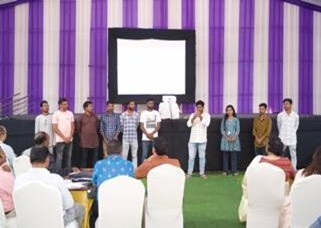
The launch of the Village Vision Saathi Hub introduced a collective of young people from Thuamul Rampur committed to supporting community- led development. Their priorities include migrant safety, reducing school dropouts, improving access to social protection, strengthening MGNREGS for water security, promoting organic farming, and
enabling women’s collective
participation.
6 The Mohuda Resolve
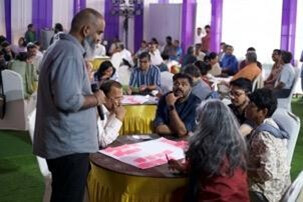
The boardroom dialogue brought together diverse participants to reflect on the future of community-led development. Discussions highlighted the need to reconnect with land, rebuild ecological alignment, and create deeper spaces for authentic dialogue in an increasingly fragmented world.
Groups reflected on youth aspirations, equity, local leadership, knowledge systems, and the pressures shaping rural development today. Themes that emerged included strengthening Panchayat-led climate action, nurturing new talent through mentorship, ensuring inclusion of women and marginalised groups, and creating enabling frameworks for local organisations. Participants spoke to the need for patience, hyperlocal engagement, trust-based collaboration, and collective purpose.
These conversations led to the articulation of the Mohuda Resolve — a shared commitment to empower youth, deepen local governance, democratise knowledge, and strengthen the collective spirit that anchors resilient, water- secure rural futures.

