How can coastal conservation, community rights, and livelihood security be pursued together? This question was central to the discussions at the Odisha Day, the state chapter of the 10th India Land and Development Conference (ILDC), held on 14 October at CYSD, Bhubaneswar. The dialogue brought together policymakers, community leaders, practitioners, and researchers to deliberate on how land, forest, and coastal governance in Odisha can become fairer and more resilient.

Across five technical sessions, participants explored themes spanning women’s land rights, tribal land rights, land leasing and tenancy, common land documentation, coastal commons and the rights of fishing communities, and urban liveability.
One of these sessions, co-organised by representatives from Centre for Research and Community Action, Common Ground, and Socratus Foundation for Collective Wisdom, brought together community leaders and representatives from Chilika, Kendrapada, Podampetta, and Puri, among others, to reflect on the state of Odisha’s coastal commons.
The discussions highlighted an important dimension of land and commons governance: the realities of traditional fishing communities, whose livelihoods, access to natural resources, and cultural identities are closely linked to coastal and wetland ecosystems. Coastal commons are governed by multiple, overlapping legal, ecological, and administrative frameworks, including the Coastal Regulation Zone (CRZ), estuarine and intertidal zones, the Exclusive Economic Zone (EEZ), continental shelves, and high- and low-tide lines. These complexities often make it challenging for local communities to understand, claim, and exercise their rights.
Drawing on experiences from Chilika lagoon, the Mahanadi delta, Bhitarkanika, Rushikulya, and the erosion-affected village of Podampetta, the session brought to the fore several interconnected challenges. The experiences shared also underscored why coastal issues cannot be addressed in isolation from questions of land tenure, local governance, livelihood security, and ecological sustainability.
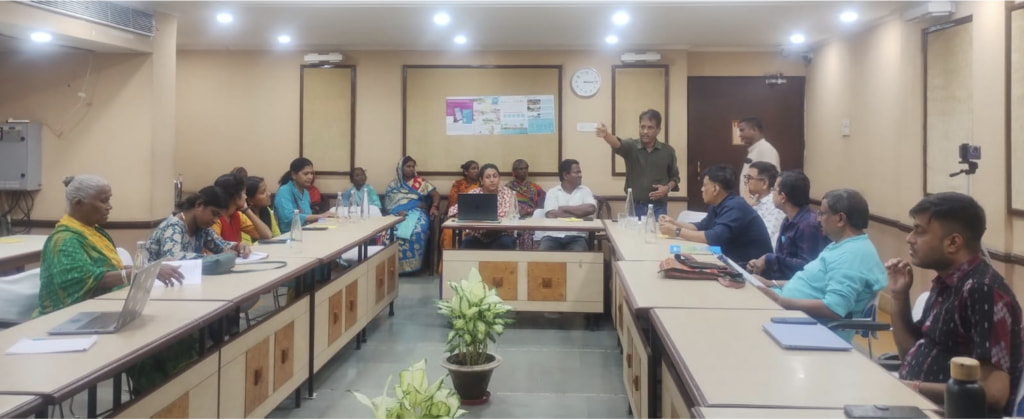
What coastal communities are experiencing
-
Insecure tenure and diminishing access to coastal commons
-
Conservation restrictions and traditional fishing rights
-
Coastal erosion, displacement, and loss of livelihoods
-
Pollution, industrialisation, and ecological degradation
-
Livelihood insecurity, migration, and gendered impacts
What would a more inclusive approach to coastal commons governance look like?
-
Recognising customary rights and strengthening local governance
-
Balancing ecological conservation with community livelihoods
-
Strengthening ecological restoration and promoting responsible investment
-
Building livelihood resilience and comprehensive social protection
Read the full blog here to learn more.