In Kalahandi’s remote, hilly, Adivasi village of Raelpas, a solar-powered piped water system freed up women’s time and relieved years of physical drudgery.

The Indravati River cuts the remote Adivasi habitation of Raelpas off from the nearest road. For years, women walked steep hillside paths multiple times a day to fetch water from a faraway dug well. Today, all households get water from taps through a community-built, solar-powered piped water system. This is the story of what water at home gave back to the women of Raelpas, and what it took to get it there.[image]
To reach Raelpas, you cross the Indravati River by boat. On the other side, a three-kilometre walk through rocky hills and uneven terrain brings you to a small cluster of homes scattered across the slopes. The path is narrow. And for the eight households that live here, it has always meant that everything from food, medicine, to schooling and markets requires crossing that river first. Raelpas is a habitation within Biribad Revenue Village, in the Adri Gram Panchayat of Odisha’s Kalahandi District. Its twin habitation, Biribad, sits on the other bank and connects to the outside world by road. Raelpas does not. The river, which is a scenic feature for a new person who visits the village, is a daily barrier for its residents.
When a community lives this far from the nearest road, the gap between it and government services widens. Safe drinking water schemes reach roadside villages first. Remote habitats wait. Raelpas waited for a long time.
A crisis that falls on women first!!!
Globally 2.1 billion people — one in four — still lack access to safely managed drinking water.
In two out of three households without water on-premises, women are primarily responsible for collection. In 53 countries with available data, women and girls collectively spend 250 million hours every day on water collection — more than three times the time spent by men and boys. These numbers describe a pattern. What they do not fully capture is what that pattern costs in time, in health, in dignity, and the immeasurable, unnoticed erasure of a day.
In communities without piped water, a woman’s morning does not begin with her own needs. It begins with everyone else’s. The walk to the water source comes before the meal, before the wash, before any moment that belongs to her. When water is absent from the home, so is the privacy of a bath, the dignity of a toilet used without inconvenience, the small rituals of personal care that most people do not think twice about. These are not small losses. They accumulate across a lifetime. Raelpas is one such community. And for the women here, the distance to water would be best measured in hours, in effort, and in what had to be given up for it.
Fifty years at one dug well
The community’s relationship with displacement goes back half a century. When the Indravati Dam was built, this Adivasi community lost its original settlement to the rising water. Bisu Majhi, 65, the village’s President, holds that memory clearly. “Our habitation sank under the dam of Indravati,” he said. “Since then we have lived here. That dug well was our only source of water.”
For all eight households of Raelpas, that single dug well served every need from drinking, to cooking and washing. The well sat 200 metres from the nearest home, at the bottom of a steep hillside. For women, it defined the shape of each day.
Laxmi Majhi, 55, described what the walk meant. “Tole jai ki, ghati rasatare munda upore boi ke pani anuchi, besi kosto laguche.” Meaning: Going down is one thing. Carrying water back up the slope on your head is another. She and the other women of Raelpas made that trip five to six times a day, spending two to three hours on water collection alone.
Without water at home, the toilets that existed in the village went unused. A bath was not a private, unhurried act. It was something arranged around the logistics of carrying enough water up a hill.
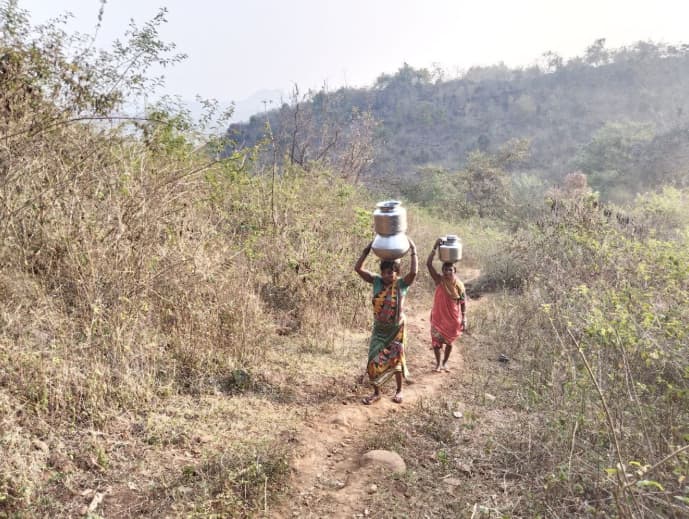
**What remoteness costs women
When water is far, women do not simply walk further. They give up time that could go to farming, to income, to rest, to their children. A finding suggests that time saved from water collection is the single biggest way access to water improves a household’s finances.
The physical toll of carrying heavy loads over uneven terrain accumulates across years. And because water collection is rarely counted as labour, its cost remains invisible in every ledger except the one women carry in their bodies.
In Raelpas, the difficulty was compounded at every level. The hillside made the walk steep. The scatter of households across the slopes meant the distance was longer for some families than others. The river cut the community off from any outside support that might have addressed the problem sooner. Dhanmati Goud, 65, spoke from decades of lived experience. “Access to water was the biggest problem for us. We women faced a lot of struggle to carry water and used to spend a lot of time on it.” The remoteness of Raelpas had kept it outside the reach of safe drinking water initiatives being carried out in other villages of the Adri Gram Panchayat. Being on the wrong side of a river, in a landscape without roads, meant the village simply did not appear on the priority lists.

More details: When Water is Far Away, Women Pay the Price