Invasive plants are a pesky problem, especially for those living at forest edges. The worst of the lot is the toxic invasive, Lantana camara. We, at The Shola Trust have been trying to deal with it in many ways, the latest being turning it into biochar- to be used as a soil additive that not only sequesters carbon, but also improves soil fertility.
Turning Lantana into livelihoods and fertile soil
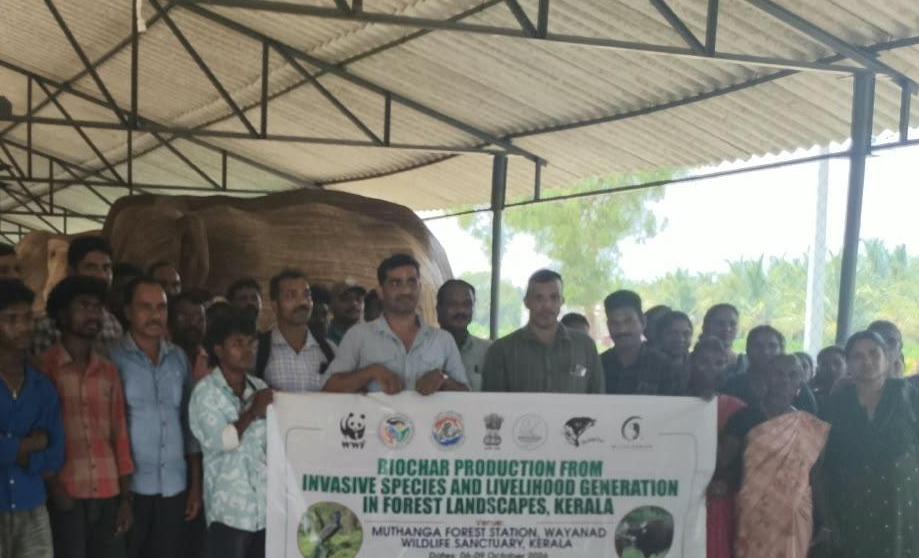
Three day-long workshops were held on 7th , 8th and 9th October 2026, at the Muthanga Forest Station in Wayanad Wildlife Sanctuary in Keralam.
It was organised by the EIACP Programme Centre at WWF-India, under the Ministry of Environment, Forest and Climate Change. The workshops had approximately 165 participants , including forest-dwellers, Eco-Development Committee (EDC) members and frontline forest staff.
The Location
The forests around Muthanga are home to rich biodiversity, including elephants. The villages at the forests’ edge are home to tribal communities whose lives and livelihoods are closely tied to the landscape. The spread of Lantana camara and Senna spectabilis is an ecological challenge here, but when converted into biochar, these invasives can offer supplementary livelihood.
The Participants
Participants came mainly from the Paniya and Bettakurumba communities. Participants also included EDC members, forest watchers, eco-tourism workers, young people and frontline Forest Department staff.
The workshop structure
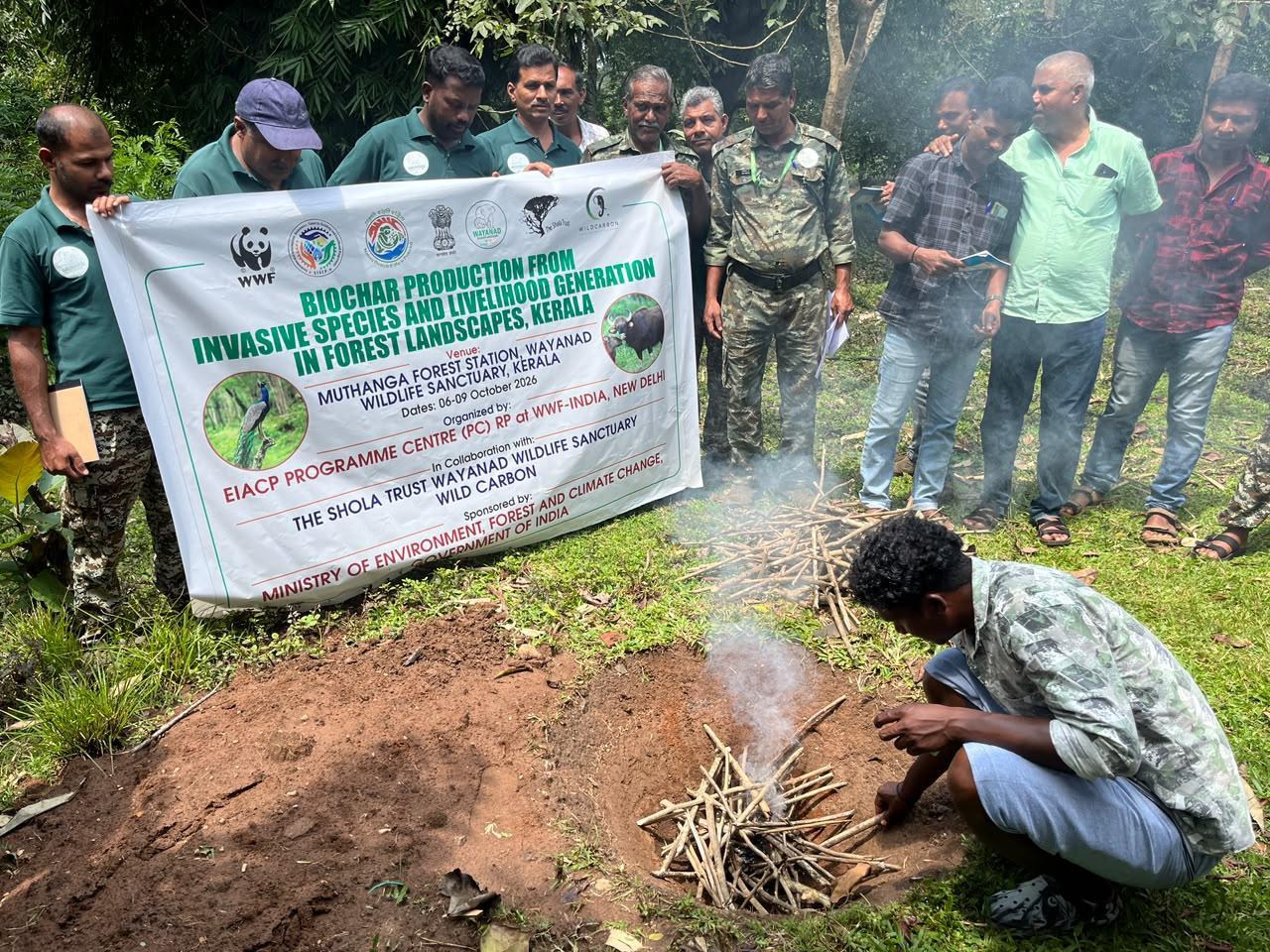
- Theory. Participants learned what biochar is, how controlled heating (pyrolysis) produces it, and how it can improve soil health and productivity. Safe handling and production practice were covered, along with possible future links to carbon credits. Trainers were Dr. G. Areendran (WWF - India), Dr. Tarsh Thekaekara (The Shola Trust), Dr. Smitha M. (WildCarbon) and Ms. P. Mullai, with Shola Trust consultants Anjali M. Ajith and Pooja P.N.
- Hands-on practice. Participants watched and took part in three low-cost methods: the pit, the Kon-Tiki kiln and the drum. They worked through biomass preparation, each method’s steps, and the safety precautions, and compared how the methods differ in setup, operation and suitability for local conditions. Each participant received a bilingual English-Malayalam handbook covering all three methods.
- An industrial exposure visit. Participants visited WildCarbon’s industrial-scale production facility at Begur, which linked the farm-level methods to larger-scale production and potential business models.
FAQs: ‘Is this feasible’, ‘what are carbon credits?’
The sessions were highly interactive. Participants asked whether biochar-based enterprises are feasible, what income they could realistically expect, and how to fit biochar into existing farming. They also asked about carbon credits and what biochar’s role in sequestration could mean for them economically. Many said they wanted to produce biochar on their own farms, both for soil health and to reduce spending on agricultural inputs.
We look forward to more such workshops where we can tell people how to make black gold (biochar) from a invasive plant.



We thank MoEF&CC (EIACP), WWF-India, the Kerala Forest Department and Wayanad Wildlife Sanctuary, and the Eco-Development Committees and communities who took part.