During the period April 2024 – March 2025, as a result of the partnership with the Department of Housing and Urban Affairs (DoHUA), Government of Assam, work progressed under the State Urban Transformation Agenda in Assam. The partnership evolved with DoHUA as the anchor partner on the Doh Shaher Ek Rupayan (DSER) programme of the state government, alongside renewal of the partnership with Rainmatter Foundation starting April 2025.
Highlights of the quarter:
Track 1
City Action Plans and City Investment Framework
The City Action Plans (CAPs) for eight cities were formally released on 27 November 2025 by the Urban Minister, Government of Assam, in the presence of key city-level stakeholders, including administrative cadres, elected chairpersons, and representatives from relevant state departments. This milestone marked an important step in advancing a structured, participatory approach to urban planning across the state.
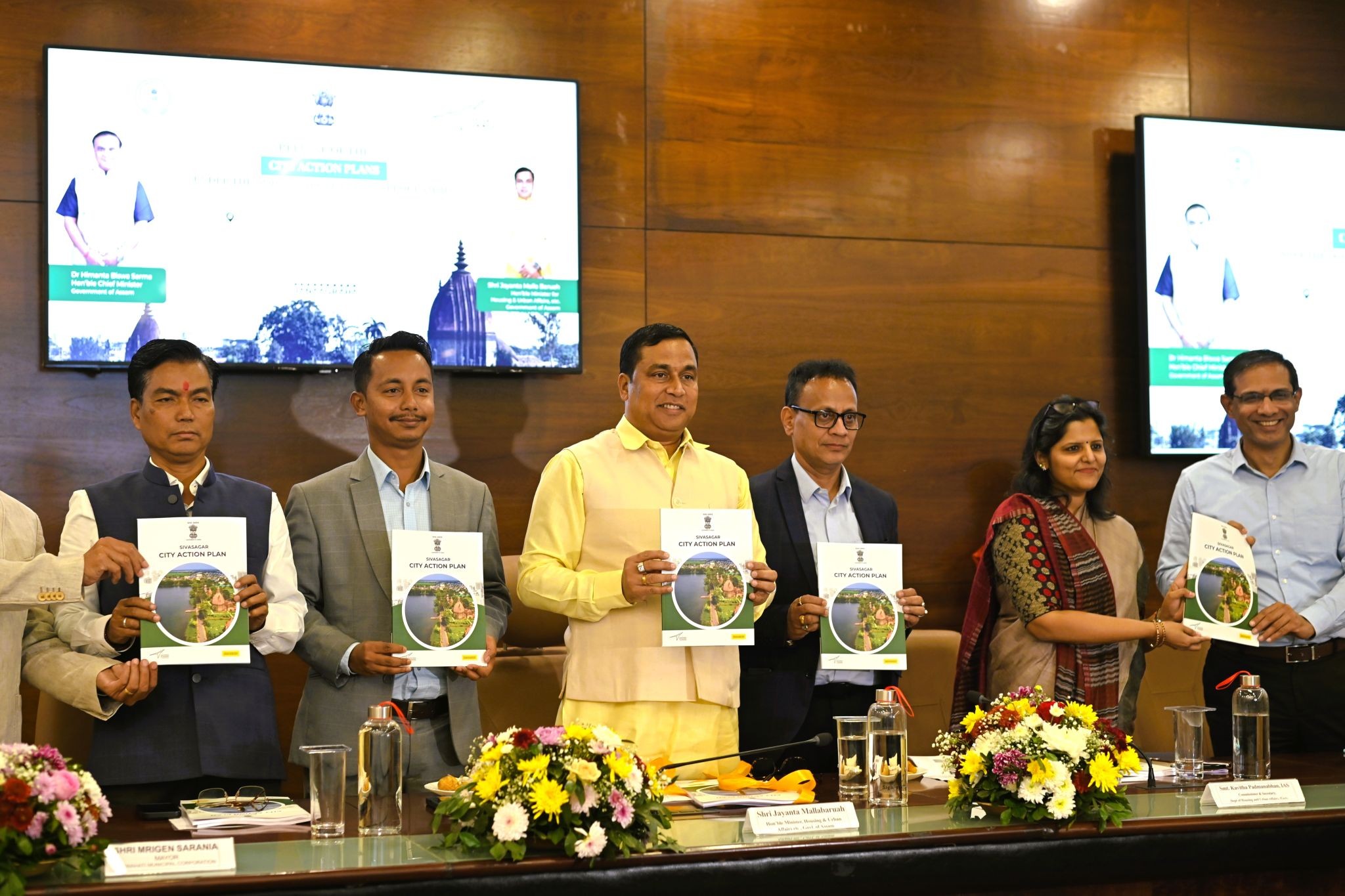
During the launch, the Minister announced the Government’s intent to introduce a dedicated scheme to incentivise cities to implement projects identified through the City Action Plans. This announcement signals a strong policy commitment towards institutionalising CAPs as a core planning and decision-making tool for urban development, moving beyond standalone project formulation to a more integrated and city-led planning framework.
In parallel, progress on the remaining CAPs has continued at different stages. The CAP for Tezpur has been drafted and is currently awaiting formal approval from the city administration. Engagements with city officials are ongoing to facilitate the approval process and prepare for the next phase of implementation planning.
For Nalbari, the CAP process is at an active and participatory stage. The project team has initiated detailed engagements with city stakeholders and undertaken multiple field visits to ground the plan in the local context and priorities. The first Municipal Planning Committee (MPC) meeting was convened on 15 December 2025, providing an institutional platform to deliberate on emerging priorities and guide the planning process. Subsequently, Self-Help Group (SHG) consultations and ward-level consultations were completed by 21 December 2025, ensuring broad-based citizen participation. Feedback received through these engagements is currently being consolidated and will be presented for review at the sub-committee level, forming a critical input into the refinement and finalisation of the CAP.

On the CIF front, detailed costing of identified projects was completed to support informed decision-making and financial planning. In parallel, a project prioritisation matrix was developed, drawing on agreed criteria such as urgency, feasibility, impact and alignment with city and state priorities. The matrix was formally presented to the Silchar Municipal Commissioner, providing a structured tool to guide project sequencing and selection. Following this, Silchar city officials applied the prioritisation matrix to systematically rank projects, demonstrating early adoption of the tool within the city’s planning and decision-making processes. This exercise enabled a more transparent and evidence-based approach to project prioritisation, strengthening the city’s capacity to move from planning to implementation.
Partnerships for Doh Shaher Ek Rupayan
Building on the momentum generated by the formal launch of the CAPs by the Urban Minister, an implementation strategy under the Doh Shaher Ek Rupayan framework has been developed. This strategy seeks to translate the CAPs into a coherent, measurable roadmap by identifying clear indicators and metrics across the seven thematic components, enabling cities to reimagine and track their urban development journey in a more integrated and outcome-oriented manner. The objective of the indicators and the metrics is not a top-down approach to monitoring but to onboard the cities on a more ambitious, sustainable journey for themselves. In parallel, engagements with partners have been renewed to explore potential areas of collaboration and contribution towards the implementation of the strategy. These discussions are focused on aligning partner expertise, resources and ongoing initiatives with the priorities emerging from the CAPs, to strengthen delivery and sustain momentum in the next phase.

Track 2
The two key horizontal levels for urban reforms in the state are the public finance management reforms and the reforms with respect to people and process, called the organisational development reforms.
Public Finance Management reforms
The Assam Municipal Budget Manual 2025 (AMBM) and the accompanying AMAM Supplement, both of which have undergone detailed vetting and review, have been formally shared with all ULGs for final feedback. This step marks an important milestone in the institutionalisation of standardised, transparent and time-bound budgeting practices across urban local governments. In parallel, the file on time-bound budgeting reforms has been submitted to the Urban Minister for approval, signalling the transition from policy formulation to formal adoption and implementation.
On the digital front, the initial development of the online Budget Module on the UPYOG platform has been completed. The module has been designed to support end-to-end budget preparation in an online environment, incorporating role-based access through dedicated Maker (Finance and Accounts Officer/FMO) and Checker (Executive Officer/EO) logins. Core functionalities have been built to enable ULGs to prepare, review, and submit budgets digitally, laying the foundation for improved efficiency, traceability and accountability in municipal financial management.
To support the effective rollout of these reforms, a structured capacity-building programme has been undertaken. An induction workshop on budgeting reforms was conducted for Chairpersons and EOs across 83 ULGs, with the objective of introducing the AMBM, clarifying institutional roles and responsibilities, explaining the revised budget calendar and familiarising leadership with the online Budget Module. This engagement was critical in building leadership-level ownership and alignment around the reform agenda.
Complementing this, in-person training programmes on budgeting reforms were conducted for FMOs and Accountants across all 83 ULGs. These trainings focused on hands-on use of the online Budget Module, detailed walkthrough of the budgeting process, and a clear articulation of the responsibilities of FMOs and Accountants under the new framework. The sessions aimed to strengthen technical capacity at the operational level, ensuring that municipal staff are equipped to adopt digital budgeting processes effectively and consistently.
In addition, we facilitated a field visit and stakeholder engagement for BORDA/FISH with officials from the ULGs, and SBM and the AMRUT Mission Director to explore opportunities for collaboration on sanitation.
Together, these efforts represent a coordinated approach to policy reform, digital system development, and capacity building, supporting ULGs in transitioning to a more structured, transparent and technology-enabled budgeting process.
Priorities for the next quarter (Jan – Mar)
Finalisation of the DSER Implementation Strategy
Finalisation of metrics along with the city stakeholders and the role for partners in each of the components is expected to be closer in this quarter.
Budget Module
In the next phase, in-depth assessments will be undertaken in 1–2 cities to identify institutional, capacity and process-related constraints affecting the effective use of the Finance & Accounts (F&A) module. Targeted corrective measures will be implemented, and key learnings documented to inform refinements and support scaling across ULGs in the subsequent financial year. In parallel, as ULGs prepare budgets for the upcoming financial year, focused support will be provided to 2–3 cities to integrate City Action Plans (CAP) and City Investment Frameworks (CIF) into budget formulation in line with AMBM guidelines, and to utilise the Budget Module for end-to-end municipal budget finalisation.
City Action Plans and City Investment Frameworks
All 10 City Action Plans will be completed in this quarter, and learnings from the City Investment Framework of Silchar will be expanded for replicability and scalability.
Learnings and challenges:
As Assam enters the State Election period in the coming quarter, a temporary slowdown in programme activities is anticipated, in line with election-related processes and shifting administrative priorities. This may affect the pace of engagement with state and city stakeholders, requiring greater flexibility in timelines and expectations.
At the same time, re-engagement with partners is expected to be more complex, particularly in the absence of clarity around individual funding commitments. While interest in continued collaboration remains strong, advancing joint initiatives during this period will require sustained dialogue, alignment of priorities and careful sequencing of activities.
Despite these constraints, the coming phase presents a significant opportunity to deepen and strengthen the role of CAPs. Moving beyond their preparation, there is growing potential to position CAPs as an integrated planning and governance tool that can guide decision-making, coordination and investment at the city level. This transition, from plan to practice, represents an important and promising trajectory for the work.
In this context, Janaagraha’s Annual Conclave offers a timely platform to further this agenda. The proposed City Action Plan-focused session will aim to showcase CAPs as a practical, place-based framework, share learnings from their development and early use and explore pathways to embed them within existing state and city-level planning and implementation frameworks. This convening is expected to help build wider understanding, legitimacy and momentum for institutionalising CAPs in the urban governance landscape.