Executive Summary
This quarter (January–March 2026) marks a renewed phase in the Jana Urban Space Foundation–Rainmatter Foundation partnership, building on earlier work at the intersection of climate, public infrastructure, urban planning, and design. The partnership has transitioned to a focused approach across two tracks: deep work with select states (notably Assam) to drive urban governance transformation, and put in place horizontal enablers to unlock demand and cultivate supply for urban reform from across states. During the quarter, significant progress was made on key projects, including the Sivadol Precinct Redevelopment, where multiple phases have advanced towards completion, and the North Lakhimpur Eco Park and Urban Forest, which has advanced from site preparation and groundwork, with progress on structural components and initiation of ecological restoration planning.
In parallel, a set of potential lighthouse projects has been internally identified for two cities – Nalbari and Silchar, based on insights from field visits and the ongoing development of the City Investment Plans. Work has been initiated towards the preparation of Preliminary Project Reports (PPRs) for select interventions, with PPRs prepared in Silchar for the redevelopment of Fatak Bazaar market and the Annapurna Ghat redevelopment project. Building on discussions with the Department of Housing and Urban Affairs and Town and Country Planning, preliminary work has also commenced on a drainage and flood mitigation strategy for Assam. The approach emphasises a street - nala - river continuum, and a pilot drainage study of Dibrugarh is already being initiated.
Highlights of the quarter:
1. The Sivadol Project
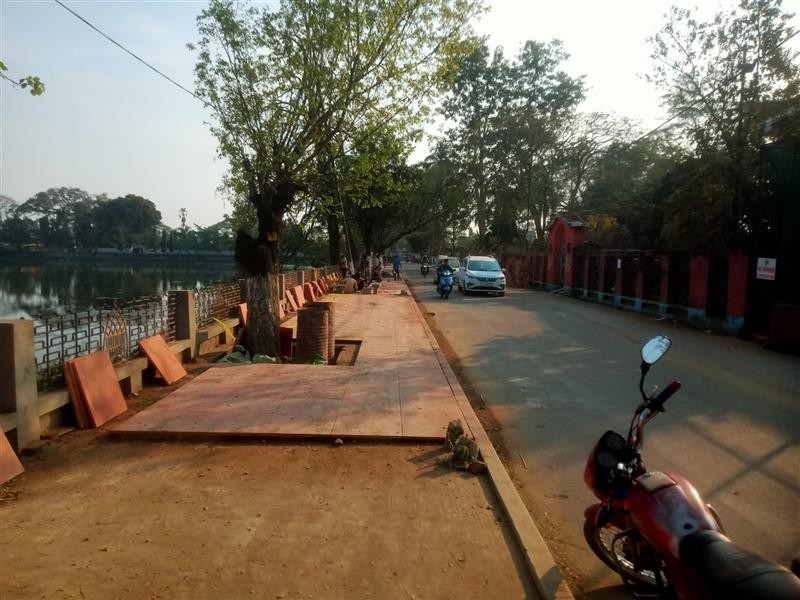
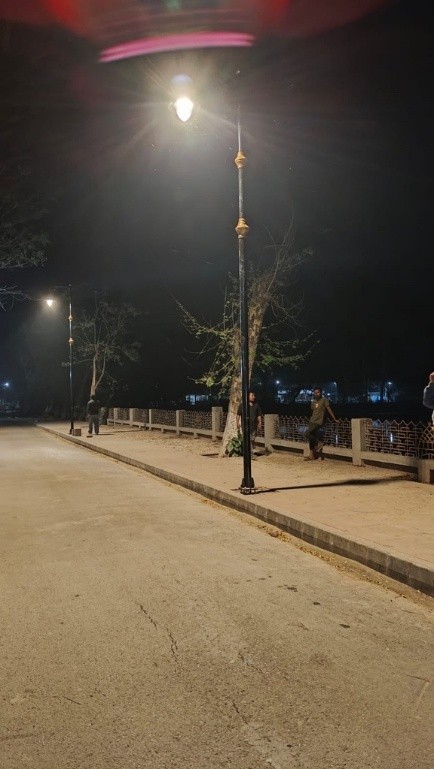
During the current reporting period, the Sivadol Precinct Redevelopment project has made substantial progress across multiple phases, with several stretches advancing into finishing stages. In Phase I (400 m), major civil works have been completed, including retaining walls, curb laying, PCC, and sandstone paving. Streetlight sampling has also been undertaken to finalize design specifications for lighting elements. The phase is now approaching completion, with pending works limited to CCTV installation, tile grouting, development of tree pits and pavers, and final streetlight installation, which are expected to be taken up in the subsequent stage.
In Phase II (300 m), civil works are largely complete, and the project has progressed into surface finishing, with sandstone paving and parking bay paver installation currently underway. This phase is steadily nearing completion, with visible on-ground transformation of the pedestrian and parking infrastructure. Phase III (260 m) has also seen consistent progress, with curb laying and PCC works completed, while tank wall construction is ongoing and forming the primary focus of current site activities.
For Phases IV and V, preliminary groundwork has been completed with surveys and level establishment in place. These preparatory steps have enabled the project to transition into execution, with curb laying scheduled to commence shortly. This marks the expansion of construction activities across the remaining stretches of the precinct.
A key aspect of project implementation continues to be coordination with the Assam Power Distribution Company Limited (APDCL). Formal communication has been initiated by the PWD Section Officer, and the matter has been escalated to higher authorities to seek clarity on electrical infrastructure requirements and scope. Critical technical concerns remain regarding HT line safety, integration of private and public transformers, and the need to establish a safe and coordinated transfer housing system. Addressing these issues is essential for ensuring seamless integration of electrical services with the overall streetscape design.
Moving forward, the project will focus on completing pending finishing works in the advanced phases, progressing structural works in Phase III, and initiating construction in Phases IV and V, while continuing to resolve inter-agency coordination challenges.
2. Urban Forest in N Lakhimpur
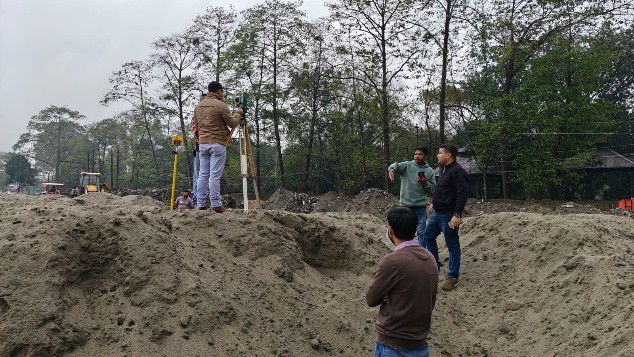
During the current quarter, the North Lakhimpur Eco Park and Urban Forest project has advanced significantly in terms of site preparation and groundwork, setting the stage for subsequent ecological and structural interventions. Land filling and levelling activities have been largely completed across the site, resulting in a more uniform base for further development. However, site assessments have identified the need for soil stabilization, particularly at the entry plaza and amphitheater zones, where ground conditions require strengthening prior to construction.
At the river edge, noticeable soil erosion has been observed, with an approximate level difference of 3 - 4 meters across certain stretches. This presents both a design and engineering challenge, necessitating careful intervention to stabilize the edge and ensure long-term resilience of the site. In response to evolving site conditions, the design for the entry plaza has been revised and shared with the site team, incorporating necessary adjustments to align with ground realities.
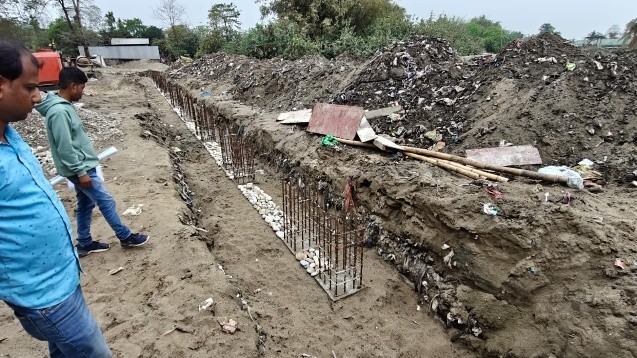
Progress has also been made on structural components, with the foundation for the compound wall now completed. The superstructure work is expected to commence in the next phase, alongside the initiation of riverside fencing, which will help define and secure the site boundary. These developments mark an important transition from preparatory works to visible built interventions on site.
In parallel, planning for ecological restoration has been initiated. The location for the nursery has been finalized in the southern zone in consultation with the site team. Green Yatra is expected to begin nursery preparation shortly, followed by phased plantation activities of indigenous plants and tress starting on the northern side of the site. This approach aligns with the broader strategy of establishing the urban forest in a structured and phased manner, ensuring both ecological viability and long-term sustainability.
Looking ahead, the focus will be on implementing soil stabilization measures, addressing erosion concerns along the river edge, advancing structural works, and initiating plantation activities to gradually transform the site into a functional urban forest.