- Overall updates (since the last update)
Background to the efforts:
The impacts of climate change are deeply context-specific, shaped by the ecological, social, economic, and institutional realities of each bioregion. Therefore, climate action cannot follow a one-size-fits-all approach; it must be designed around the specific needs, risks, capacities, and opportunities of different bioregions so that communities, ecosystems, and local economies are better equipped to adapt and transform. While landscape-level initiatives exist, contextual and bioregional thinking requires mainstreaming into policy design and implementation systems.
The partnership between Shakti Sustainable Energy Foundation, in collaboration with Rainmatter Foundation, aims to institutionalise this contextual lens in subnational climate. By embedding this approach across multiple levels of governance, the initiative seeks to ensure that climate and development strategies are responsive to the unique needs and capacities of diverse regions.
- Progress on the goals listed while on-boarding
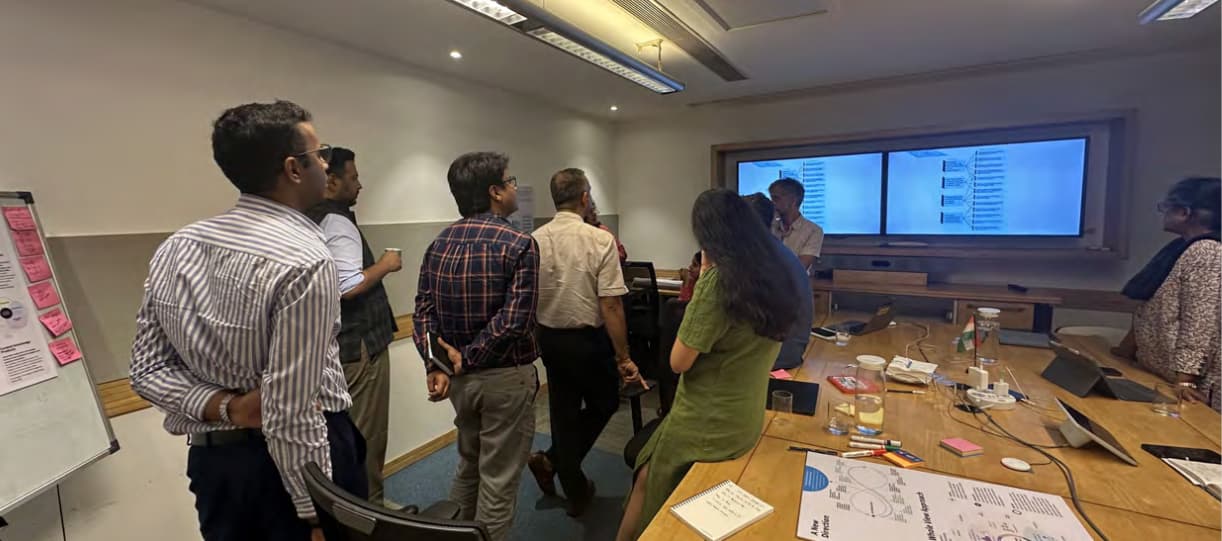
The work began with the development of a systems map, which helped guide the initial phase and ensured that the programme design remained adaptive and responsive to the wider ecosystem. Systems mapping workshops were conducted to support strategy design, stakeholder mapping, and ecosystem mapping, helping identify key actors, ongoing initiatives, potential synergies, and gaps within existing bioregional efforts. Based on this, an adaptive systems map was developed to visualise relationships, interdependencies, and key leverage points.
Building on these insights, a bioregional scoping study was undertaken to understand major bioregional interventions in India, assess what has worked and what has not, and identify critical gaps around institutional convergence, financing, monitoring, and community ownership.
Basis a strong foundation built in the initial phase, efforts are now in place to sandbox the systems map in identified geographies with the relevant stakeholders, such as advancing on bioregional approach to build community-led natural climate solutions, including ecological baselining, restoration planning, livelihood integration, and institutional anchoring through local governance structures. A parallel effort has also been initiated to bring together philanthropies, communities, on-ground actors and practitioners, around place-based rural transformation models that can align finance, markets, governance, and implementation in selected geographies.
- Any challenges
None
- Any new avenues of collaboration (with other Grantees of RCF or other NPO/NGO)
Multiple conversations are being facilitated to enable knowledge exchange across bioregions, drawing on the experience of partners with deep social capital, strong local networks, and on-ground implementation experience. These engagements are helping surface practical learnings, contextual insights, and models that can inform future bioregional efforts.
- Highlights from the initiatives being undertaken as part of your organization
The initiative has focused on building a stronger understanding of how bioregional governance can be mainstreamed in India by reviewing key domestic and international examples across river basins, wetlands, aquifers, mangroves, deltas, and landscape systems. The work highlights that while India has several ecosystem-based interventions and policy building blocks, these remain largely programmatic and fragmented rather than structurally embedded into governance systems.
Key learnings point to the need for clear ecological framing, dedicated institutional authority, aligned incentives, stable financing, strong monitoring systems, political support, community ownership, and social capital for bioregional approaches to succeed. The review also identifies major constraints, including administrative–ecological mismatch, sectoral fragmentation, weak enforcement, fiscal centralization, short political time horizons, fragmented legal regimes, and gaps in science-policy translation. Overall, the research has supported frame a clearer pathway for institutionalizing bioregional ecosystem-aligned planning and implementation within subnational climate and development systems.
Moreover, Shakti’s ongoing subnational programme wherein states are engaged on their green-growth pathways provides necessary and relevant policy machinery audience to position evidence for any transition. This engagement is reflected through multiple Memoranda of Understanding (MoUs) with various state departments to advance this work. Some of the states include Assam (with Assam Climate Change Management Society, Government of Assam), Tamil Nadu ( with Tamil Nadu Infrastructure Fund Management Corporation), Goa, Jharkhand, and Maharashtra (with their Energy Development Agencies).
- Outcomes you are chasing for the next 6 months (these can remain the same if unchanged since the last update)
Over the next six months, the focus will be on moving from scoping to sharper action by prioritising geographies and validating bioregional models with on-ground stakeholders and anchor organisations. The data and evidence generated through these bioregional models will then support in building and designing an adaptive and scalable model which can be replicated across geographies. This will include:
- List item
Stakeholder alignment and convening: This involves fostering networks, building shared commitments, and engaging key actors. Shakti, as a sector convenor, aims to unify stakeholders through a dual approach**:** capacity building and stakeholder convening**.** Shakti will leverage its subnational presence to unite diverse development value chain players to drive multi-stakeholder discussions. Its strong sectoral connections position it to align research, community needs, and policy, addressing stakeholder gaps in bioregional discourse. Additionally, Shakti’s multi-state reach will enable cross-state learning, enhancing collaboration, knowledge sharing, and the scaling of impactful bioregional strategies**.**
- List item
Capacity Building: Research conducted during the programme will help identify required capacities and the targeted stakeholders. Tailored capacity-building programs for diverse stakeholders—from local communities to government agencies will be central to advancing bioregional development.
- List item
Institutionalising solutions: Shakti’s approach focuses on ensuring that existing bioregional efforts effectively inform and influence policy. Rather than launching new pilots, Shakti aims to strengthen or expand existing institutional models where possible and test them where absent. The emphasis is on embedding the bioregional approach within governance structures, not merely implementation.
- KPIs (please use this section to let us know of the impact and reach of your work since the last update)
Key progress includes completion of the bioregional scoping work and systems mapping which will serve as the foundation for scaling the bioregional work at a sub national level.
- Can Rainmatter be of help with anything at all
The effort is also engaging with the wider Rainmatter ecosystem, particularly partners where bioregional work is already underway, to enable knowledge exchange and draw learnings from ongoing ground-level efforts. The intent is not to duplicate or replicate existing work, but to understand what is already emerging, identify areas of complementarity, and build convergence with partners working across different bioregions.
-
Any additional details you would like to provide
-
Please also share any images or videos that you have documented as part of your work