Jana Urban Space Foundation in partnership with Rainmatter Foundation, commencing in October 2021, enabled targeted initiatives across our work to localise climate action in cities and towns and advance environmental sustainability. During the period April 2024 – March 2025, as a result of our partnership with the Department of Housing and Urban Affairs (DoHUA), Govt. of Assam, we engaged in a State Urban Transformation Agenda in Assam. Concurrently, we aligned and worked with the Rainmatter Foundation by bringing new elements/aspects, and focus areas to our work compared to preceding years. The work evolved into a partnership with DoHUA as the anchor partner on the Doh Shaher Ek Rupayan (DSER) program of the state government. This led to the grant getting foreclosed in March 2025 and renewal of the partnership with the Rainmatter Foundation for a period of 4 years, starting April 2025, as a new grant agreement.
During the quarter of April 2026–June 2026, Rainmatter Foundation–Jana Urban Space Foundation partnership advanced an important combination of institutional reform, project preparation and on-ground urban-design implementation in Assam. The work continues to reflect the partnership’s wider ambition: to address the intersection of climate, public infrastructure, urban planning and urban design through deep engagement with states, notably Assam, while also creating horizontal enablers that can unlock demand and cultivate supply for urban reform across states.
The most consequential development during the quarter was the initiation of a state-level Project Management Unit, proposed as the Design Management Unit (DMU). The DMU responds to persistent constraints in urban project delivery, including limited technical capacity, the absence of Assam-specific standards and tools, weak coordination, and inadequate monitoring and fiduciary oversight. Its significance lies in the fact that it is not being conceived merely as an additional layer of project management. It is intended to become the principal technical mechanism through which City Action Plan priorities can be converted into feasibility-assessed, costed and implementation-ready projects.
Alongside this institutional work, the quarter saw tangible progress in North Lakhimpur and Sivasagar. For the North Lakhimpur Eco Park and Urban Forest, the project has moved beyond preparatory groundwork into visible implementation. The next phase will require close monitoring of site construction while advancing soil stabilisation, river-edge protection, nursery development and phased plantation activities.
The Sivadol Precinct Redevelopment progressed into a broader implementation phase, with work extending to the western edge of the tank while the remaining design packages continued to advance. Jana Urban Space Foundation is supporting the development of an initial action and execution plan, drawing on its experience with the CM-GRIDS projects in Uttar Pradesh and TenderSURE projects in Karnataka.
The proposed lighthouse projects in Tinsukia, Silchar and Dibrugarh are at different stages of readiness, but together they demonstrate the programme’s effort to connect city-specific needs with replicable models of urban transformation.
The forthcoming DSER review will be the principal decision point for the next phase. The draft Terms of Reference and institutional structure of the DMU will be presented to the Commissioner and Secretary, Department of Housing and Urban Affairs. Its mandate, staffing structure, institutional location, operating arrangements and initial portfolio will then need to be finalised. Strategic direction and approvals will also be sought for the lighthouse-project portfolio. Tinsukia will require approval to proceed to corridor identification, baseline assessment, feasibility analysis, phasing and the preparation of an implementation and funding strategy. Silchar will require further project definition and financial analysis, while work in Dibrugarh will progress through baseline assessment, stakeholder consultation and identification of priority intervention areas, aligned with the partnership between C-STEP and the Directorate of Town and Country Planning.
Taken together, the quarter reflects a deliberate effort to build both the institutional architecture and the practical evidence required for urban reform. The DMU is intended to improve how projects are prepared, reviewed, financed, implemented and sustained; the city-level initiatives provide the testing ground. The value of the portfolio will therefore lie not only in delivering individual projects, but in generating tested design approaches, implementation frameworks and lessons that can be replicated across other Assam cities.
Highlights of the quarter:
1. Design Management Unit, Assam
During the quarter, the process of establishing a state-level Project Management Unit, coined as the Design Management Unit (DMU), was initiated, and a draft structure and its functions were prepared. The DMU is being proposed to address three key constraints affecting urban project delivery in Assam.
-
Limited technical and project-development capacity within Urban Local Bodies and implementing agencies.
-
Absence of Assam-specific design standards, templates, standard operating procedures and project-review tools.
-
Inadequate coordination between projects, government schemes, funding sources, approvals and implementing agencies.
-
Weak monitoring, fiduciary, and sustainability oversight across the project lifecycle.
The DMU is envisaged as a technical support mechanism that will help cities convert priority proposals into well-designed, financially viable and implementation-ready projects. Its proposed responsibilities span the full project lifecycle, including:
Project Development & Design: Prioritise, develop, and design implementation-ready projects (DPRs, feasibility studies, tender documents, GFC drawings), built to Assam-specific standards that embed seismic and flood resilience.
-
Quality, Cost & Fiduciary Oversight: Review design quality, site risk, cost realism, and value-for-money, with fund utilisation tracking to support donor fiduciary compliance.
-
Environmental & Social Safeguards: Screen projects for environmental and social impact, manage resettlement/grievance redress, and embed citizen consultation and gender/inclusion considerations into design.
-
Capacity Building: Mentor and train ULB staff alongside project delivery, with a defined pathway for ULBs to progressively take over DMU functions.
-
Monitoring, Sustainability & Reporting: Track outcomes against a results framework, verify O&M financing is secured before construction, and standardise reporting aligned to donor formats.
The DMU will also develop Assam-specific design guidelines and toolkits for roads, public spaces, markets, waterbodies, drainage systems and blue-green-grey infrastructure. Capacity-building programmes will be developed for municipal engineers, planners, architects, contractors, consultants and other implementing agencies.
2. North Lakhimpur Eco Park and Urban Forest
During the current quarter, all working drawings for the project were completed and submitted. This provides the site team with the detailed design information required for implementation.
Construction of the boundary wall also commenced, marking the transition from preparatory groundwork to visible structural development on site.
The progress during the quarter therefore included:
-
Completion and submission of the working-drawing package.
-
Commencement of boundary-wall construction.
-
Continued transition from site preparation to implementation.
-
Excavation for the Toilet Block has commenced

Image 1: Excavation of the Toilet Block and Underground Sump
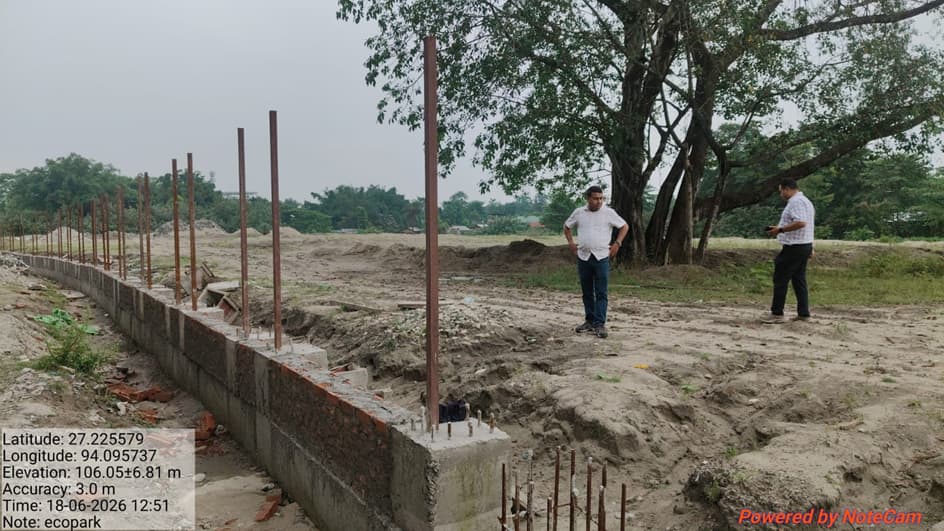
Image 2: Blockwork progress in Boundary wall
3. Sivadol Precinct Redevelopment, Sivasagar
During the current quarter, the Phase II drawing package was submitted. Preparation of drawings for Phases III, IV and V continued and remained in progress at the end of the quarter.
Work also commenced along the western edge of the Sivadol tank, extending project activity to another important part of the precinct.
Key progress during the quarter included:
-
Submission of the Phase II drawings.
-
Continued preparation of drawings for Phases III, IV and V.
-
Commencement of work along the western edge of the tank.
-
Coordination was established with Assam Power Distribution Company Limited regarding the planning and integration of electrical infrastructure within the precinct.
During discussions, APDCL highlighted limitations in its in-house capacity for planning and executing the proposed electrical-infrastructure interventions. Jana Urban Space Foundation is supporting APDCL in developing an initial plan of action and execution approach, drawing on its experience with the CM-GRIDS projects in Uttar Pradesh and TenderSURE projects in Karnataka. This coordination is important for addressing electrical safety, utility integration, transformer requirements and the sequencing of electrical works alongside the streetscape improvements.
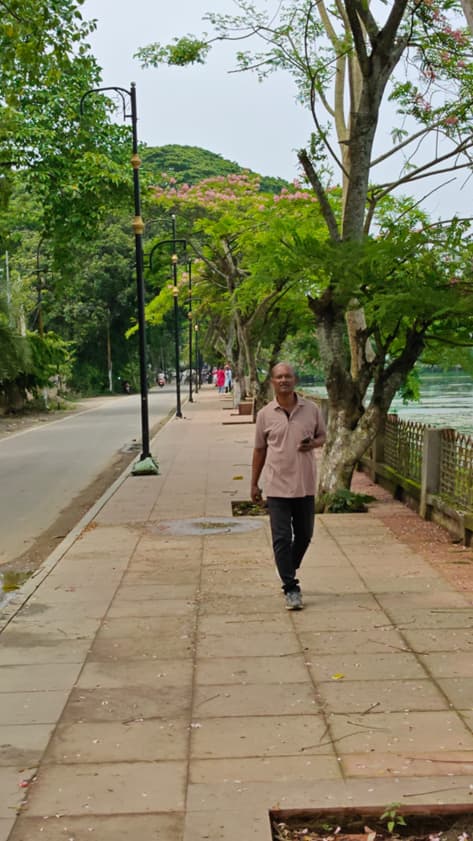
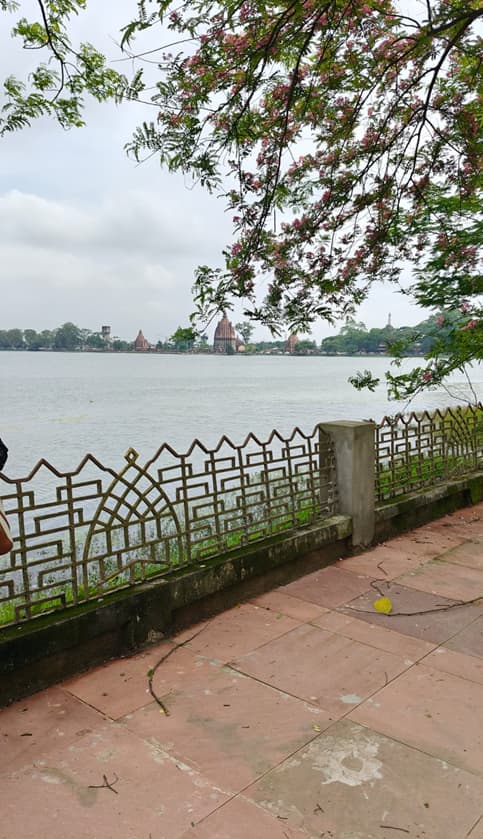
Images 3 and 4: Ongoing Progress of the Footpath and Tank side Boundary
4. Urban Mobility Plan, Tinsukia
During the quarter, a concept proposal for Urban Mobility Plan, Tinsukia was presented to Shri Sarbananda Sonowal, Hon’ble Minister of Ports, Shipping and Waterways; Shri Pulok Gohain, MLA, Tinsukia; and Shri Pulak Chetia, Chairperson, Tinsukia Municipal Board. The proposal was well received by the stakeholders.
The presentation outlined the principles of an integrated urban-mobility and road-redevelopment approach. These included treating streets as complete public spaces, improving pedestrian safety and accessibility, organising vehicular movement and parking, coordinating underground and above-ground utilities, improving the streetscape and developing a phased and maintainable implementation model.
The proposal draws on the TenderSURE approach and is intended to demonstrate how coordinated street design can improve mobility, public-space quality and infrastructure delivery.
5. Lighthouse Project for Silchar
During the quarter, initial discussions were held with the Commissioner and Secretary, Department of Housing and Urban Affairs, regarding potential lighthouse projects in Silchar.
The discussions highlighted the need for a financial analysis before the proposals can proceed. This assessment will be necessary to understand capital costs, operations and maintenance requirements, lifecycle implications, revenue potential and possible funding sources.
Two potential projects have been identified for further consideration:
-
Fatak Bazar Redevelopment.
-
Annapurna Ghat Revitalisation.
For next quarter, the focus will be on defining the scope and intended outcomes of the two proposals, undertaking preliminary feasibility and financial analysis and identifying which intervention is most suitable for development as a lighthouse project.
The proposals and recommended next steps will be presented to the Commissioner and Secretary through the forthcoming DSER review.
6. Drainage and Flood-resilience Plan for Dibrugarh
During the quarter, the ideation process for a drainage and flood-resilience plan for Dibrugarh was initiated.
The initiative is intended to develop an integrated strategy for addressing recurrent flooding and supporting the development of flood-resilient neighbourhoods. The approach emphasises a street - nala - river continuum, integrating nature-based solutions with conventional infrastructure to address waterlogging and improve system performance.
The current work remains at an early conceptual stage. Further assessment will be required to document:
-
Existing drains, natural drainage channels and outfalls.
-
Flood-prone and low-lying areas.
-
Infrastructure bottlenecks and maintenance gaps.
-
Interfaces between roads, drains, waterbodies and surrounding development.
-
Immediate, medium-term and long-term intervention requirements.