During Q3 (October–December 2025), work under the Rainmatter–Jana Urban Space Foundation partnership focused on advancing on-ground lighthouse projects and consolidating learnings from ongoing city-level planning processes in Assam.
Highlights of the quarter:
1. The Sivadol Project
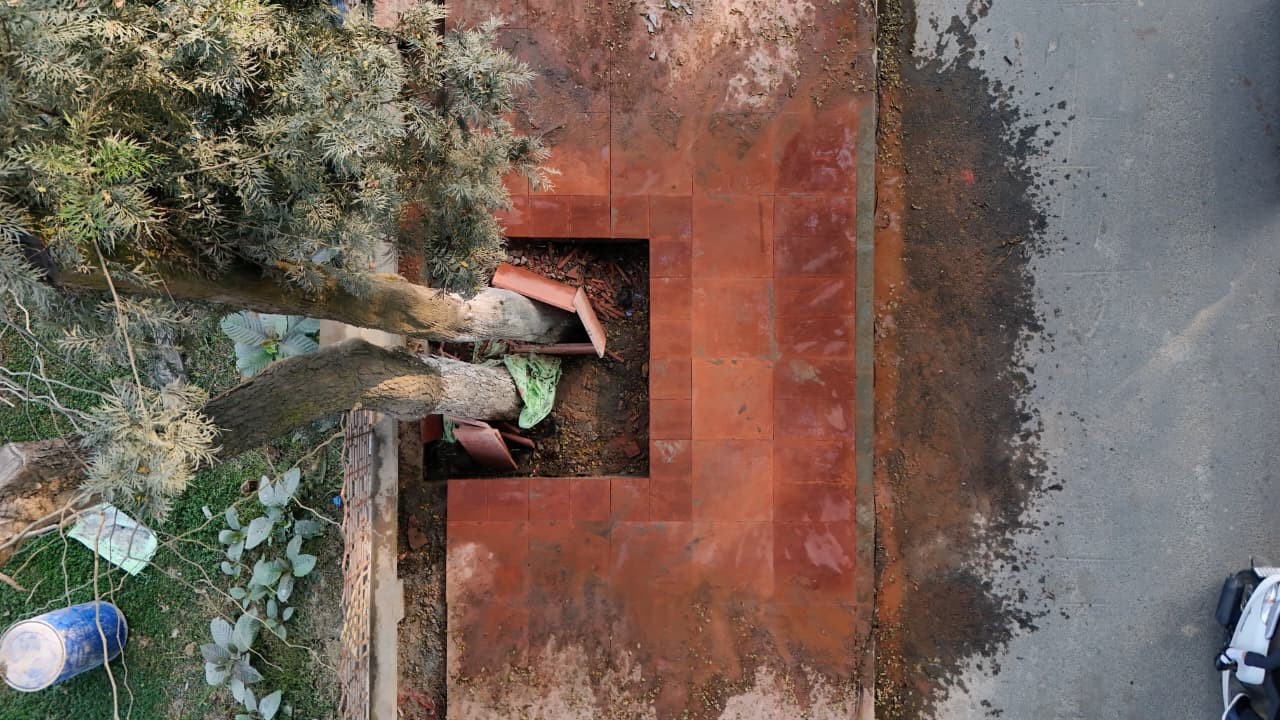
During the reporting period, significant progress was made on the Tank-Side works. In Phase I, base construction activities were completed, including groundwork for pedestrian areas and the necessary provisions for street lighting and surveillance infrastructure. Preparatory work for lighting installations was also finalised, and initial materials for surface finishes were delivered, with on-site decisions taken to ensure consistency in design and execution. The project is now moving into the next stage, with flooring works scheduled to commence shortly alongside the procurement of lighting fixtures. For Phase II, preliminary site preparation has been completed, with alignments and levels established to enable the next round of construction activities. The forthcoming phase will focus on extending the pedestrian infrastructure in a coordinated manner. To facilitate seamless implementation, support is required from APDCL (Assam Power Distribution Company Limited), particularly with respect to finalizing proposals for shifting overhead electrical lines underground, including associated budgets, technical specifications, and coordination inputs with other service networks.
Looking ahead, property-side works will be taken up once the electrical infrastructure proposals are finalized. A joint alignment and coordination meeting with all relevant departments and service providers is proposed to ensure smooth execution and avoid overlaps during subsequent stages.

2. Urban Forest in North Lakhimpur
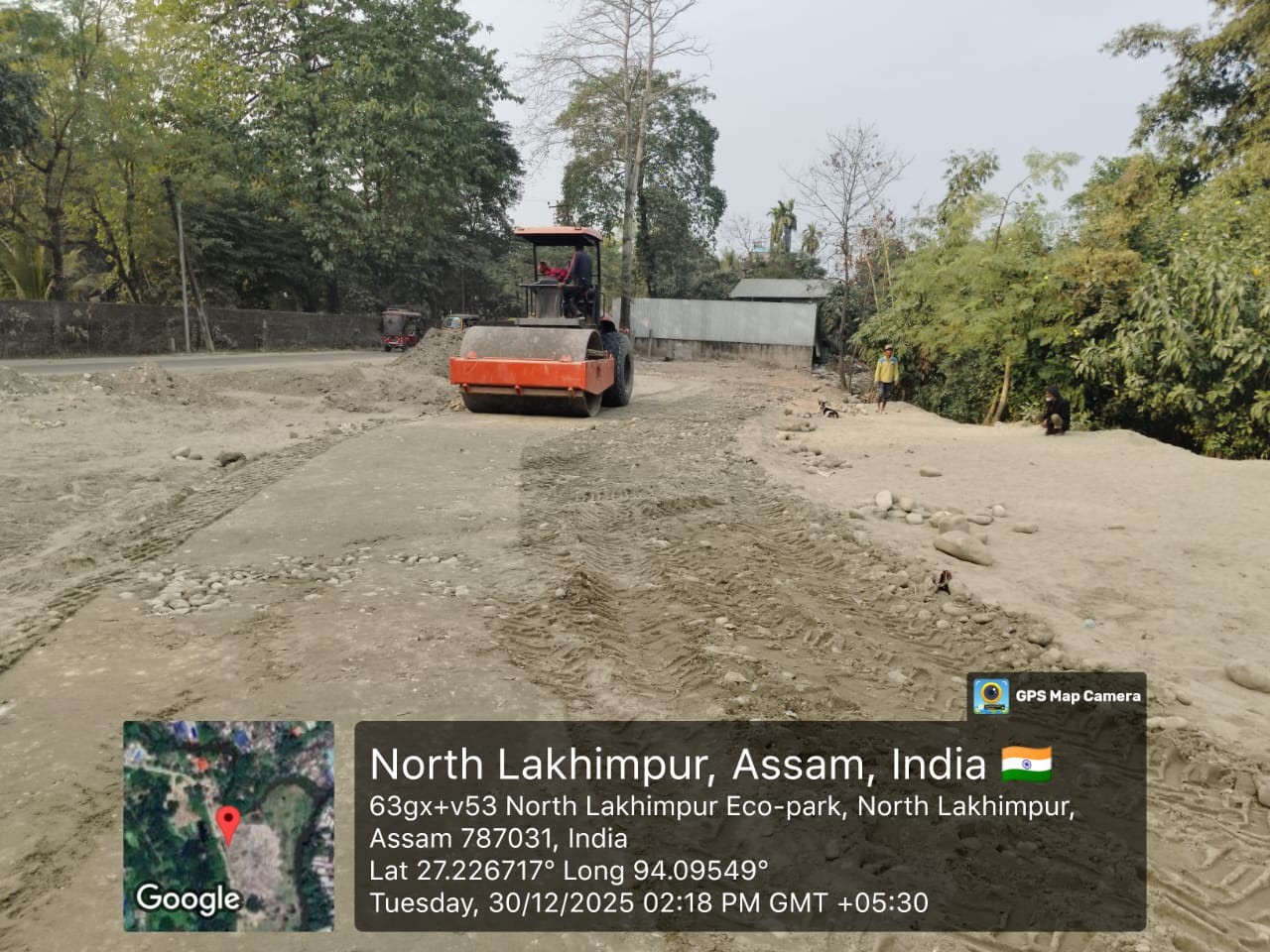
During the current quarter, substantial progress has been made in site preparation works. The site has been uniformly filled with approximately 2 feet of soil, while designated mounds are being developed up to a maximum height of 5 feet to support the proposed landscape and plantation strategy. The remaining areas of the site are undergoing systematic compaction, and the alignment of internal pathways has progressed in accordance with the approved layout.
Coordination has been undertaken with Green Yatra for soil mixing protocols and preparation methodologies specific to the Miyawaki plantation. During ongoing civil assessments, a significant limitation was observed in the existing base soil conditions, necessitating revisions to the foundation design. Accordingly, foundation details are currently being prepared based on the actual site conditions to ensure structural stability and long-term performance.
In parallel, the appointed contractor has initiated procurement of construction materials. With the revised foundation details nearing completion, civil works are expected to commence on-site in the upcoming phase.

Priorities for the next quarter (Jan – Mar)
Identification of further Lighthouse Projects
During this quarter, based on insights from field visits and the ongoing development of the City Investment Framework, potential lighthouse projects have been identified for two cities, Dibrugarh and Silchar. From the shortlisted projects, work has been initiated towards the preparation of Preliminary Project Reports (PPRs) for one potential lighthouse project in Silchar and one potential project in Dibrugarh. These lighthouse projects are being conceptualised as innovative and replicable pilots, with the intent of developing clear implementation frameworks that can be scaled across other cities in subsequent phases.
Strengthening the City Action Plan with a spatial element
As the City Action Plan for Nalbari moves towards completion, learnings from the development of the remaining nine City Action Plans are being consolidated. One of the most significant insights has been the role of spatial planning tools in enhancing participatory processes and project mapping. Visual engagement with place, through maps and spatial representations, has emerged as a powerful enabler of informed decision-making and sustained citizen engagement. An attempt will be made to incorporate the same for the Nalbari City Action Plan.
Learnings and challenges:
Capacity Building and Exposure for Lighthouse Project Implementation Authorities in the city:
This was outlined as a challenge in the previous quarter, and as we undertook an event in Bangalore on Nature-Based Solutions, a capacity-building programme was organised for a team from Assam Urban Knowledge Hub (AUKH) and the Department of Housing and Urban Affairs (DoHUA). The session was designed to give participants a practical understanding of people-centred street design and nature-based solutions (NBS) for urban drainage and involved visits to TenderSURE roads, the K100 site visit, along with the sessions at the event. Initial feedback from the participants indicates usefulness, easy applicability and transferability of learnings among peers. A key reflection has been the opportunity to approach this as a holistic and state-wide effort - systematically rolled out to all Urban Technical Officers and anchored in an assessment of the skills required for effective delivery.
Potential delays on account of elections:
With Assam approaching the state elections in March–April 2025, a modest slowdown in activities is expected during the last quarter, as administrative focus shifts to election-related responsibilities.