Hi everyone,
I’m Shoumik Guha, Director of Development at Janaagraha Centre for Citizenship and Democracy. We haven’t been very active on this platform, and I want to be honest about that—we’ve been deeply invested in our work and have been reticent in ‘talking about it’. Going forward we plan to change that and I am hoping to be more active on this platform, leverage the learnings and staying engaged.
Here’s what keeps me engaged: By 2050, 814 million Indians will live in cities—nearly double today’s urban population. This represents an unprecedented opportunity: cities already generate over 60% of GDP and have seen dramatic expansion with a 932% increase in Ministry of Housing and Urban Affairs budgets, metro networks across 21 cities, and 8.7 million homes built under PMAY-Urban. Yet systemic governance gaps constrain this potential. Economic productivity lags global benchmarks (1% urbanisation yields only 1.7% GDP increase per capita versus the global average of 3.9%), millions live in slums without secure tenure, cities contribute 44% of emissions while 59% face water scarcity, and 61% of urban local governments operate without elected councils due to delayed elections. India’s future is inextricably urban—the question is whether that future will be one of inclusive prosperity or compounded inequality. At Janaagraha, we believe the answer lies in strengthening city-systems.
What We Actually Work On
We work across three city-systems with nine specific impact goals:
Planning and Design – Enable govt. adoption of plans (neighbourhood improvement plans, rural-urban transition, etc.) and design guidelines (roads, public spaces, etc.) and demonstration through lighthouse projects.
Decentralized Participatory Governance – Advocacy for decentralisation, leadership development of councillors, and demonstration and scaling of sustainable models of civic participation and civic learning.
State Capacities – Strategic assistance to the union and states on municipal finance and staffing reforms.
All our work is enabled by our research, insights and thought leadership work in Urban Policy. We are now increasingly focused on working at the intersection of climate, health and equity with a specific focus on women and urban poor.
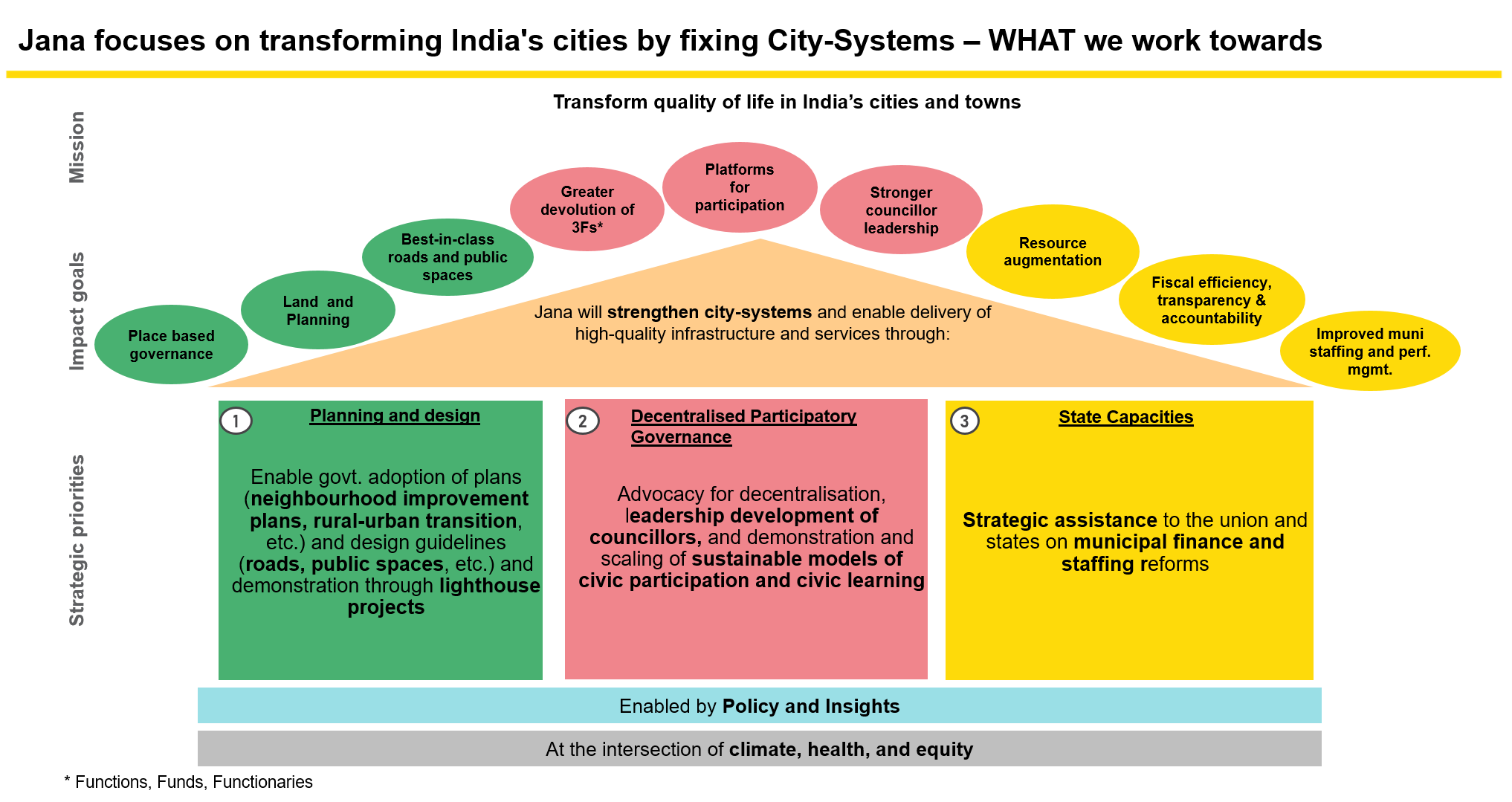
I am sharing an overview of our work and With the groundwork now set, going forward, we will elaborate on specific developments, learnings, and innovations that emerge from this work as we continue this journey together. The intent would be to update on any interesting development, insights that we come up and challenges we face, to get others to collaborate as fellow travellers in the journey of sustainable urban transformation in India’s cities and towns.
Overview of Our Recent Work
Union Level Partnerships
- Support to XVI Finance Commission – Janaagraha has supported the XVI Finance Commission on Rural to Urban Transition, differentiated city approaches, and outcome-based grants. Over the past 18 months, Janaagraha’s team has been actively engaging with the entire team of XVI FC including 4 in-person meetings with the entire commission members and secretariat on a slew of deliberations.
One of the key meetings was held on 26 November 2024, wherein we organized a National Conference of Mayors at Bharat Mandapam, New Delhi. Nearly 60 elected city leaders from 25 states—representing municipal corporations, municipalities, and town panchayats—participated. Chaired by Dr. Arvind Panagariya, Chairman of the XVI Finance Commission, the conference featured three sessions addressing governance, fiscal, and resilience challenges across different urban tiers.
What’s Next: Release of XVI Finance Commission Report and Furthering of Urban Reform Agenda
- Partnering with the Ministry of Housing and Urban Affairs – Since 2019 we continue to partner with Ministry of Housing and Urban Affairs (MoHUA), Government of India on www.cityfinance.in, XV FC grants management, Property Tax reforms, Municipal Shared Services
• CityFinance.in – We conceived, developed, and now manage this platform for the Ministry of Housing and Urban Affairs. Over 95% of India’s 4,300+ urban local governments now publish audited accounts in standardized formats. The platform hosts 15,000+ financial statements, administers ₹1.08 lakh crore in Finance Commission grants, and is cited by the Economic Survey of India 2023-24 as an important source for urban finance data.
What’s Next: CityFinance Features - Upgrade city analytics and grants dashboard, and Market-Readiness Tool.
-
Comptroller and Auditor General (CAG) Partnership – Five years of work with the Comptroller and Auditor General culminated in November 2024 with the release of the first comprehensive audit of the 74th Constitutional Amendment’s implementation across 18 states and 393 urban local governments. The findings: only 4 of 18 constitutional functions effectively devolved, 1,600 of 2,625 ULGs lack active elected councils, 412-day average delay in forming State Finance Commissions. In April 2025, we signed a new five-year MoU to develop improved municipal accounting standards and pioneer place-based audits.
What’s Next: Place-based Audit on mobility across 101 cities to be undertaken by the CAG office evaluating services and institutional strength. -
Niti Aayog – Since 2024, we have been partnering with NITI Aayog to conceive and launch a City Data and Analytics Platform for data-driven decision-making
• City Data and Analytics Platform (CDAP): On 20-21 November 2025, NITI Aayog launched the City Data and Analytics Platform (CDAP) as a microsite on its National Data and Analytics Platform (NDAP) at the Data Forum 2025 in Bhopal. Conceived, created, and developed by Janaagraha, CDAP provides a unified interface for accessing, analyzing, and visualizing urban datasets spanning national, state, district, and city levels. The platform features nearly 1,00,000 data points across sectors including housing, sanitation, water, transport, environment, and governance, with state-of-the-art visualization tools including spatial maps and interactive dashboards. CDAP enables data-based and place-based decision-making by integrating public datasets (NSSO, NFHS, Census, and HMIS) with city-specific data, supporting improved quality of life, resilience, and sustainability in India’s cities. Future capabilities include AI-powered insights, custom dashboards, mobile applications, and automated data pipelines for real-time updates.
What’s Next: Build CDAP into a scalable and widely adopted urban data platform that, through an outside-in approach, that helps governments improve outcomes on the ground, guided by place-based and data-based decision-making.
State Level Partnerships: What We’re Doing and What’s Next
- Assam – Doh Shaher Ek Rupayan – The Doh Shaher, Ek Rupayan programme is our anchor partnership with the Department of Housing and Urban Affairs, Government of Assam, to drive holistic urban transformation across ten cities in one of India’s most climate-vulnerable states. We have completed City Action Plans in eight cities through extensive field visits and engagement with more than 1,700 residents, including SHGs and community groups. These CAPs—supported by emerging sectoral partnerships in solid waste management, sanitation, blue-green infrastructure, and mobility—are now moving into implementation with lighthouse projects such as the North Lakhimpur Urban Forest.
Building a coalition of partners across the sector has been central to this work. Through the Rainmatter Foundation partnership, we have brought together 18 national and regional organisations across key thematic areas, including solid waste management, drinking water, sanitation, public infrastructure, blue-green infrastructure, urban planning, traffic management, and street lighting. These partners have conducted detailed field assessments across the ten cities, identifying sectoral gaps and opportunities. This collaborative approach ensures that implementation is not siloed but rather integrated—with partners like Saahas taking the lead on solid waste management while coordinating with partners in sanitation (CDD, CWAS, FISH/BORDA) and blue-green infrastructure (C-STEP, EcoSattva). The collective effort represents a fundamental shift from departmental work in isolation to cross-sectoral collaboration anchored in each city’s specific context and needs.
Recently, on August 5th, we convened a group of 18 organisations where we shared the vision for DSER, reiterated our intent to collaborate, received feedback, and refined the scope of work across select sectoral components.

What’s Next: Looking ahead, we’re implementing the City Investment Framework in Silchar and Dibrugarh to prioritize CAP projects, deploying partners to build ULG capacities for systems change, and scaling the CAP process across all Assam ULGs with Special Assistance to States for Capital Investment (SASCI)-like reforms to incentivize development aligned with City Action Plans.
-
Odisha – Building Democracy from the Ground Up – Janaagraha has been supporting the Housing and urban Development Department (HUDD) since 2019 as an anchor partner in furthering urban governance reforms in the state. We have supported the Jaga Mission across 2,919 slums in 115 cities. We’ve trained 10,094 Slum Dwellers Association (SDA) members through 261 training batches, resulting in 1,654 slums upgraded as Biju Adarsh Colonies and 1,95,537 families gaining improved infrastructure.
Currently we are piloting integrated City Action Plans in 4 cities, enabling submission of Annual Action Plans and Budgets for 115 ULBs on SUJOG platform, and conducting needs assessments for Councillor Leadership Development Programs.
What’s Next: Next steps include improving the efficiency of the Finance & Accounts module adoption and grants management dashboard, integrating CAP baseline works into Annual Action Plans, -
Uttar Pradesh – Aspirational Cities Programme: Since 2024, Janaagraha is supporting the Urban Development Department (UDD) as governance and urban health partner (in collaboration with Samyak) to the states Aakankshi Nagar Yojana for 100 small cities . We have worked on creating City Action Plan (CAP) in the pilot cities with a formal communication being issued by Directorate of Urban Local Bodies (DULB) to initiate City Action Plan preparation across all 100 ULGs. Also serving as end-to-end partner for Chief Minister – Green Roads Infrastructural Development Scheme (CM-GRIDS) road infrastructure program across 17 municipal corporations, with 90+ km tendered and 120+ km identified for Phase 2.
What’s Next: Moving forward, we’re evolving CAP into a comprehensive tool for place-based governance that informs annual action plans, ULG budgeting, and state-level prioritization. We’re aligning SUTrA vision with Viksit UP 2047 planning and establishing full Urban Health Initiative governance architecture while activating convergence pathways for scale. -
Karnataka – Supported the 5th State Finance Commission on horizontal fund devolution and revenue augmentation. Strengthening Participatory Governance: Mobilizing citizens across 5 cities (Bengaluru, Hubballi-Dharwad, Mangaluru, Kalaburagi, Ballari) through Ward Samiti Balaga—engaging ~500 community organizations, facilitating 2,300+ monthly ward committee meetings across 303 wards with ~4,000 citizens applying for ward committee membership. Successfully created a 15-Minute Neighbourhoods framework/toolkit with a focus in Nallurahalli, Bengaluru with a comprehensive neighbourhood mobility plan.
What’s Next: Looking ahead, we’re expanding ward committee mobilization efforts, deepening engagement with State Finance Commission on fiscal reforms, and scaling the 15-Minute Neighbourhood toolkit for replication across additional localities in Bengaluru and beyond.

Why I’m Here
Urban governance reform is slow work. It requires patience—what we call “urgent patience.” It means working simultaneously with union governments, state governments, and ecosystem to build coalitions and forge partnerships to collectively advocate for change and aid in their adoption.
One insight that has become increasingly clear to us: we do not see climate as a separate vertical or silo in our work. Rather, climate considerations are woven into the intersection of everything we do. We are increasingly focused on working at the intersection of governance & climate, health and equity. Be it the City Data and Analytics Platform (CDAP) or Doh Shaher Ek Rupayan program we will continue to integrate the climate lenses in our work of urban systems. This reflects our belief that sustainable cities cannot emerge from treating climate, health, equity, and governance as separate concerns, but rather when these dimensions inform how we strengthen city-systems holistically.
Going forward, I plan to share what we’re learning, especially the hard lessons and simultaneously learn from this forum.
Thank you, Rainmatter Foundation, for creating this space and supporting the long and arduous journey of urban transformation.
— Shoumik Guha
Learn more : https://www.janaagraha.org/