Gram Swabhiman in Gram Vikas: Story So Far
Introduction
Gram Swabhiman is a community engagement practice propounded by Goonj, which Gram Vikas has adopted within its community mobilisation processes under the Water Secure Gram Panchayat (WSGP) programme. The approach is grounded in the belief that rural communities possess inherent strengths, knowledge systems, and resources, and that development should begin by recognising and building upon these capacities.

Rather than viewing villagers as passive beneficiaries, Gram Swabhiman encourages communities to see themselves as active contributors to their own development. Within the WSGP programme, it acts as an important entry point for building community ownership, strengthening collective identity, and enabling participatory planning aligned with the MANTRA principles of inclusion, responsibility, equity, cost-sharing, and sustainability.

The process encourages communities to reflect on their strengths, identify issues collectively, and initiate local action using their own capacities and resources. Gram Vikas has found this approach to be highly relevant in strengthening confidence, self-worth, and collective action within villages.
Coverage
Between December 2024 and May 2026, the Gram Swabhiman process had been carried out in 340 villages in 29 Gram Panchayats of five districts.
| District | Period | Number of GPs | Number of Villages |
|---|---|---|---|
| Jharsuguda | Dec 2024 | 1 | 12 |
| Sundergarh | Dec 2024 | 1 | 14 |
| Kandhamal | Dec 2024 – Nov 2025 | 11 | 163 |
| Kalahandi | Sept 2025 | 1 | 20 |
| Ganjam | Jan 2025 – May 2026 | 15 | 156 |
| Total | 29 | 365 |
The process has been implemented across diverse geographies and social contexts, demonstrating its adaptability within different village settings.
Gram Vikas Experiences with Gram Swabhiman 1
[image][image]
Gram Swabhiman Orientation at Sarabadi Gram Panchayat, Surada Block, Ganjam district
Results achieved:
Gram Swabhiman Meeting at Kumbharigaon Gram Panchayat, Daringbadi Block, Kandhamal District
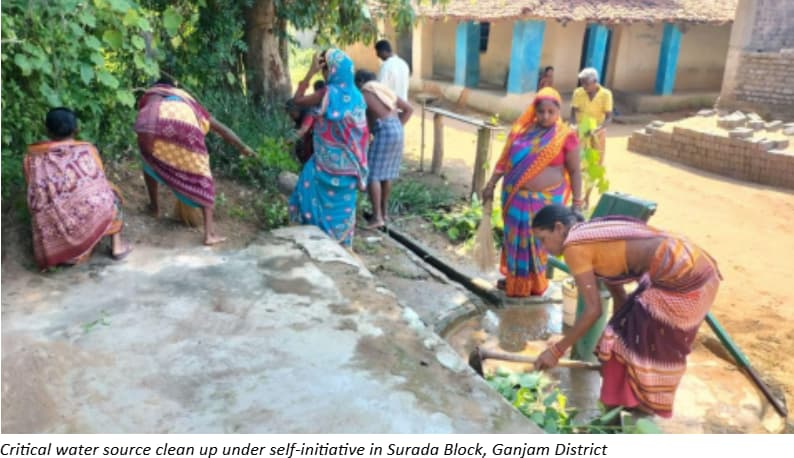
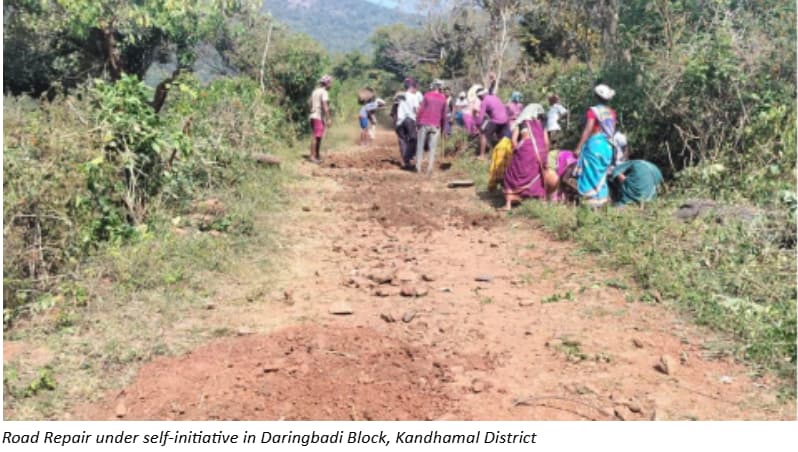
The most significant outcome of the Gram Swabhiman process has been the emergence of collective action within villages. In all 340 villages, community demands were identified and discussed collectively, and Action Committees were formed to carry forward prioritised issues. In more than 100 villages, communities came together to solve at least one issue on their own, without external financial support. These self-initiated actions included:
• Cleaning and restoration of drinking water sources
• Repair of village roads and infrastructure
• Clearing drainage channels and stagnant wastewater
• Waste management activities
• Pond cleaning and renovation
The following types of actions were reported:
| Type of self-initiated work | Number of villages |
|---|---|
| Water source-related work | 48 |
| Infrastructure-related work | 26 |
| Waste management activities | 42 |
| Other village-level issues | 2 |
Gram Vikas Experiences with Gram Swabhiman 2
In addition:
• Action Committees were formed in more than 300 villages.
• Community demands and priorities were documented across all villages. • Prioritised demands were integrated into Village Poverty Reduction Plans (VPRPs) under the WSGP programme across 23 Gram Panchayats and in 6 Gram Panchayat integration work is under progress.
These actions indicate an early shift from dependence on external agencies towards greater confidence in collective problem-solving and local responsibility.
Process and Methods
The Gram Swabhiman process is facilitated by Gram Vikas through the Spearhead Team, which acts as the primary interface between the organisation and the community during the initial stages of engagement.
The process broadly involves the following stages:
Initial engagement at Gram Panchayat level
The process begins with meetings with Gram Panchayat representatives, PRI members, and local leaders to introduce the WSGP programme and the principles of Gram Swabhiman and MANTRA. This stage helps establish trust and creates the initial entry point for community engagement.
Village immersion and transect walks
The Spearhead Team conducts transect walks with village members, ASHA workers, Anganwadi workers, and local leaders to understand village realities, local resources, water systems, and key issues related to water, sanitation, and infrastructure.
Gram Vikas Experiences with Gram Swabhiman 3
Gram Swabhiman meetings
Village-level meetings encourage communities to reflect on their own strengths, local knowledge, and collective identity. Discussions focus on dignity, responsibility, and the possibility of solving problems through collective effort.
Self-initiated action
Communities are encouraged to identify and undertake one activity on their own, without waiting for external support. These activities become practical demonstrations of collective action and local ownership.
Prioritisation and action committees
Villagers collectively identify broader development issues and prioritise them. Action Committees are formed to take these issues forward and coordinate future engagement. Consolidation and handover
Information gathered during the mobilisation process — including community demands, prioritised issues, and village observations — is consolidated and integrated into the broader WSGP planning process.
Challenges
Several challenges emerged during the process.
Many villagers initially continued to associate Gram Vikas primarily with the construction of toilets and bathrooms. Despite repeated clarification about the wider scope of the WSGP programme, expectations of direct external support remained high.
Another challenge was balancing expectations of external assistance with the idea of community ownership. While some community members expected immediate solutions from the organisation, others were willing to take responsibility but required greater clarity on the nature of support available.
Social divisions related to caste, religion, and gender also influenced participation and trust building in some villages. These dynamics sometimes affected the development of a unified collective vision.
In larger villages with more than 100 households, mobilising people for meetings centred on reflection and collective identity required significant effort and time.
Lessons learnt
At the same time, several important learnings emerged:
• Participatory observation and village immersion helped build trust.
• Visible improvements through self-initiated activities boosted morale and confidence. • Communities responded positively when discussions focused on strengths and dignity rather than deficits.
• Sustained facilitation is required to ensure inclusive participation across different social groups and to strengthen Action Committees over time.
Gram Vikas Experiences with Gram Swabhiman 4
Testimonials
“If the village truly wants, everything is possible. Earlier, we used to talk about things only when necessary, but no one came forward to do the work. Reflecting on our village-respect made it possible.” Bada Dumula GP, Ganjam District
“We earlier believed that development would be done only by the government, but Gram Swabhiman created new thoughts in our hearts and helped us understand our own duty.” Kumbharigaon GP, Kandhamal District
“Remembering the wisdom of our ancestors and understanding the value of our efforts, we will work together to build unity, pride, and affection for our village. ”Lakhbahali GP, Kalahandi District
“We have learned to solve our village problems ourselves, and we now have the confidence to take responsibility for any work needed for our village.” Dasingbadi GP, Kandhamal District