From Livelihood Projects to Place Based Consumption, Production and Economic Systems
An Alternate Approach for the Indian Social Sector to See, Map and Strengthen Local Economies
The Limits of the Livelihood Project Imagination
For many years, the Social Sector in India has worked on Livelihoods through a familiar set of Instruments - Self Help Groups (SHGs), Producer Groups (FPOs/FPCs), Skill Training, Micro Enterprises, Credit Linkages, Government Schemes, Market Access and Entrepreneurship Promotion. These approaches remain important. They have helped millions of households, especially Women, to join formal collectives, access finance, build confidence and participate more actively in local economic life.
At the same time, an important limitation has become harder to ignore. Livelihood Interventions are often designed without a full understanding of the Economy in which those Livelihoods must function and survive.
A Place is usually described through Poverty, Vulnerability, Entitlements, Caste, Gender, Institutions, Infrastructure and Access to Schemes. All of these are essential. The Social System, consisting of its People, is the Foundation of a Place. It shapes who participates, who owns, who decides, who is excluded and how benefits are shared. But a Place is not only a Social Unit. It is also a Living Consumption, Production and Economic System. Materials move through it every day. Food, Fuel, Labour, Cash, Knowledge, Machines, Services and Products move in and out continuously. Households earn, spend, borrow, save, migrate and consume as a function of the Place where they dwell.
Resources are grown or extracted locally, sent elsewhere for processing and often return in finished form. Yet the way a Place Consumes is rarely mapped with the same seriousness. Household purchases, institutional procurement, food habits, energy use, mobility, construction, repair and waste together create a Consumption System that shapes which Products are demanded, where Money flows and which forms of Local Production can become viable.
The issue is not that Places, specially Villages, produce too little. In reality, many rural places generate substantial Value through Agriculture, Livestock, Forest Produce, Biomass, Household Work, Crafts, Repair, Services and Labour. The deeper issue is that the Place often participates in the Economy at a low Value Node. A Farmer grows Oilseed, but the Village buys Packaged Oil. A Village produces Milk, but purchases Processed Dairy Products. A Cluster grows Turmeric, but usually sells Raw or Semi Processed Turmeric while the branded value is created elsewhere. Bamboo, Banana Fibre, Paddy, Pulses, Vegetables, Livestock, Soil, Water and Human Skill all enter Economic Circuits, yet Local Actors may retain only a small share of the value created.
Seeing the Place as a System
A different imagination is therefore needed. Instead of asking only, ‘Which Livelihood activity should we promote?’, it may be more useful to ask, ‘What is the Consumption, Production and Economic System of this Place?’ That shift changes the starting point. It asks us to Map what the Place has, what it makes, what and how it Consumes, what it buys, what leaves, what returns, where value is added, where value leaks and what local capability is missing.
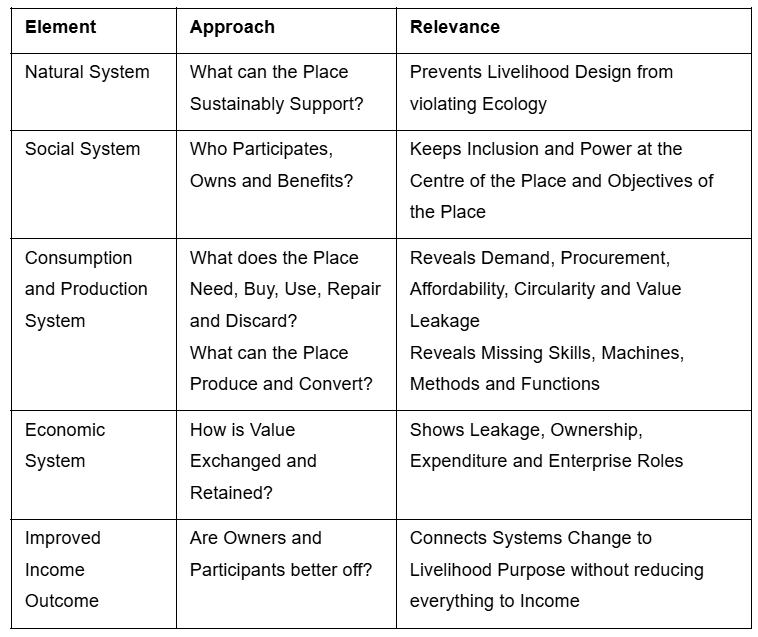
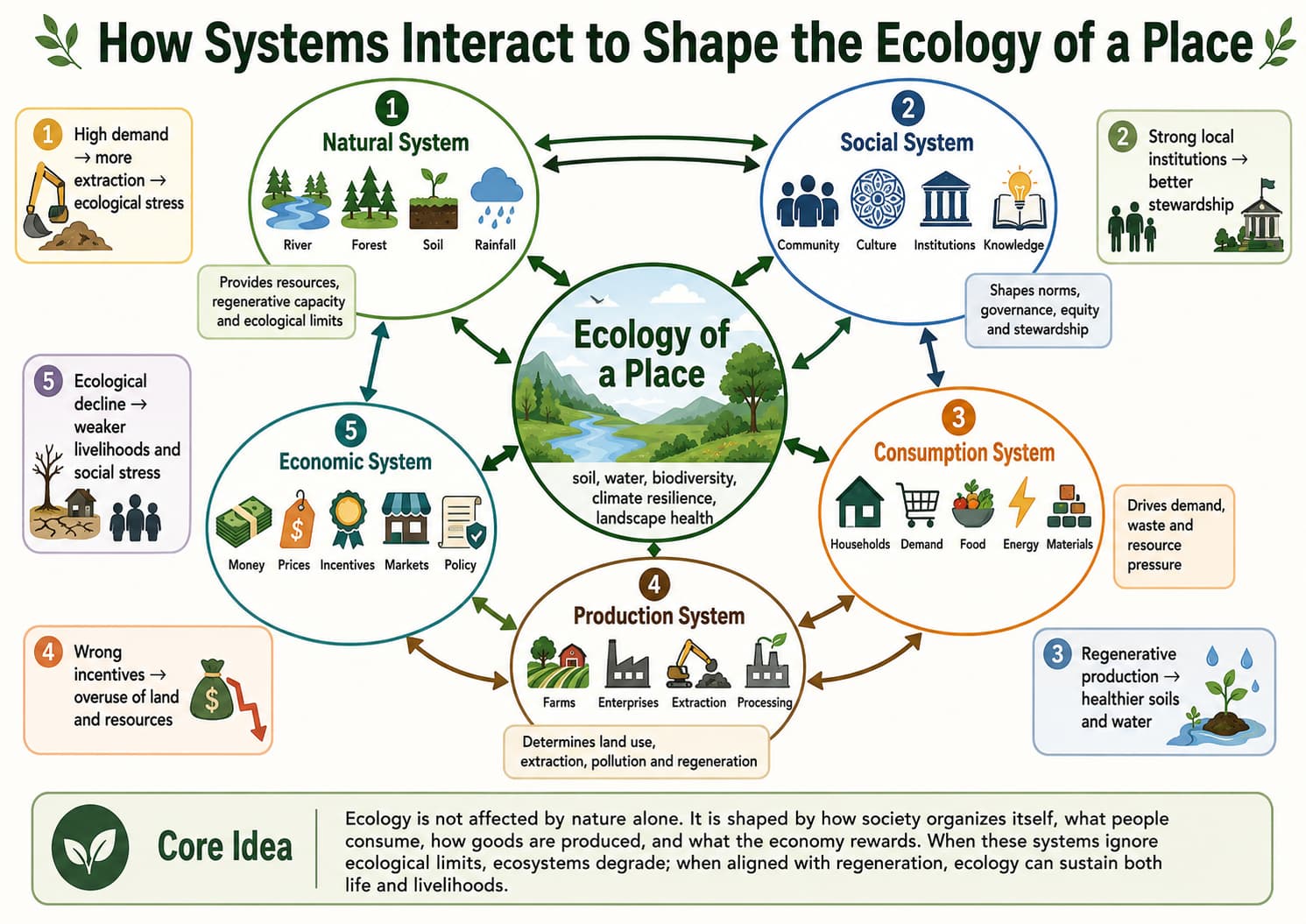
This approach recognises four interlinked Layers,
-
The Natural System - Land, Water, Soil, Biodiversity, Biomass, Livestock, Forests and Climate.
-
The Social System - People, Households, Collectives, Institutions, Ownership and Inclusion.
-
The Consumption and Production System - Usage, Needs, Resources, Skills, Machines, Methods, Processing, Repair and Productive Services.
-
The Economic System - Enterprises, Jobs, Income, Expenditure, Capital, Markets, Ownership and Value Flows.
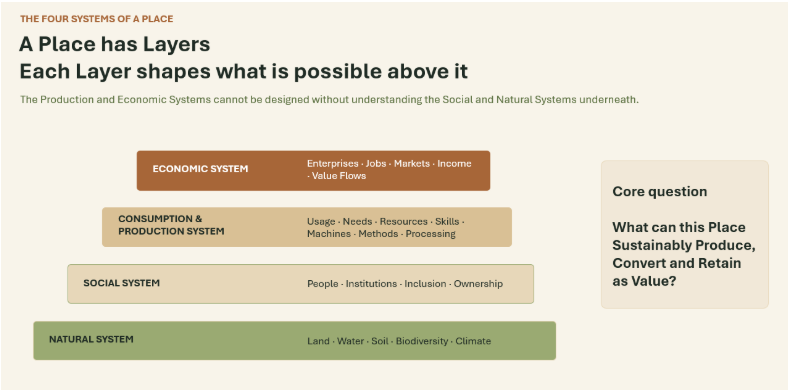
The Social System is not displaced by Economics. It remains Foundational. But the Economic Imagination becomes far more useful when it is grounded in the Social and Natural realities of the Place.
Consumption, Production and Economic Circulation
The Consumption System is best understood as a cross cutting part of the Production System rather than as a separate fifth layer. It is the demand side of the Place - what Households, Enterprises, Schools, Hospitals, Local Governments and other Institutions regularly buy, use, repair, share and discard. Mapping Consumption reveals the Basket of Goods and Services that keeps money circulating or leaking out, the quality and affordability expectations that Producers must meet, and the opportunities for Local, Cluster Level or Regional supply.
This prevents the approach from becoming purely Production led in a narrow sense. Local Production should not be promoted merely because a Resource or Machine is available. It should respond to an understood Consumption Need, a wider Market Opportunity, or an Ecological Function. In practice, the Systems Map therefore connects Resource and Production Flows with Expenditure, Procurement, Use, Reuse and Waste Flows. Consumption is both an Economic Signal and a site of Climate Action. Choices around Food, Energy, Mobility, Housing, Materials and Repair can reduce Ecological pressure while creating Demand for more Local, Circular and Climate Aligned Enterprises.
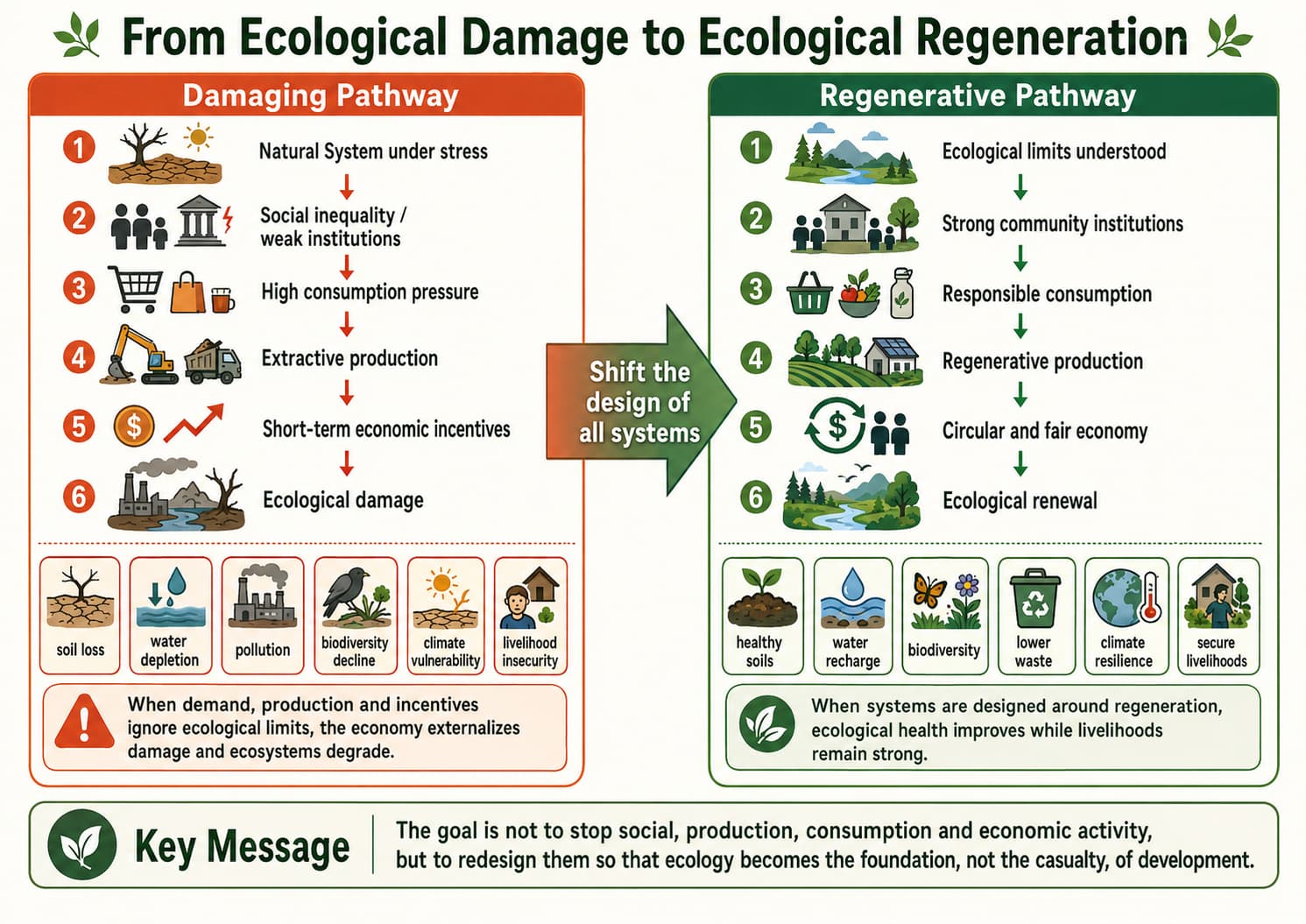
The Production System must grow out of the Ecology of the Place. A Turmeric growing Region cannot be approached in the same way as a Millet Landscape. A Forest fringe Village cannot be planned like a Peri Urban Settlement. A water scarce area should not be pushed toward a water intensive Enterprise Model. Ecology is not simply a constraint on Livelihoods. It is a Design Rule for the Production System. In the same way, the Economic System must emerge from the actual Social Context - Who owns Resources, Who controls Decisions, Who has Skills, Who can take Risk and Who is able to participate in Enterprise.
The same logic applies beyond a Village context. In an Urban Neighbourhood or Town, the relevant Resources may include Organic Waste, Construction Debris, Rooftops, Wastewater, Underused Buildings, Repair Skills, Public Procurement and Consumer Demands. Missing Functions may include Segregation, Material Recovery, Composting, Reuse, Cooling, Water Services, Local Food Distribution, Low Carbon Mobility and Repair. In a Conservation or Restoration Landscape, Production may take the form of Ecological Stewardship - Native Nurseries, Seed Collection, Habitat Restoration, Invasive Species Management, Soil and Water Regeneration, Biodiversity Monitoring, Sustainable Nature Based Tourism and carefully governed Value Chains for Non Timber Forest Produce such as Honey, Lac, Gums, Resins, Medicinal Plants, Fibres, Fruits and Seeds. In each case, the Economic System must reward regeneration rather than make Extraction the only viable source of Income.
From Enterprise Promotion to Economic Functions
Traditional Entrepreneurship Programmes often begin with the question - Who wants to become an Entrepreneur? The Place Systems approach starts somewhere else - What Economic Functions are missing in the Place? Is there a need for aggregation, grading, drying, storage, processing, repair, packaging, logistics, bookkeeping, quality testing, local retail, input production or market linkage? Once the missing Function becomes visible, it becomes easier to ask Who should Own it, Who can Operate it, What Capacity is required and How it fits into the wider Value Chain.
This is an important shift. An Enterprise is no longer seen as an isolated unit. It is understood as a Function within a Local Consumption, Production and Economic System. A flour mill, oil expeller, drying unit, cold storage, nursery, feed unit, bamboo treatment facility, dairy processing unit or repair service becomes meaningful only when it is connected to Resource Availability, Local Demand, Market Opportunity, Operating Skill, Finance, Ownership and Long Term Sustainability. Without this Systems View, Machines become Assets without throughput, Trained People become Skilled without Demand, Enterprises become Scheme Outputs rather than Viable Economic Nodes and Markets remain disconnected from Local Production Capability.
The same principle can be seen in other Place types. In Cities, a Decentralised Composting Unit, Repair and Refurbishment Hub, Construction Material Recovery Enterprise, Neighbourhood Cooling Service or Local Food Aggregation Platform is meaningful only when linked to Municipal Systems, Resident Demand, Land and Space, Logistics, Quality Standards and long term operating responsibility. In Conservation and Restoration Landscapes, an NTFP Processing Centre, Native Plant Nursery, Restoration Crew, Ecological Monitoring Service or Community Tourism Enterprise must be linked to Tenure and Access Rights, Sustainable Harvest Protocols, Biodiversity Outcomes, Traceability, Seasonality, Local Governance and fair Value sharing.
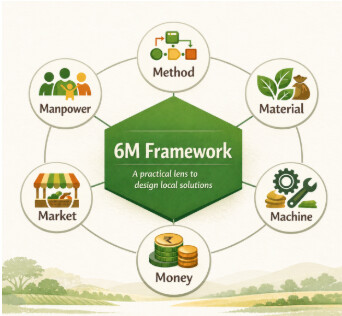
This is where the 6M lens becomes useful as a Solution Architecture - Manpower, Machine, Money, Material, Method and Market. Once a Consumption and Production System gap is visible, different Actors can see where they fit. A Technical Institution may support Method. A Manufacturer may supply Machine. A Bank or Scheme may support Money. A Community Institution may organise Manpower and Ownership. A Buyer may support Market. A Local Resource Inventory may clarify Material. The value of the Systems Map is that it helps prevent each actor from entering with a separate instrument and an isolated logic. Instead, it creates a shared picture of what the Place needs in order to mature Economically.
The Six Maturity Markers
The proposed approach uses Six Markers to assess the Maturity of a Place’s Production and Economic System.
-
Import Dependence and Consumption Mapping - Every Place consumes a Basket of Goods and Services - Food, Fuel, Farm Inputs, Construction Materials, Household Goods, Services, Repair and Processed Products. 1. The first task is to understand who consumes what, in what quantity, at what price, from where, with what quality expectation and through which procurement channel. Some Imports are necessary and efficient. But many remain unexamined. The question is not whether a Place should Produce everything. The more useful question is whether it understands its Consumption System, why value flows outward, and where Local, Cluster Level or Regional Production, Repair, Reuse or Public Procurement could reduce avoidable Value Leakage without compromising Choice, Quality or Ecological Limits.
-
Resource Utilisation - What Natural and Productive Resources does the Place have, and how well are they being used? Land, Water, Crop Residues, Livestock, Biomass, Forest Produce, Machines and Human Skill may all be visible, yet still be underused, seasonally used, wastefully used or unsustainably used. Mature Resource Utilisation means not simply extracting more, but using Resources productively within Ecological Limits.
-
Value Addition Depth - At what point does the Place enter and exit the Value Chain? Does it sell Raw Material, perform Primary Processing, create Semi Processed Products or produce Finished Goods?
-
Production Capability - The density of Skills, Enterprises, Jobs and Local Production Functions required to operate the System.
-
Local Value Retention - How much Value remains connected to Local Actors through Ownership, Spending, Reinvestment and Multiple Value Chain Nodes.
-
Sustainability - This replaces the narrower idea of Carrying Capacity as a standalone category. Sustainability asks whether the Productive Economy can Create and Retain Value without Degrading the Natural System on which it depends. It includes Ecological Limits, Renewable or Circular Inputs, Waste Reuse, Regeneration practices and long term Viability Checks before Scaling.
Income is an Outcome, Not the whole System
One of the most important Design choices in this approach is the decision to separate System Maturity from Improved Income. In many Livelihood Programmes, Income Increase becomes the Primary, or sometimes the only, measure of Success. Income matters deeply. But when Income is the only thing measured, the architecture that produced it can easily disappear from view. A temporary Price Rise, a Subsidy, an external Wage opportunity or a one time Procurement Contract may increase Income without strengthening the Local Economy. On the other hand, a Production System may be actually becoming stronger over a period of time before Income gains are fully visible.
For this reason, Improved Income is treated as an Outcome of the Designed Ecosystem, especially for people who have Place Ownership or Direct Participation. The approach checks whether real Median Income is rising, whether participating Owners and Producers are benefiting, whether a larger share of Income is being generated through Place Linked activity, whether Households are better able to meet essential Expenditure and whether Income gains are sustained across Production Cycles. This keeps the moral purpose of Livelihoods intact while avoiding the mistake of reducing the entire System to a single Income number.

The distinction also makes interpretation more useful,
-
A Place with Low System Maturity and Low Income Improvement needs Foundational work.
-
A Place with High System Maturity but Low Income Improvement may be facing problems of Value Distribution, Lag, Exclusion or Weak Ownership.
-
A Place with Low System Maturity but High Income Improvement may be benefiting from an External or Isolated Opportunity (such as temporary funding like CSR Projects / Philanthropy Capital) and is not yet embedded in a durable Local System.
-
A Place with both High System Maturity and High Income Improvement represents the desired direction - a capable Local Economy translating into broad and sustained Outcomes.
Working with Mixed Evidence
India’s Place realities rarely appear in neat Datasets. Some Places have Administrative Records, Enterprise Accounts, Transaction Histories and Production Data. Others rely mainly on Community Memory, Field Observation, Group Discussion and Partial Estimates. All the data - the Quantitative and the Qualitative, have to come together to reflect the “Health of the Place”. A practical approach therefore would be to get their hands on all kinds of available data, which helps with the better understanding of the Place. Data which helps own the Present and Act in Service of it keeping the Economy as a Sustainable and Integral part of it, without becoming paralysed when that data is incomplete or absent.
The proposed approach suggests a Mixed Evidence Architecture. Wherever a numerical value exists, it can be entered and scored against thresholds. Where numbers are not available, a Structured Qualitative Rating can be used, supported by a Narrative Note and an Evidence Source. At the same time, Qualitative and Quantitative Evidence should not be treated as identical. The approach is therefore to separate Maturity Score from Evidence Confidence.
Quantitative Measured Evidence carries Higher Confidence. Estimated Numbers, Triangulated Qualitative Ratings and Single Source Judgements carry different Confidence Factors (especially when it comes from ground-up, discussed and agreed by the people of the place). This makes it possible to compare Places on a Common Maturity Scale while still being honest about how strongly each conclusion is supported.
This matters for On Ground Practice. It allows assessment to begin with what is available and improve over time. A first version may rely on Community Mapping and Practitioner Judgement. Later, Market Samples, Enterprise Accounts, Household Expenditure Surveys, Production Logs and Ecological Measures can strengthen the Evidence. The approach is therefore not a One Time Survey but a Learning and Evolving System.
What this Means for the Social Sector
For Civil Society Organisations, CSRs, Government Programmes and Place Based Entrepreneurship Platforms, this approach offers a different way to organise Livelihood and Climate Work. It shifts attention from Beneficiary Lists to Place Economies, from Livelihood Selection to Consumption and Production System Discovery, from Enterprise Promotion to Economic Function Design, from Isolated Assets to Value Chain Architecture, and from Income Reporting to System Maturity plus Outcome Assessment. While the framework is rooted in Rural realities, it can also be applied to Urban Settlements and to Conservation and Restoration Landscapes where the central questions are how resources are used, what needs are being met, which ecological functions must be restored and how value can be retained fairly.
It also opens the door to better Collaboration. A Place Systems Map can show where different Actors are needed - Community Institutions for Ownership, Technical Agencies for Methods, Manufacturers for Machines, Banks and other Financial Providers for Working Capital, Buyers and Consumers for Markets including those catering to Local Consumptions, Local Governments and Anchor Institutions for Procurement, Local Youth for Services and Value Additions, Government Schemes for Catalytic Support and Ecological Practitioners for Sustainability and Restoration. Instead of every Actor pushing their own Programme Logic, the Place becomes the common reference point.
The approach is not about Place Self Sufficiency. Villages and Clusters should Trade, Connect, Specialise and Participate in Wider Markets. To and Fro Economic Movement from Villages to Blocks to Towns should be done in a designed manner. The approach is more precise - to help each Place participate in the Economy at the level where it has Natural, Social and Productive Advantage, reduce avoidable Value Leakage, deepen Local Capability, improve Ownership, regenerate the Resource Base and translate the resulting Ecosystem into better Incomes.
Learning to see Place Economies again
The Indian Social Sector is skilled at seeing Deprivation, Vulnerability, Collectives and Entitlements. It has also increasingly learned to see Ecology and Natural Systems. The next frontier is to see the Consumption, Production and Economic Systems of Places with equal seriousness. Rural Economies remain a critical starting point, but the same lens can help interpret Urban Neighbourhoods, Towns and Conservation or Restoration Landscapes. Livelihoods are not only Activities. Enterprises are not only Individuals. Income is not just a Household Number. A Place Economy is an Architecture of Resources, Capabilities, Value Chains, Ownership, Markets, Expenditure, Regeneration and Aspiration.
When that Architecture becomes visible, Interventions can become more Intelligent. It becomes possible to stop asking only which activity to introduce but actually begin asking what System must be strengthened. It becomes possible to stop treating Villages, Urban Settlements or Conservation Landscapes as passive sites of Needs and begin recognising them as Places with Consumption Demand, Production Potential, Ecological Functions, Economic Flows and Design Possibilities. That is the promise of a Consumption, Production and Economic System Approach to Livelihoods and Climate Action - To Restore Imagination to Place Based Development and To build Local Economies that are Socially Rooted, Ecologically Aligned, Productively Capable, Economically Value Retaining and able to Improve Incomes with Dignity.
Summary of the Approach