On Energy and Buildings
-
A roundtable was convened at the IIT Roorkee Summit on Biofuels (17 March), examining biofuels from a sustainability and rural livelihoods perspective. The discussion brought together stakeholders from industry, academia, and policy to deliberate on key trade-offs and potential pathways.
-
Inputs were provided on energy and buildings interventions for municipal corporation budgets in Bengaluru through the working group on Ward Climate Action Plans (in collaboration with the Climate Action Cell), supporting the translation of climate priorities into budgeted, ward-level implementation.
-
Engagement with the Reserve Bank of India Expert Group on modelling transition risks for India included contributions from SAFARI, which informed the committee’s assessment of climate-related financial stability risks.
-
A blog series titled ‘Thinking in Models’ on the State of Long-term Modelling in India was published in response to NITI Aayog reports on Viksit Bharat and Net Zero, contributing to the national discourse on credible climate and development pathways. [Click here to read the final blog in the series].
On Water
-
Water Ecosystem and Policy Mapping
The stakeholder ecosystem has been comprehensively mapped across the country along multiple intervention areas and bio-geographies. An in-depth stakeholder exercise has been conducted in Bengaluru to identify gaps in research areas for the water sector. A policy mapping exercise has been conducted, in which 67 national policies, schemes, programmes, and services have been coded through thematic and financial lenses. This mapping exercise has been examined through the lens of the climate–water–energy–food nexus, with each policy scored on a 7-point scale. Additionally, to assess the impact of policies, an Intent–Implication–Action framework has been deployed to understand the effectiveness of large-scale policies. In particular, a similar policy mapping exercise is being replicated for Bengaluru. -
Climate risk-based urban planning and decision support tool for Dibrugarh and Silchar Towns in Assam, with support from Janagraha
An MoU with the Directorate of Town and Country Planning (T&CP), Department of Housing and Urban Affairs (DoHUA), Government of Assam, was signed on 30th March 2026 to initiate climate risk-informed urban planning in Dibrugarh and Silchar Towns. In addition to an exchange of datasets, preliminary discussions were held with T&CP officials. Follow-up visits and capacity-building efforts are being planned. -
Site-specific instrumentation and data collection initiated in select states with Foundation for Ecological Security (FES) and Water, Environment, Land and Livelihoods (WELL) Labs for groundwater recharge layers preparation
A proposal is currently being developed to create a decision-support tool for springshed management in Himachal Pradesh, modelled on the Composite Landscape Assessment & Restoration Tool (CLART) developed by FES.
On Air Quality
-
Open-source publicly accessible version of AQ-DMS
The AQ-DMS project source code was made public in a GitHub repository under the Apache License 2.0 (on 2 February 2026). This setup is currently being tested for the planned IndiSET Expansion in Kolkata and Ajmer. -
Planning and development of modelling setups to develop an urban sensor network
We are developing a multi-layered dataset that integrates satellite-derived measurements (column nitrogen dioxide and aerosol optical depth) with ground-based observations from CSTEP’s AirNET and CPCB CAAQMS across Bengaluru. This is being combined with spatial data on industrial locations, major road networks, and other anthropogenic activities to design an urban sensor network. These layers will be integrated with high-resolution (1 km) modelling outputs to inform the design. -
Develop a multi-model air pollution control and scenario tool
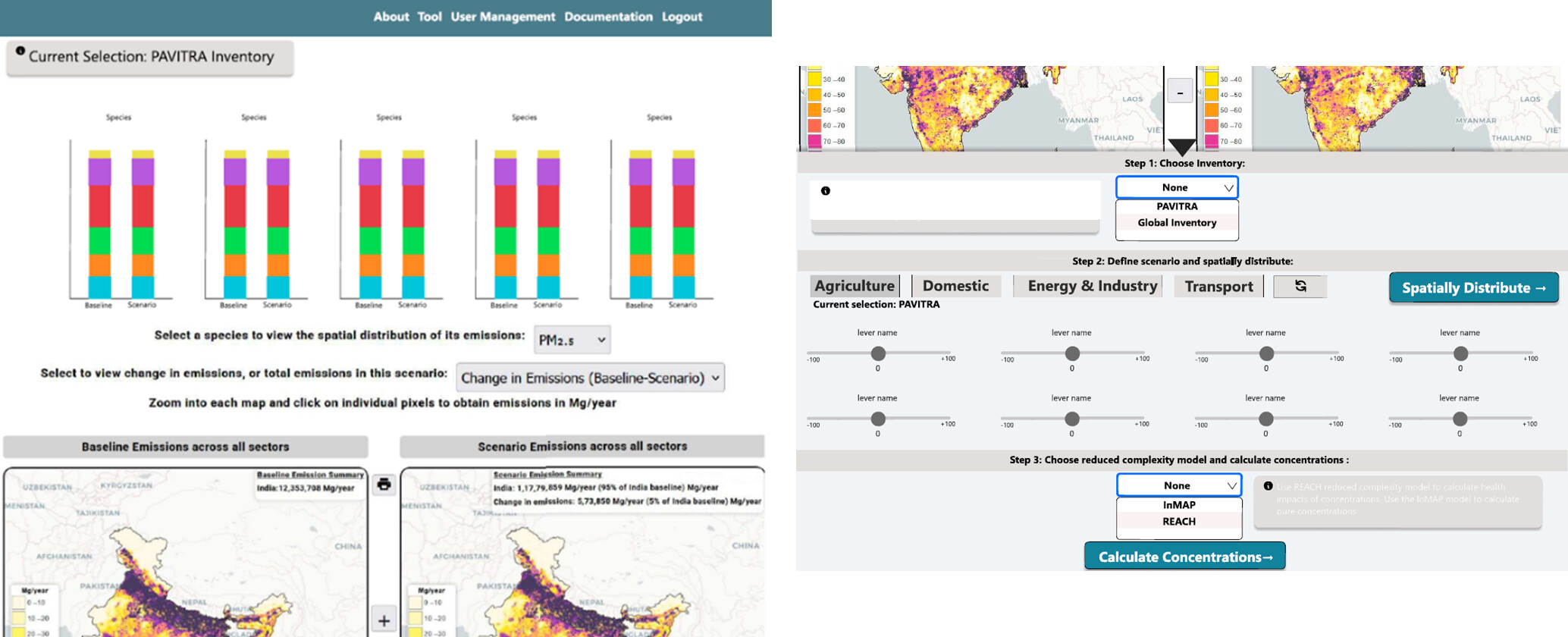
The base reduced-complexity model setups and emission inventory testing over India are in progress. The multi-model dashboard structure was finalised in February 2026. The screenshot attached below shows the graphical user interface of the first version of the multi-model air pollution dashboard.
- Technical Support to GBA: Understanding municipal solid waste management issues (garbage dumping and burning) in Bengaluru
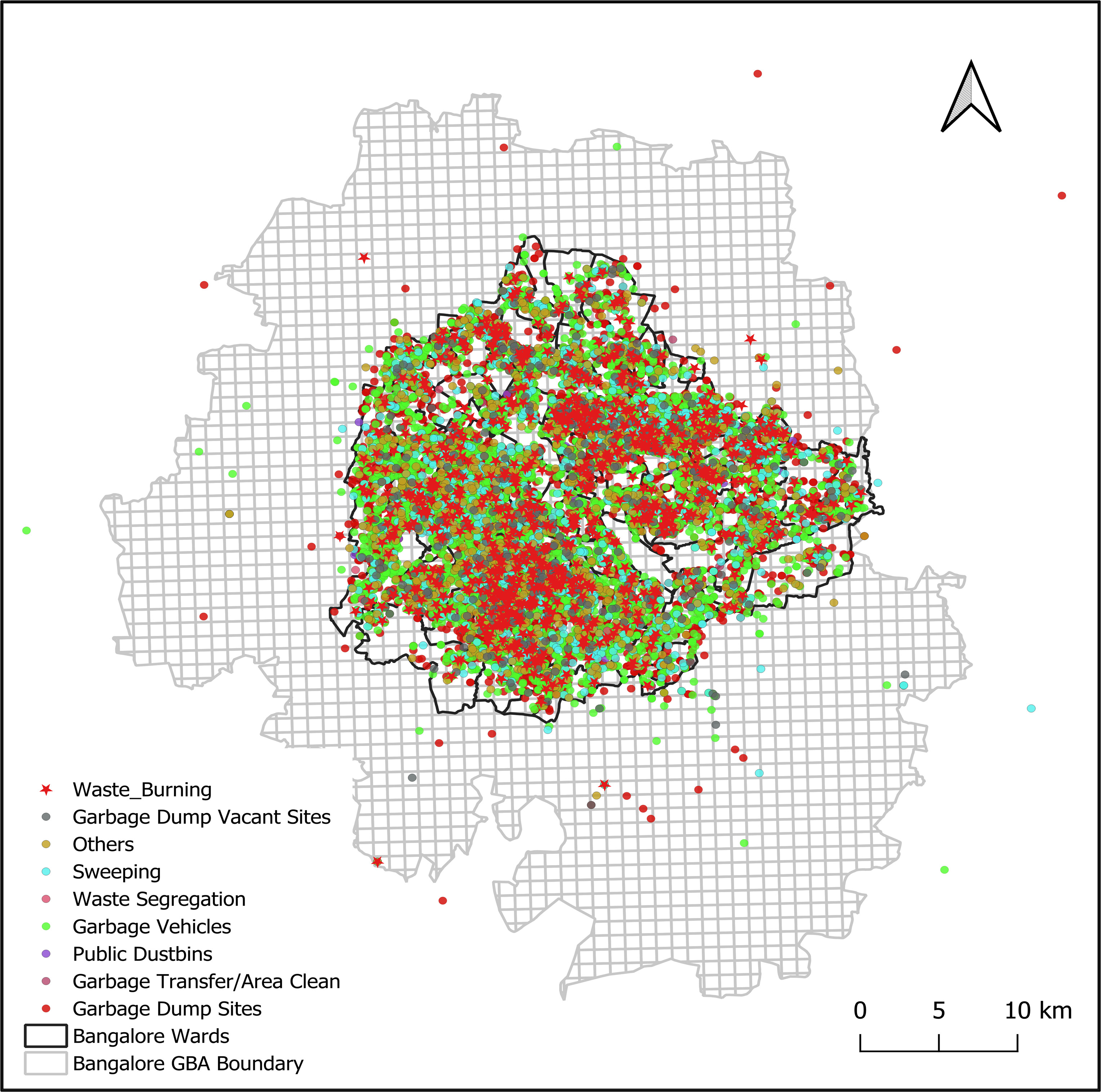
We continue to support the Greater Bengaluru Authority as part of a strategic coalition of partners facilitated by the Rainmatter Foundation. Building on earlier discussions, the CSTEP team, along with Mr Deepak Shagrithaya (Urbanist), visited Bengaluru Solid Waste Management Limited (BSWML) to obtain citizen complaint data on solid waste management. This dataset, with nearly 20,000 data points, was geolocated and analysed to better understand prevailing challenges related to waste management and waste burning. The data was further aggregated to generate ward-level insights, which informed the prioritisation of actions to reduce waste dumping and burning. The figure below illustrates the spatial distribution of solid waste management complaints. Overall, the analysis indicates that open waste dumping and waste burning are widespread issues across the GBA region. Based on these initial findings, we have requested additional data from BSWML to fine-tune the actionable strategies.
- Additional updates
CSTEP will soon (fourth week of April 2026) release a technical report titled ‘Performance Evaluation of Multipollutant Air Quality Sensors at IndiSET Bengaluru (First Edition)’, which assesses the short- and medium-term performance of low-cost air quality sensors available in India. The report underscores the importance of sensor calibration and robust QA/QC protocols to ensure reliable long-term air quality data in Bengaluru.