CoRE Insights: From Landscape Data to Explainable Diagnosis
The CoRE Stack assembles an extraordinary volume of geospatial, hydrological, agronomic and socio-economic data for every micro-watershed (MWS) in India—typically 1,000–1,500 hectares of lived landscape. The challenge is understanding what all this data is telling us: how can a watershed developer or community landscape steward use this information to diagnose problems and take action?
We built a diagnostics engine prototype that turns peer-reviewed knowledge and MWS variables into executable logical expressions—rulesets evaluated deterministically in milliseconds, without requiring a large language model (LLM) at query time. The approach follows a neurosymbolic AI model: LLMs help extract and draft symbolic rules from literature; humans and scripts curate them; and the runtime executes them reproducibly over real data. This reduces hallucination and makes the reasoning inspectable.
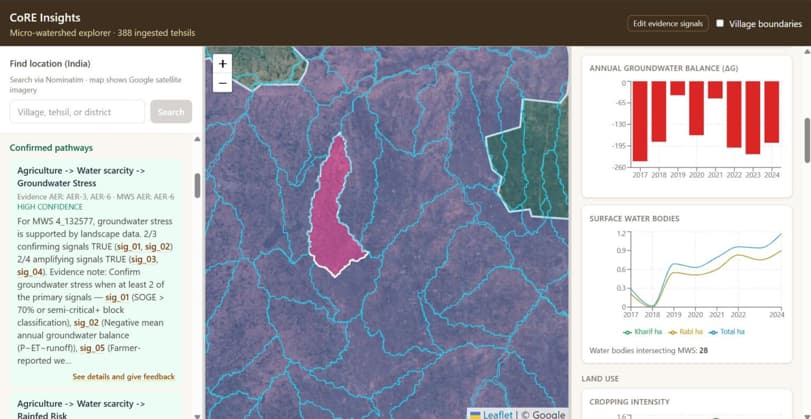
The goal is to move beyond raw data dashboards. A landscape steward needs to know whether a village cluster is facing groundwater stress or rainfed risk, whether forest degradation or grazing encroachment is a more plausible explanation for NTFP decline, what solutions fit the aquifer and terrain, and—importantly—what is still missing from the data and should be asked of the community. Every confirmation therefore needs to be traceable to specific variables and boolean conditions.
Building the framework ground-up
The framework began with identifying nearly 300 case studies and field reports from civil society organisations working on natural resource management in India. These were run through LLMs to identify a core set of production systems, stresses that were typically observed within them, and causal pathways that were typically identified for these stresses. To then understand these causal pathways better, more than 200 peer-reviewed and grey-literature papers were then screened and used to generate citation-backed rulesets.
The resulting rulesets contain diagnostic signals, confirmation policies, explanations and follow-up questions for variables not available in the CoRE Stack data dictionary. Eight causal pathways currently have full evidence-card coverage, including drought, groundwater stress, rainfed risk, irrigation challenges, forest degradation, encroachment, multi-sector vulnerability and small landholding.
For example, the pathway Agriculture production system → water scarcity observed stress → groundwater stress causal pathway uses Boolean expressions over MWS variables such as the Stage of Groundwater Extraction (SOGE) in the block is not ‘Safe’, the vertical water balance (rainfall - ET - runoff) in the micro-watershed is negative, the micro-watershed is situated at the head of the broader watershed, and so on. A confirmation policy determines when a pathway can be confirmed, while follow-up questions can address information not available in the database. At runtime, the engine evaluates the active signals, applies the confirmation policy and returns confirmed or uncertain pathways, solutions and the highest-priority follow-up question—all without an LLM.
Why we moved away from “LLMs diagnose everything”
In our initial approach we asked LLMs to read the full variable bundle and generate diagnostic prose. While the LLMs produced rich and context-aware reasoning, the approach had significant limitations: hallucinated variable names, broken arithmetic, opaque reasoning, cost and latency, and non-reproducibility.
We therefore shifted to using LLMs for a one-time ruleset generation that can be executed deterministically, followed by an optional LLM-in-the-loop approach where LLMs can act as reviewers for the final diagnosis. This keeps humans in charge of checking and improving the compiled rules rather than outsourcing judgement to AI.
The result is promising. Across a groundtruth of 28 case-study instances, the deterministic expression-based approach achieved a mean accuracy score of 82.8% compared with 86.0% for Claude. The symbolic approach runs in milliseconds and has no LLM cost per query.
From diagnosis to collective action
The longer-term vision is to bring this capability into community-facing workflows alongside Commons Connect, which is already used by hundreds of landscape stewards in participatory natural resource management planning.
The proposed next step is to embed a conversational diagnosis panel and evidence-backed information panel into Commons Connect or an accompanying chatbot, with local-language translation and plain-language explanations. This would enable changemakers to:
- Diagnose the production-system stresses supported by the data.
- Discover context-appropriate solutions.
- Connect with enabler CSOs and mentors in their geography.
- Collectivise and take action.
What comes next
The current system is just a research prototype and needs substantially more testing. Future work includes improving the codebase, strengthening signal expressions and confirmation policies, expanding the remaining pathways and adding new variables for areas such as grasslands, pasture health and forest biodiversity.
Another important direction is systems-level diagnosis. Rather than diagnosing each pathway in isolation, combinations of confirmed and absent pathways could reveal broader landscape patterns—for example, linking groundwater stress with forest degradation or identifying when livelihood stress may dominate over hydrological problems.
The framework could also extend beyond the micro-watershed to waterbodies, farms and forest patches, allowing diagnostics to operate at the scales at which stewards already think and work.The underlying principle remains simple: use LLMs in the loop, but not in charge. The LLM helps bring knowledge from literature into the system; humans curate and approve it; and the deterministic engine applies explicit rules to real landscape data.
For rural natural resource management, this keeps agency with stewards and enablers, while making the reasoning behind a diagnosis visible, reproducible and grounded in evidence.
Please read the full blog here