Climate Narrative Hub - Dasra Updates (August 2025 to March 2026)
Building ecosystem infrastructure to mainstream climate narratives from communities across India
The Climate Narrative Hub (CNH) was established with the goal of making localized, rooted
in India climate stories mainstream and part of everyday conversations in India. We aim to
do this by creating shared narrative infrastructure for creatives and climate experts. This
report covers activities and outcomes for the period of 8 August 2025 (when the grant
period began)- March 31 2026.
This first phase of the grant was focused on establishing the Hub, aligning on offerings,
identifying priorities and ways of working, and beginning delivery across selected offerings.
1. Setting Up the Hub: Offerings, Structure and Prioritization
This first phase has had a heavy focus on defining and iterating through learning what the
core offerings of the Hub are, and how we work with the ecosystem.
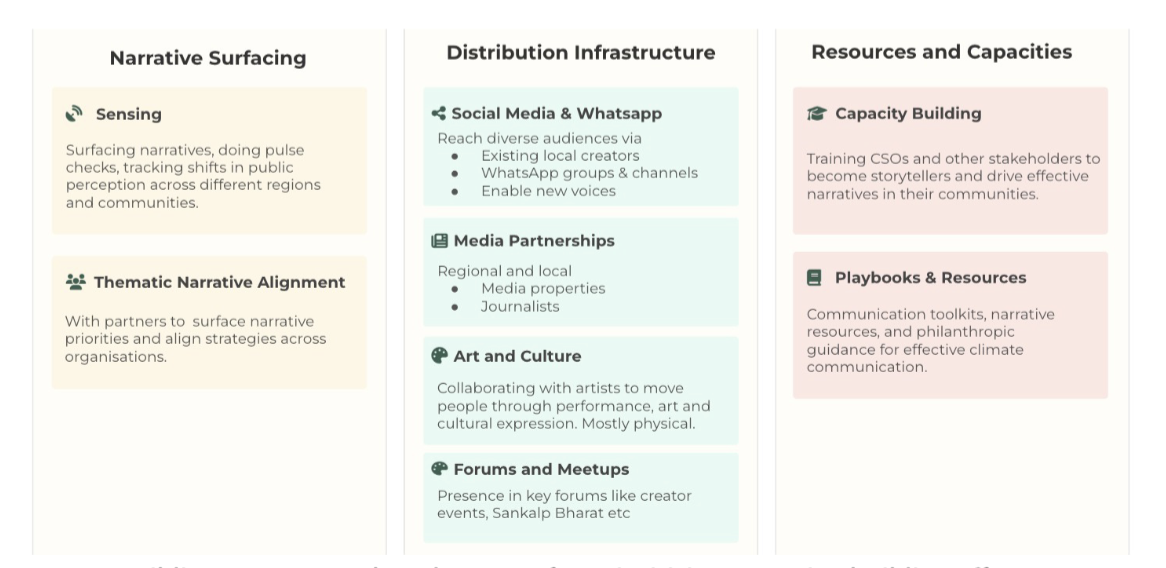
A. Defining our offering areas: Based on many conversations with partners and understanding where the gaps and opportunities lay in the ecosystem, we have defined our offerings across 3 interconnected areas. The thematic pilots that we have begun running focus on testing and putting into motion these offering areas.
B. Building a Framework and Process for Prioritizing narrative building efforts:
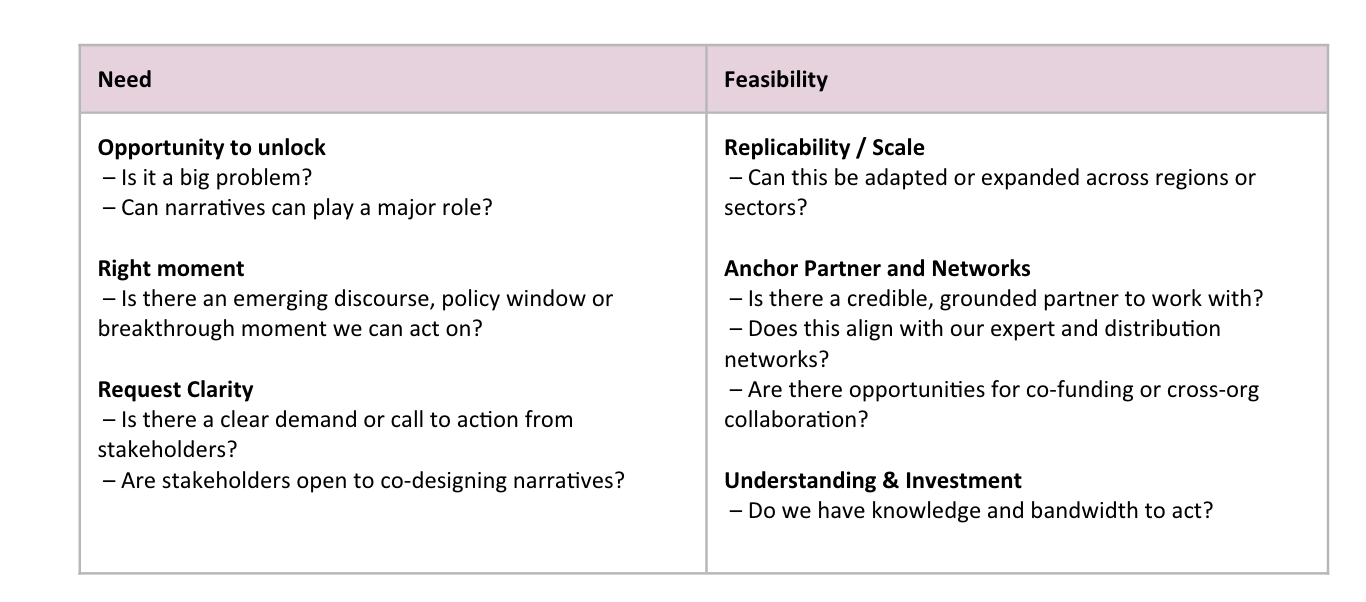
Given the vast need for narrative building within the climate ecosystem in India, we needed an approach to prioritize the hub’s efforts. This has gone through a few rounds of iterations- to both define the process for collating requests, reviewing them and a framework for prioritization. We now have an intake form that partners can fill out to indicate areas where they would like to collaborate with the hub on narrative building work. The form also allows us to distinguish between short term, tactical and longer-term strategic narrative shift opportunities. Additionally, when choosing areas to work on, we also look at applying the following selection framework:
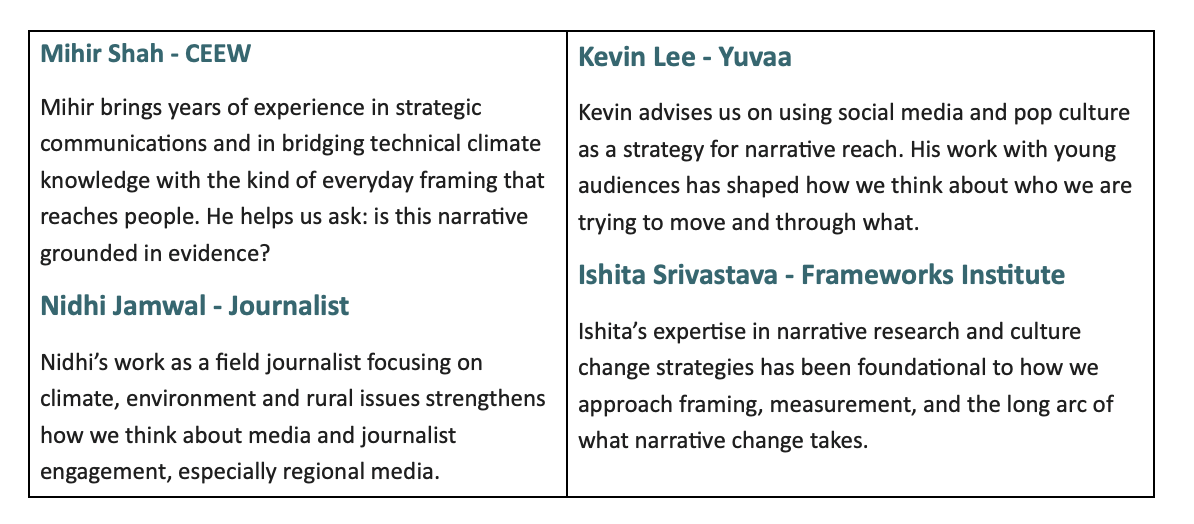
C. Brain Trust: In order to help guide us on narrative change areas and approaches, we
also assembled a Brain Trust of 4 advisors who bring expertise in a range of narrative
change areas (strategic communications, social media, narrative research and
cultural practice and journalism). We have engaged the group via one meeting in
December and continue to lean on each of the advisors on a 1:1 basis to share
updates and seek advice as needed.
D. Roadshows and the emerging Community of Practice
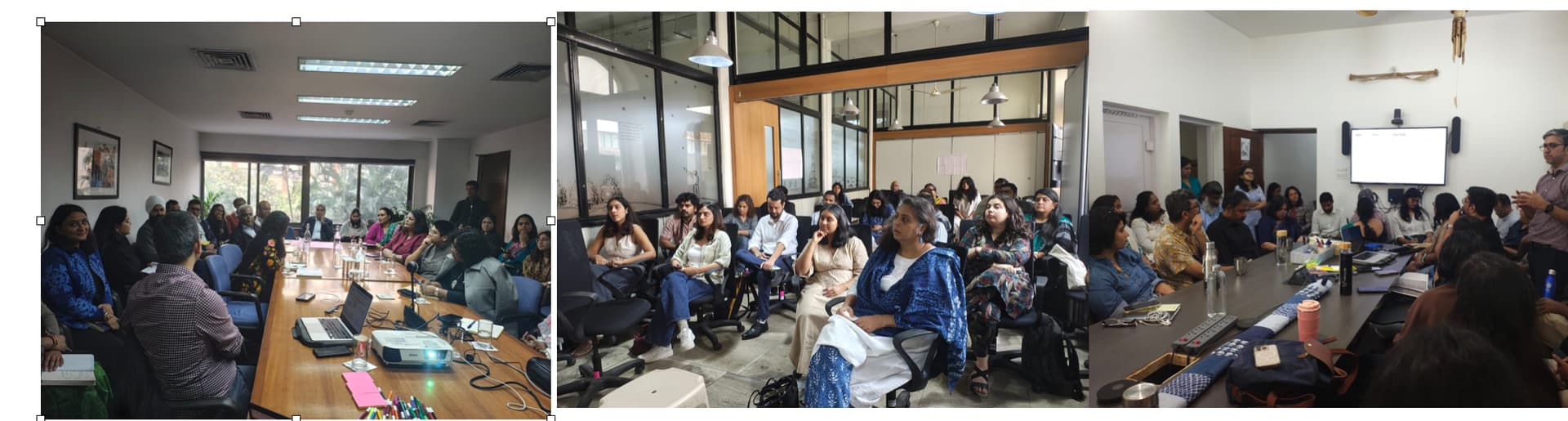
To introduce the Hub and build buy-in across the ecosystem, we hosted roadshows across Bangalore, Mumbai, and Delhi between October and December 2025.
Across 3 roadshows, we introduced the Hub to more than 100 participants from over 70 organisations
Some learnings and feedback we gathered through these interactions included:
- High demand for a coherent narrative strategy, values, and guardrails.
- Universal ask for impact measurement frameworks.
- Partners suggest CNH thinking through offerings and ways of engagement with government, corporates, policymakers, and businesses/ entrepreneurs
- Stakeholders want structured processes: roadmaps, calendars, governance model, financial models of engagement
- Big emphasis on how narratives translate to systems change and policy influence (Theory of Change)
- Alignment building on narrative as an aid to programs and policy engagement efforts by domain partners
Partner |
Sensing, M&E, Research | Media | Digital | Capacity Building | Art & Culture |
|---|---|---|---|---|---|
| CSBC, Frameworks Institute, Youth Ki Awaaz, Mindworks Lab, Transitions Research, Jhatkaa, Back to Village | ★ | ★ | |||
| CVoter, Yale YPCCC, Antkind | ★ | ||||
| 101 Reporters, The Reporters’ Collective | ★ | ||||
| Migration Story, IDR, Mongabay, Chambal Media, PARI | ★ | ★ | |||
| Climate Action Live, Climate Rubik, Chetan B | ★ | ||||
| Mint, Hindustan Times, Dainik Jagran | ★ | ||||
| Civic Studios, MTV, Alt Eff, Green Stories, Sumit Roy, ClimateSprring, Prakriti Sena | ★ | ★ | ★ | ||
| Pluc.TV, Yuvaa, Voices of Rural India, Reading Room, Brut | ★ | ||||
| Video Volunteers, Cicada | ★ | ★ | |||
| Revisual Labs, Coconut Thinking | ★ | ||||
| Kaivalya Plays, Tafreeh Wale, Sustaina, Swarathma | ★ | ||||
| Climate Trends, Purpose, Asar | ★ | ★ |
2. Thematic Narrative Building Efforts
Through August- March, we worked in Depth on Human-Wildlife Interactions- working across all the offering areas. We have also worked on applying select offering areas to other themes- Place based ownership, Gender x Climate, Green Economy. Other themes have focused on digital and social media activations led by Hub co-anchor Momentum Shifts.
Thematic Updates
a. Human Wildlife Interaction: Moving from Conflict to Coexistence
Across India, communities living on the edges of forests face a daily reality that the dominant media narrative barely touches. Tigers, leopards, wolves, and elephants are cast as threats. Forest-dwelling communities are cast as victims or encroachers. Neither story is true enough, community voices rarely reach mainstream audiences, and the predominant story is one of conflict. The goal is to move to a realistic narrative of coexistence.
How the Opportunity Was Identified
The Climate Rise Alliance Conservation and Restoration working group partners highlighted rising conflict between communities, conservationists, and forest departments - wolf, tiger, leopard, and elephant conflict in Central India; tiger and elephant conflict in Karnataka. Through convenings, the Hub identified three key gaps:
1) The regional and national media needed better tools for covering these issues: access to factual information, community voices, and the kind of editorial framing that de-sensationalises without diminishing the real challenges.
2) Forest-dwelling communities were being vilified in ways that ignored their lived knowledge acquired over generations of living with the land
3) Researchers and CSOs working with communities lacked the narrative tools and support to produce rooted, accurate content at scale.
Offerings In Action
1) Sensing:
Landscaped the narrative in media and social media on human-wildlife interactions in Central and North India.
2) Narrative Alignment Building:
Built alignment on a coexistence-focused framing, centred on indigenous wisdom and continual collaboration and compromise between forest-dwelling communities and forest officials/wildlife champions with 7 partners (NCCI, Coexistence Consortium, Arocha India, Corbett Foundation, The Nature Conservancy, WCS India, Vidhi Legal). Identified key audiences to focus on: media (mouthpieces), communities (where fear spreads but indigenous wisdom resides), wider public (where sensational stories gain traction), and forest departments (who implement policy and control power)
3) Media Engagement:
- We conducted 4 media workshops and sensitisation convenings, engaging over 50 journalists.
- In December 2025, the Hub hosted a solutions journalism workshop with The Migration Story, bringing together 10 journalists from Maharashtra, Madhya Pradesh, and Chhattisgarh. They went into the field, developed story pitches, and received mentorship to refine them into publishable work.
Here are the links to the three stories that have been published:
1. In the land of Mowgli, women find rare entry into ecotourism jobs
2. Meet Chhattisgarh’s Elephant Trackers (English)
3.Making Way for the Wild: the importance of animal underpasses
4) Convenings:
- Organised 1 convening with partners to identify narrative gaps and opportunities
- Hosted a panel on the power of narratives at Sustaina’26, spotlighted Karnataka based creator working on issues of Human Wildlife Interactions
5) Capacity Building
- Directly working with on ground partners- (NCCI, Corbett, Cicada, Chambal Media) to conduct intergenerational storytelling circles and use other methods to document and amplify unheard community perspectives on coexistence that will be amplified via culture and media platforms under the Stories of Coexistence campaign.
- Sensitized over 50 journalists via workshops and roundtables on accurate and non-sensational reporting on the issue.
6) Playbooks and Resources
- Built and published 1 Media Reporting Manual for Journalists and Communicators in 3 languages- Hindi, English and Marathi
- Created a directory of experts on various conservation and human-wildlife interaction issues for journalists to reference
7) Art and Culture:
We have begun amplifying stories from communities and CSOs via art, social media and through partners and platforms like PLUC TV, Khabar Lahariya, Brut, Reading Room - alongside other media platforms. The Hub is engaging creators, artists, and cultural voices to translate these stories into formats that reach beyond the usual audiences - music, digital storytelling, and creator-led interpretations.
b. Gender and Climate
Women - particularly those living at the intersection of climate vulnerability and social marginalisation - are among the first to notice when the monsoon is shifting, when seeds are failing, when the river is lower than it used to be. Yet their voices are consistently absent from the dominant climate narrative.
How the Opportunity Was Identified
Via the CRA Gender Working Group, the narrative was refined through additional convenings, but the core need was to find a stronger, leadership-focused narrative for gender and climate. Through conversations with the Gender Working Group of the Climate Rise Alliance, the Hub led 3 alignment-focused conversations that helped narrow down to the core narrative shift: moving from women being perceived simply as victims of the climate crisis to leaders driving adaptation and resilience measures.
Offerings In Action
1) Narrative Alignment Building
Conducted 3 alignment-focused conversations with the CRA Gender Working Group to surface and sharpen the core narrative shift - from women as victims to women as leaders driving climate adaptation and resilience
2) Convenings
- Hosted a panel at DPW focused on gender and climate, where the storytelling fellowship was announced publicly
3) Capacity Building
- Launched a capacity building fellowship with 30 on-ground storytellers across 6 partners from the CRA Gender Working Group, in collaboration with Youth Ki Awaaz. The stories from these storytellers are expected to be launched in October
c. Sense of the House: Strengthening Place-Based Community Ownership
Development narratives in India are often shaped at a distance by funders, policy makers, and urban intermediaries. The voices and wisdom of communities who are most embedded in a place are rarely centred and fragmented by themes. The Sense of the House (SoTH) theme works to build a narrative that recognises and advances place-based ownership where communities define what sustainability and resilience mean in their context. Beyond these offerings, we have begun media and social media work which will be put out in the coming few months.
How the Opportunity Was Identified
Via the SOTH Alliance that Climate Rise Alliance and Rainmatter convene to advance place-based ownership and development, the Hub identified the need for a narrative intervention that could make the case for community-driven, place-centred development to a wider audience, including funders and CSR givers.
Offerings In Action
1) Narrative Alignment Building
- Regular conversations with CRA SOTH core group on narrative building and messages (Conducted 2 alignment-building conversations with the SOTH Alliance on narrative building, surfacing key messages that are now being translated into media pieces and stories.
- Message frames for SOTH focused on frames including Ecological Atmanirbharta, place-first community ownership etc. are being developed and will be shared with the ecosystem by end of Y1 of the grant period.
2) Convenings
- Hosted a CSR-focused philanthropy convening at DPW with place-based ownership as one of the focus areas, engaging domestic CSR givers on the value and evidence for locally-rooted development.
d. Green Economy: Making the Case for Low-Emissions Growth
A dominant narrative among Indian funders and corporates assumes that economic growth necessarily demands investment and scale in high-emissions sectors. This narrative crowds out investment in green alternatives and makes the transition to a low-emissions economy seem economically risky. The goal is to shift this framing by making green economy a credible, attractive, and urgent investment thesis for Indian philanthropists and CSR givers.
How the Opportunity Was Identified
Via GramEEE partners and CEEW, who highlighted the need for a narrative intervention especially with funders and corporates in order to counter the narrative that growth demands investment and scale of high-emissions sectors. This gap was particularly acute among domestic CSR givers, who remained largely disengaged from climate-aligned investment.
Offerings In Action
1) Sensing
- Mapped philanthropists across archetypes via interviews and secondary research to determine where the narrative within funders sits around the green economy, and which adjacencies and values can be tapped into to drive the narrative ahead.
2) Narrative Alignment Building
- Conducted 2 workshops with CEEW to determine narrative building strategy for philanthropists, identifying the right entry points and message frames for this audience.
3) Convenings
- Hosted a roundtable at DPW 2026 with CSR givers, including a focus on the green economy, gaps, and opportunities for domestic CSR givers to engage with climate-aligned investment.
Building the Narrative around the need for Climate Narratives
Throughout the year, the Hub showed up at sector forums to build a narrative around the need for narrative change as a practice, and the power of storytelling that highlights solutions and community narratives. We leveraged the offering areas of convenings and art and culture to spark conversation and support artists who are using their practice to ignite climate conversations.
ICLEI ARISE Forum
At the ARISE forum hosted by ICLEI in October of 2025, we participated in a session on the role of narratives in igniting citizen participation along with YLAC, Oorvani/ Citizen Matters and NIUA.
We also supported theatre group Kaivalya plays to conduct an interactive session at the event focused on imagining alternate city futures through movement and theatre.
Sustaina India 3.0 (January 2026)
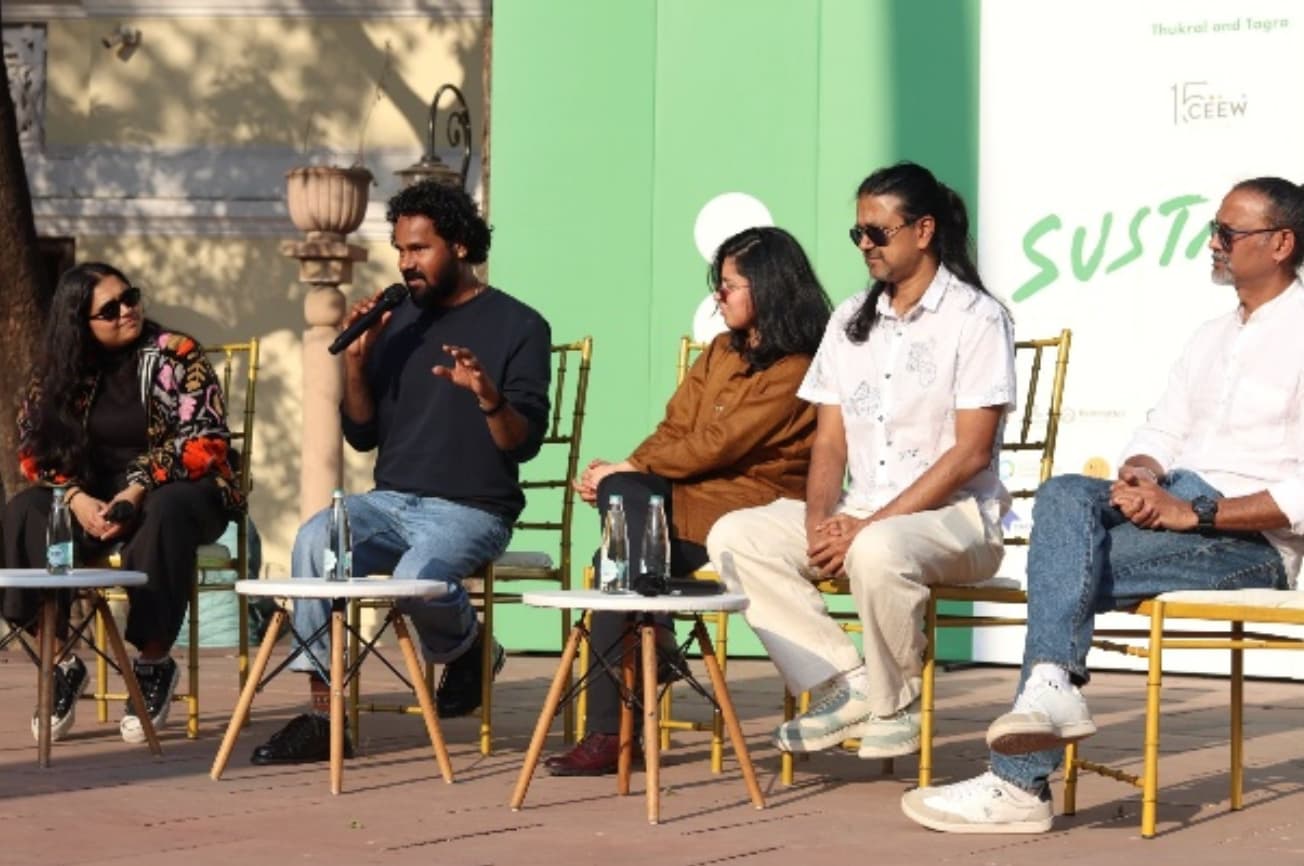
In New Delhi, the Hub co-hosted a creator-led showcase at Sustaina India 3.0 with CEEW, bringing together four creators to reimagine what climate storytelling can look like through music, visual arts, and social media:
- Multimedia artist Niroj Satpathy
- Musician Jishnu Dasgupta from Swarathma
- Wildlife biologist and creator Gowri Shankar
- Artist and agripreneur Anuja Dasgupta
We also supported theatre group tafreehwale to do a play Kaivalya plays to conduct an interactive session at the event focused on imagining alternate city futures through movement and theatre.
Dasra Philanthropy Week, Feb 2026
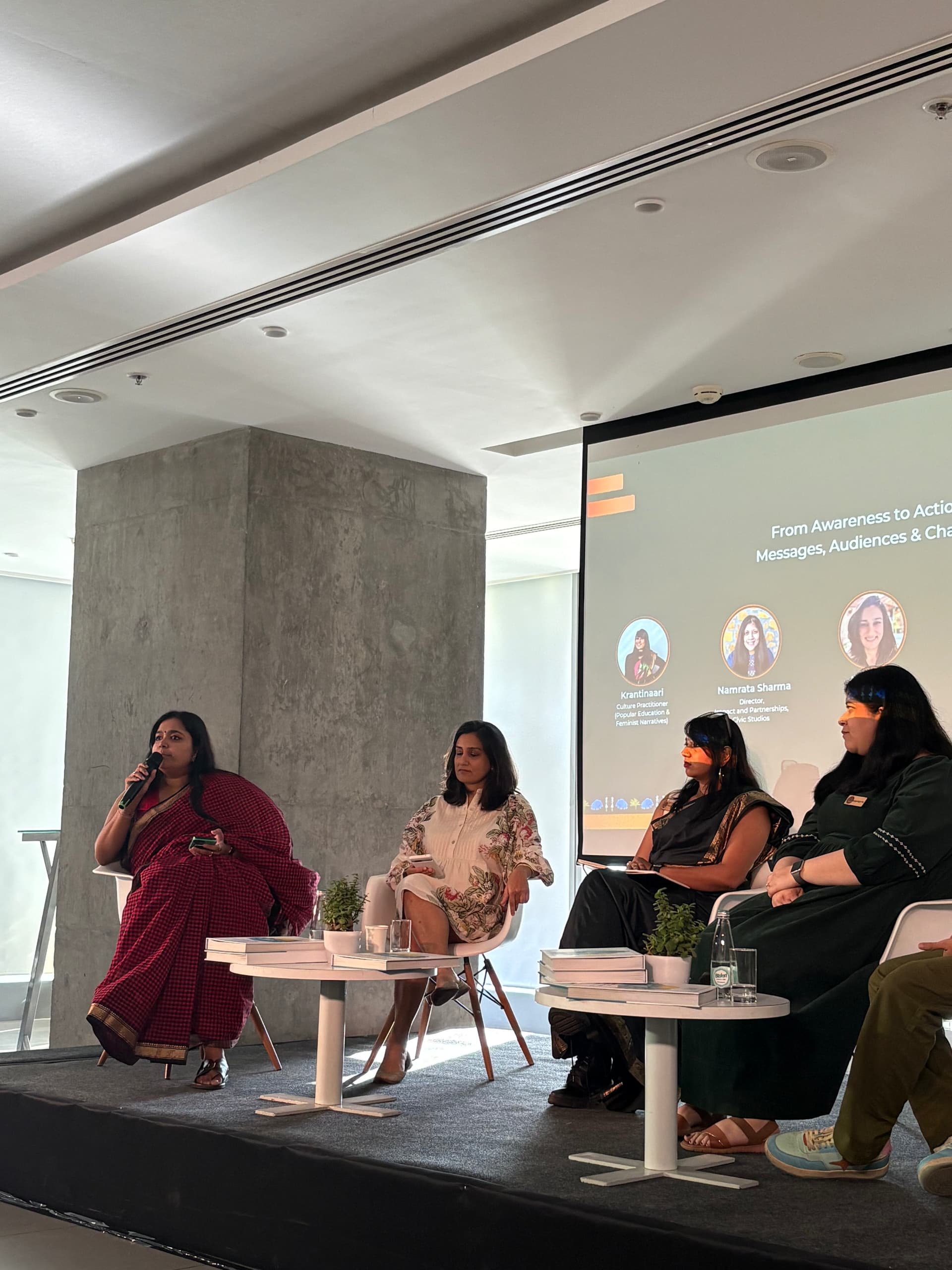
We hosted a session at DPW 2026 on messaging and understanding audiences, with speakers from Ek Kutumb, Yuvaa, Civic Studios, and independent artist KrantiNaari. Speakers offered a consistent message: urgency and action-focused storytelling must go beyond awareness. Climate response requires the flexibility to act in real time, not just within grant cycles. And children and young people must be brought into the conversation not as future stakeholders, but as present ones.
Amplifying Climate Stories through Art and Culture
Data can inform. But stories - told through music, performance, visual art, and lived cultural expression - can move people in ways that data cannot.
Kaivalya Plays at the ARISE Forum
The Hub partnered with Kaivalya Plays to deliver a performance-based session at the ICLEI ARISE Forum. Theatre brought urban climate realities into the room in ways that a presentation could not. Participants stayed in conversation long after the session ended.
Plan B/C/D/E at Sustaina India 3.0
Theater company Tafreehwale, led by artist Meghana AT performed her interactive piece Plan B/C/D/E to a new audience at Sustaina 3.0 The session used theatre as an interactive vehicle to engage urban audiences on the realities of the climate crisis, turning data and evidence into stories and relatable scenarios
Recap of Progress against Milestones agreed upon for the first Phase- Establish and Seed- were as follows:
-
Content Creation & Messaging
a. Run 2 small-scale content collaborations with aligned CSO or grassroots media partners- (7+ Partnerships with CSOs on HWI stories, 1 partnership with migration story on HWI media training, 1 CSO partnership on Gender) -
Capacity Building & Ecosystem Support
a. Publish or update 2 public resources for sector use- HWI manual in 3 languages, resource directory
b. 2 CSO convenings engaging at least 25 partners to exchange learnings on narratives on aligned priority and geographic areas- 3 roadshows, 3 panel discussions, 4 narrative alignment sessions with groups (Gender, HWI, SOTH) -
Media Engagement
a. 2 media engagement/ sensitization convenings aligned to priority themes and geographies- HWI Media Workshops
b. 1 language and media focused resource aligned to priority themes and geographies launched- HWI media Guide
c. 3 regional media pieces + 2 national media pieces aligned to priority themes and geographies- d. 100+ pieces published across regional and national themes on HWI, 5 regional and English media deep dives -
Art and Culture
a. 1 installation/performance art showcase aligned to 1 aligned priority area- 2 theatre performances focused on larger climate narratives -
Reporting
a. Submit 1 interim progress report documenting outputs, learnings, and recommended course corrections. -
Hub Collaboration and Management
a. Identified set of Narrative Hub offerings- completed
b. 5 Brain trust members onboarded and Brain Trust cadence kicked off- 4 member BT activated
c. Selection criteria and framework for selecting priority themes created- completed
d. Regular operational and governance cadence and ways of working for Hub partners created and kicked off- completed
e. Narrative Hub website created- completed