Once the harvest is in, the fields around Sonepur in Odisha often go up in smoke. Farmers burn leftover paddy straw as the quickest way to clear the land, but the fire rarely stays where it is lit. “If someone strikes a match here, the fire travels two or three kilometres,” says Abani, chief executive of Greenovibe. In one village, he and Archana Mahapatra have found another use for that straw. Today, it grows mushrooms tended by 30 women from three self-help groups. Their ambition is simple: to turn waste into wealth.
Greenovibe began in 2023, shaped by summers when temperatures climb beyond 45°C, and was registered as an organisation in 2024. Its early work focused on tree planting and waste management, drawing on Abani’s background in biotechnology and Archana Mahapatra’s training in Physics and Psychology to approach environmental challenges through both scientific understanding and an awareness of people and communities. But as they began building their work in Sonepur, they needed more than the willingness to act; they needed the recognition, resources and guidance to grow. They found an opportunity in Changelooms. “When we started working, we had no recognition. Changelooms was the first to recognise us and give us the chance to learn,” Abani recalls.
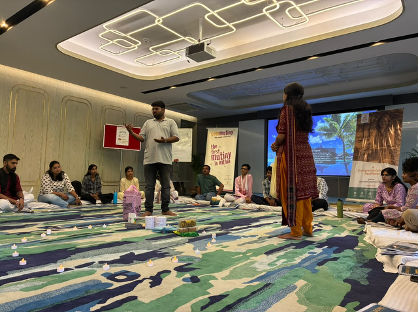
Abani Participating in the “Window to Changelooms” workshop
Through Changelooms, Abani and Archana began to see their work in a broader ecological context. Orientations and field visits introduced them to the connections between biodiversity, carbon, wildlife and water, helping them understand how tree planting and waste management fit into a larger environmental picture. They had been taking action, but needed a framework to identify the problems most pressing in their community and work out how best to address them.“We knew we had to work, but we didn’t know how,” Abani says.
The turning point came through MADS (Mapping, Analysis, Diagnosis and Synthesis), a framework introduced during one of the Changelooms’ sessions. Back in Sonepur, Greenovibe used it to map its community and identify its needs. The exercise revealed challenges that extended well beyond the environment, from transport and education to livelihoods and the effects of a changing climate. Their mentor, Sachidananda, helped them connect these broader concerns to something happening in the fields around them every harvest season.
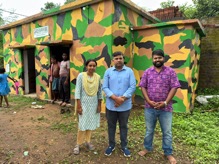
Abani and Archana with their Mentor Sachidananda Mishra during field Visit
Walking through the farmland, he noticed the smell of fertiliser and asked what happened to the paddy straw after the crop was harvested. The answer was familiar: it was burned. The practice released carbon into the atmosphere and destroyed habitats for birds, insects, reptiles and organisms living in the soil. Here was an environmental problem that was both immediate and deeply connected to the community’s livelihoods. With self-help groups of village women already in place, Sachidananda suggested exploring mushroom cultivation using paddy straw, drawing inspiration from similar work elsewhere in Odisha.
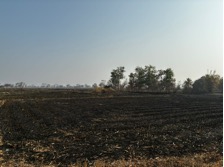
The problem that Greenovibe was trying to Solve
For Abani, the discovery brought an old scientific lesson into an entirely new perspective. “I have been a science student. I studied the carbon cycle from childhood and wrote it in so many exams,” he says. “But I never thought it was happening right next to me.”
The idea became Nourishing Now, Greenovibe’s initiative to turn agricultural waste into a source of food and income. Instead of burning paddy straw, the project uses it to cultivate mushrooms, offering an alternative to a practice that damages local ecosystems while creating a livelihood opportunity for women.
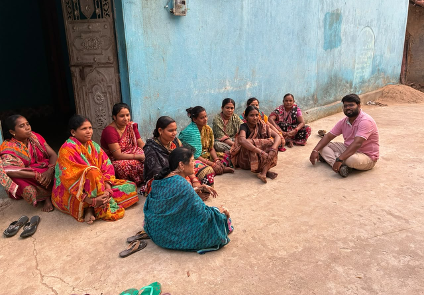
Community meeting with SHG Women
The initiative began with ten women from one self-help group. As word spread, women from neighbouring groups wanted to participate too, bringing the total to 30 women across three groups. With training from the Maleshree Mushroom Unit, whose owner trains farmers for the state government, they learnt to prepare straw beds and introduce mushroom spawn. Within twelve days, the first mushrooms began to appear.
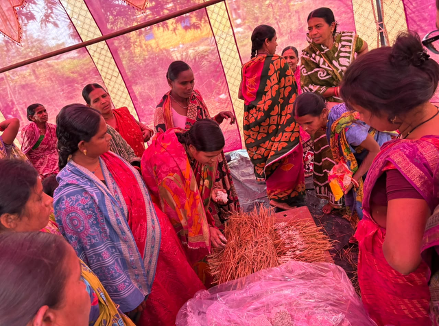
Mushroom Production unit training by Maleshree Mushroom Unit
But the harvest was only part of the change. The initiative gave women an opportunity to develop new skills and demonstrate what they could do. “People who never saw them as capable of this are now watching them do it,” Abani says. As their confidence grows, so does their interest in exploring other activities, from kitchen gardens to fish farming.“It has only just started,” he says. “It will take time, but the change inside people will begin.”
Sabita, Greenovibe’s point of contact at Changelooms, says the pilot was tested by both extreme heat and heavy rains. It also revealed that the women had different ideas about how they wanted to work. Some felt that cultivating mushrooms at home would yield more than sharing a common unit. Greenovibe has accommodated both preferences, allowing women to continue using the shared facility or start growing mushrooms individually. Six women, two from each self-help group, now take the lead in managing the unit. As the initiative expands, they are expected to train other women, helping the model grow through the community itself.
The change in Abani himself is harder to measure. In his earlier jobs, he was a coordinator with five people reporting to him. He was used to pushing work forward, but that approach failed when he began working with villagers. Over time, he began to understand that village life follows its own rhythms. Transplanting, weeding and irrigation each have their season, and any new activity has to find space within the time people have available. He learnt that working with a community required him to change his approach. “If you want to work with the community, you first have to set yourself aside and listen.”
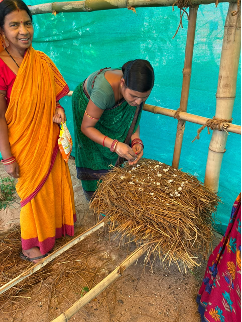
Women with produced Mushroom
Another shift came through birds. During Changelooms’ Delhi sessions, a visit to Asola Bhatti Wildlife Sanctuary introduced Abani to birdwatching. Using apps such as Merlin and eBird, he learnt to identify species and understand how birds can serve as indicators of environmental change. He has been birding ever since. “I used to talk a lot. Now I sit for three or four hours watching birds, without speaking,” he says. He describes himself as calmer and less aggressive than before. In and around his area, he has recorded 98 bird species, adding another to his list recently. Birdwatching has since become an extension of Greenovibe’s conservation work.
Greenovibe now organises birdwatching sessions in schools and communities, helping people understand the role birds play in the local ecosystem. By explaining these relationships, the team hopes to discourage people from hunting them. Villagers have begun alerting Greenovibe when they encounter someone hunting birds, and Abani believes these efforts have helped reduce poaching. The team is also working with the Forest Department to identify birding hotspots, including locations where 20 to 25 species can be spotted during a four-hour watch. A book documenting the area’s birds is also in the works, with Greenovibe contributing to the effort.
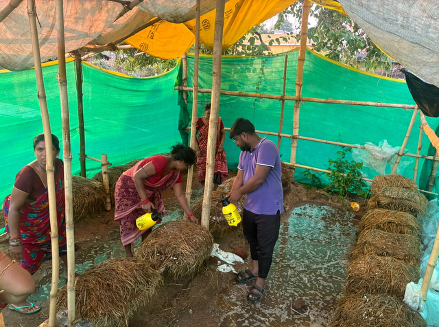
Producing mushrooms
The organisation, meanwhile, has grown alongside its founders. “When we started Greenovibe, we were completely blank,” Abani says. “We were thinking about work, doing it our own way, moving here and there. Now, with guidance received from Changelooms, we have come together in one place.” Greenovibe has since developed an organisational structure with defined roles and reporting lines, expanded its team from three people to eight, and grown its annual budget from ₹1 lakh to ₹5 lakh. Its relationships with government departments have evolved, too. What began with buying plants from nurseries has developed into more regular engagement. The Forest Department has invited the team to Wildlife Week celebrations, the Education Department has worked with it on environmental education in schools, and the panchayat has entrusted Greenovibe with leading its Independence Day programme. The team has also facilitated 25 community consultations, reaching more than 3,000 people. Of the four funding proposals it has submitted so far, one has secured funding. Abani is candid about the work still ahead. “I would not say my confidence is complete yet,” he says, “but it is no longer at zero.”
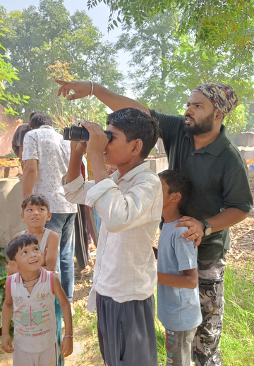
Abani Conducting Bird watch sessions with School Children
Sabita, who co-anchors the programme and has worked with the team for thirteen months, has noticed how consistently women participate. “No matter how many times they are called, they will still show up,” she says. Sachidananda, their mentor, has witnessed a similar evolution, pointing to growth in the team’s vision, strategy, exposure and skills, both individually and across its community and wider network.
Ask Abani what Changelooms has meant to Greenovibe, and he speaks less about a programme than about the relationships it has made possible. For a young organisation, having people to turn to when funding becomes difficult or a decision feels uncertain can matter as much as any formal training. “The speciality of Changelooms is that whoever you meet, it feels like an old friend,” he says. “You can speak openly and in detail.”
Greenovibe’s next step is to take its mushroom cultivation model beyond the village where it began. The team hopes to establish units in neighbouring villages, with six women from the existing initiative trained to teach others. The idea is to make an alternative to stubble burning easier for more communities to adopt, while creating additional livelihood opportunities for women. The team also hopes to deepen its conservation work. Alongside the bird book being developed with the Forest Department, it is exploring work on a Schedule I species, following Sachidananda’s suggestion that the Wildlife Trust of India might be interested in supporting the effort. The proposal remains subject to permission from the Chief Wildlife Warden.
In Sonepur, where summer temperatures can cross 45°C and a heavy monsoon can flatten a bamboo shed, progress is not always straightforward. Greenovibe’s growth has come through a series of small but consequential shifts: from burning straw to growing mushrooms, from asking people to follow a plan to learning to listen, and from seeing birds as part of the landscape to understanding the role they play in sustaining it. The next measure of success may be how far these changes travel - to more women, more villages and, eventually, fewer fields going up in smoke.
Changelooms: Youth Leaders in Climate Action is a 3-year programme to nurture young social entrepreneurs towards prioritising Climate Action as a critical agenda in their respective communities. The programme is collaboratively run with ComMutiny - The Youth Collective, vartaLeap, Dhriiti, Jhini Learning, Pravah, Wild Tales and Bindi International. Greenovibe is a Changeloomer in Cohort 4 of Changelooms: Youth Leaders in Climate Action.