Janaagraha’s partnership with Rainmatter Foundation, commencing in October 2021, enabled targeted initiatives across our work to localise climate action in cities and towns and advance environmental sustainability. During the period April 2024 – March 2025, as a result of our partnership with the Department of Housing and Urban Affairs (DoHUA), Govt. of Assam, we engaged in a State Urban Transformation Agenda in Assam. Concurrently, we aligned and worked with the Rainmatter Foundation by bringing new elements/aspects, and focus areas to our work compared to preceding years. The work evolved into a partnership with DoHUA as the anchor partner on the Doh Shaher Ek Rupayan (DSER) program of the state government. This led to the grant getting foreclosed in March 2025 and renewal of the partnership with the Rainmatter Foundation for a period of 4 years, starting April 2025, as a new grant agreement.
During April–June 2026, the Rainmatter–Janaagraha partnership made important progress in building the institutional chain required to move urban priorities in Assam from planning to investment and, ultimately, implementation.
A key achievement during this quarter was the rollout of the City Investment Framework (CIF), across the remaining nine DSER cities, following a successful pilot in Silchar. The exercise enabled municipalities and relevant line departments to systematically assess, and rank capital expenditure projects identified through the City Action Plans (CAPs) based on impact, affordability, sustainability, and implementation readiness. The process resulted in a prioritised list of projects for each city, supporting investment planning at both the city and state levels.
To build partnerships under DSER, a consultation workshop with the National Faecal Sludge and Septage Management (NFSSM) Alliance was convened at Janaagraha’s Bengaluru office to discuss Assam’s sanitation reform pathway and the role of the Alliance in developing the roadmap for the same. The workshop brought together key sectoral organisations to deliberate on collaborative approaches for strengthening faecal sludge and septage management systems across the state.
Under the Councillor Leadership Development Programme (CLDP), a Champion Councillor baseline assessment was conducted with the women councillors of Nalbari. The assessment was undertaken to understand leadership priorities, governance challenges, and mentoring needs, thereby laying the foundation for targeted capacity-building and leadership development interventions under CLDP Assam.
The next quarter will focus on scaling the Councillor Leadership Development Programme across the nine DSER cities that have councils, conducting C-STEP partnership consultations in Silchar and Dibrugarh, and convening a state-level NFSSM Alliance workshop. The central task will be to ensure that the frameworks developed so far begin to operate as one connected system.
Highlights of the quarter:
1. City Action Plans
The process of creating City Action Plan in Nalbari had to be paused owing to Assam Assembly election. Once the process was over and new government was formed, the city resumed the process of conducting the final Municipal Planning Committee (MPC) meeting during the quarter. The City Action Plan for Nalbari is under review by the ULB and will be finalised once approved by the Council.
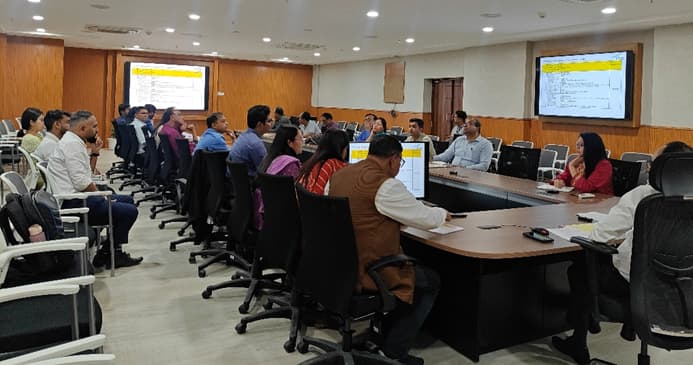
Image 1: Final MPC meeting in Nalbari under CAP
2. City Investment Framework
As a part of the City Investment Framework (CIF), based on the feedback received from the Silchar pilot, the assessment parameters were revised, particularly in terms of weightages, to improve the robustness and applicability of the framework. Following which, prioritisation of capital-intensive infrastructure projects were undertaken in the 9 cities under the DSER programme. The exercise enabled municipal officials and relevant line departments to assess capital expenditure projects identified through the CAPs using the project prioritisation framework, with criteria including impact, affordability, sustainability, and implementation readiness. The prioritised list was then reviewed by the municipal council to align the same with the priorities of the council. This exercise resulted in a prioritised list of capital expenditure projects for each city, which can serve as a basis for funding decisions and project uptake at both the city and state levels.
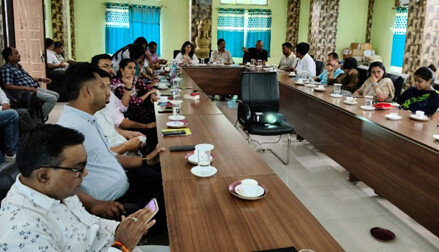

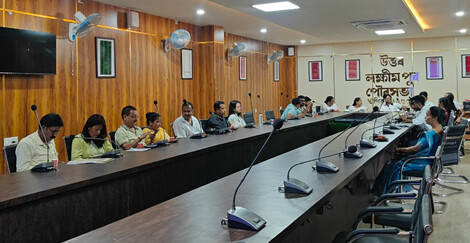

Images 2, 3, 4 and 5: CIF rollout in DSER cities
3. Monitoring and Review Mechanism for Municipalities
Another key component of the ongoing DSER engagement is the development of the DSER Review and Monitoring Mechanism. With CAPs prepared under DSER, the next step is to ensure effective implementation through a structured monitoring and review framework. This mechanism aims to support their effective implementation through a structured review framework at the ULB level. It is intended to strengthen governance and accountability, enable data-driven decision-making, and create feedback loops between state-level programme management and city-level implementation for timely course correction.
The review system is based on the metrics developed prior to assess city-level progress across DSER components. The review mechanism was presented to the DoHUA for its approval.
4. Partnership under DSER
A consultation workshop with the National Faecal Sludge and Septage Management (NFSSM) Alliance, one of the partners under DSER, was held at Janaagraha’s Bengaluru office to discuss the Alliance’s engagement in Assam and the sanitation reform pathway for the state. The workshop was organized by Janaagraha with support of Dasra, and had participants from the Foundation of Inclusive and Sustainable Habitat (FISH), Centre for Science and Environment (CSE), the WASH Institute (WASHi), Consortium for DEWATS Dissemination (CDD), CWAS/ CEPT, and Dasra. Discussions focused around the current challenges on Sanitation in Assam derived through the City Action Plans and suggestions from the government departments, support that the alliance can provide under the DSER programme and a roadmap for the state on sanitation sector. The discussion also included the timeline for each intervention, and collaborative actions required to strengthen sanitation systems.
Saahas has been working in select wards of the DSER city of Jorhat for the last two years through a partnership with the district administration. As a part of the DSER programme, Saahas has increased their coverage to all the wards of Jorhat city and started their operation in Nalbari, another city under the DSER programme. The organisation has been working closely with the ULBs to improve service delivery in the city’s solid waste management system.
Following the signing of the Memorandum of Understanding (MoU) between C-STEP and the Directorate of Town and Country Planning (T&CP), Government of Assam, a state-level consultation meeting was convened with representatives from C-STEP, T&CP, and Janaagraha. Representatives from C-STEP shared the plans and expected outcomes from the partnership at the end of two years, along with list of interventions in the selected cities of Silchar and Dibrugarh. This included the scope of work and implementation approach for the proposed climate resilience and urban planning activities. During the meeting, a city level convergence meeting was planned with the Municipal Planning Committees of the two cities to understand the city level needs and challenges and share C-STEP’s objective for the partnership.
5. Other work strands
Public Finance management (PFM)
Engagements with the Directorate of Municipal Administration (DMA) focused on finalising a one-year roadmap for the Finance & Accounts module, while supporting the planned migration of the UPYOG platform to the State Data Centre (SDC) by DoHUA and the System Integrator (SI) team.
Under the Budget Module, a Standard Operating Procedure (SOP) was developed to support ULBs in transitioning to function-based budgeting in line with the Assam Municipal Budget Manual (AMBM). Coordination was also undertaken with the SI team and NUDM for the development of a state-level login for the budget module.
Supported DoHUA in undertaking a comprehensive assessment of the state’s performance under the 15th FC, analysing the evolving urban finance landscape, and identifying key reforms required to strengthen ULB access to performance-based grants. Based on this analysis, supported DoHUA in drafting recommendations to the Ministry of Housing and Urban Affairs (MoHUA) on the 16th FC operational guidelines, incorporating state-specific considerations related to fiscal reforms, grant design, implementation timelines, and institutional capacity to improve the effectiveness and uptake of the Commission’s recommendations.
In addition, Janaagraha supported DoHUA and DMA in developing state-level implementation guidelines for the Urban Challenge Fund (UCF), contextualising the national guidelines for the state’s institutional and financing environment. The same mandates projects for UCF to be selected from the CAP shelf of projects in DSER cities and recommends cities having 50,000+ population to follow the CAP approach to create a shelf of projects.