Hello everyone!
This is our first update.
About Us
Kalpavriksh Environmental Action Group
Founded in 1979, Kalpavriksh is a non-governmental organisation engaged in environmental education, research, campaigns and direct action. Rooted in ecological sustainability and social equity, its work spans Alternatives, Environment Education and Conservation & Livelihoods.
Vikalp Sangam (Alternatives Confluence)
Vikalp Sangam is a collective process involving 90+ movements and organisations working towards grounded alternatives to current development models based on ecological destruction and inequality. The process facilitates documentation, outreach, gatherings and policy advocacy for a just and ecologically conscious society.
Project Overview
The project focuses on:
-
Creation of Alternatives Courses in multiple formats (online, institutional and in-person) to disseminate frameworks and practices for transformative development.
-
Establishment of Alternatives Decentres, physical hubs that document, share and incubate community-driven engagement.
Objective:
To build a collaborative ecosystem of institutions and transformation enablers that nurture co-learning, dignified livelihoods, democratic processes and climate-resilient responses to multiple, intersecting crises.
Ongoings
- Alternatives Decentres
Milestone - Identification of 2 Decentre Partners
Progress & Outcomes -
- Himalayan Institute of Alternative Learning HIAL (Ladakh): Visit completed; MoU at drafting stage.
- Sambhaavnaa Institute (Himachal Pradesh): Co-visioning note mutually agreed; site visit scheduled; MoU to follow.
- Preliminary outreach initiated with Timbuktu Collective (Andhra Pradesh).
- Alternatives Courses
Milestone - Formation of Working Group
Progress & Outcomes
TALC (The Alternatives Learning Collective) formed with 25–30 members representing education and community institutions. Holds monthly meetings. (Annex: List of Members)
Milestone - Course Framework & Resources Developed
Progress & Outcomes
- Preliminary course template/concept note created based on Vikalp Sangam learnings.
- Resource documentation and Ethics guidelines drafted (living documents under revision).
- Sub-group to continue focus on online courses
- Two universities currently in discussion to integrate the course.
- In-Person Course
Milestone - Partner Finalisation
Progress & Outcomes
- Sambhaavnaa Institute identified as host for a 1–2 week residential course in early 2026, aligned with their natural building work. Discussions underway to embed FOT (Flower of Transformation) from VS Framework as an analytical and action tool.
Performance Indicators
| Indicator |
|
Current Status |
| Partner Decentres Contacted |
|
3 contacted (HIAL, Sambhaavnaa, Timbuktu - preliminary outreach) |
| Formal MoUs |
|
1 in drafting (HIAL); 1 upcoming after visit (Sambhaavnaa) |
| TALC Group Meetings |
|
3 completed |
|
|
|
Constraints & Mitigation
| Challenge |
Impact |
Mitigation |
| Correspondence with HIAL slow |
MOU finalization may take time |
We will continue correspondence towards finalisation of MOU; if it is seeming difficult this year, we will consider choosing another potential decentre |
|
|
|
Planned Activities for Next Quarter
-
Finalise and sign MoU with HIAL, complete visit and MoU with Sambhaavnaa.
-
Conduct exploratory call with Timbuktu Collective
-
Draft detailed concept note for in-person course (2026).
-
Continue inputs to institutions designing alternatives courses as part of TALC forum.
3rd Quarter Update - January, February, March 2026
1. Alternatives Decentres
A. Deccan Development Society (DDS)
- Collaboration advancing with DDS, Centre for Sustainable Agriculture (CSA); MOU likely to formalize roles across training, content and platform use.
- Grameen Academy (CSA-run) to host low-cost courses; need to simplify and adapt content (not just translate) into Telugu/Hindi.
- Facilitator training planned for this year; two-step, interactive model with multilingual core group.
- Training focus: Flower of Transformation, rights, governance, interspecies justice within Vikalp Sangam (VS) framework.
- “Livelihood Park” at DDS proposed as a skilling, enterprise and demonstration hub; early-stage but aligned with long-term rural transformation goals.
B. Desert Resource Centre (DRC)
- An exploratory discussion happened with the Desert Resource Centre (DRC) in January.
- DRC is a potential DeCentre within the Vikalp Sangam ecosystem, rooted in desert bioregions. The campus is located in Bajju village, Bikaner.
- Positioned as a knowledge and immersion hub linking land, life and living systems.
- Can anchor place-based learning through seasonal, long-term immersion in desert contexts.
- Strong fit with DeCentre philosophy: decentralization, community ownership and alternatives thinking.
- Opportunity to host fellows and yatras across desert ecosystems and partner regions.
- Could lead documentation and synthesis of desert knowledge systems and practices.
- Potential role in building bioregional knowledge within DeCentres network.
- Can catalyze desert-focused convenings and transnational exchanges.
- A visioning document is in progress
C. Timbaktu Collective (TC)
- An initial exploratory conversation took place at the Timbaktu campus in January when the Kalpavriksh team visited there.
- The team is currently reflecting internally on their capacity and potential role in the project, and will share an update once they’ve had the space to consider this further.
D. Himalayan Institute of Alternatives Leaning (HIAL)
- MOU shared with them
- Awaiting confirmation from HIAL
E. Sambhaavnaa Institute
- After some initial discussions, it seems this collaboration may not work out.
2. Alternatives Courses
A. In person Course
- A 5-day residential course on Designing for Life in Urban India: An Introduction to Ecological Responses to the Metacrisis was held from 3rd-7th April at the Sambhaavnaa Institute campus
- Organised by Kalpavriksh in collaboration with Sambhaavnaa Institute. Co-created by a subgroup of The Alternatives Learning Collective under the Vikalp Sangam process
- The course brought together 28 participants to explore ecological design as a response to interconnected urban crises through the lens of the metacrisis
- Examined food, energy, governance and care systems as regenerative and life-affirming
- Included talks, discussions, films, embodied practices, a walk to a hydropower plant and creative reflections
- Engaged with frameworks like the Flower of Transformation and grounded alternatives
- Focused on nurturing ecological relationships, ethical clarity and collective imagination
- Supported participants in translating insights into meaningful action and building community
- A detailed report is currently in progress and will be shared soon
B. Online Course
- Urban ecology course concept taking shape; builds on previous course with a focused theme
- Hybrid format finalized: online sessions + city-based experiential learning
- Tentative schedule for the course set for mid-November to mid-December 2026
- Session structure improved (weekday + Saturday) to boost engagement
- Concept note, resource mapping and facilitator identification underway
- Immediate focus: finalize concept, secure coordination and initiate funding outreach
C. TALC (The Alternatives Learning Collective)
- The collective met in January 2026, and discussed the possibility of having a facilitation team. But recent attempts to schedule TALC meetings have faced low availability and engagement.
- Core members emphasized the need for collective clarity (especially for future direction and funding), and we aim to re-initiate efforts soon after gauging members’ current levels of interest and availability.
Hello everyone!
Sharing our Q4 update for April, May, June 2026
1. Alternatives Decentres
A. Himalayan Institute of Alternatives Learning (HIAL)
- Our team had an online meeting with the HIAL team on 9th June 2026 to sense into opportunities for collaboration.
- This year, HIAL is offering two fellowships- HELM (designed like an internship) and the Social and Political Leadership, a eleven-month fellowship.The Social and Political Leadership fellowship will be grounded in Indian knowledge systems (with a critical lens). As the Kalpavriksh team has experience documenting and studying governance systems, we can curate resources and design a module/session on governance from non-Western perspectives, sharing stories of communities from the global south. Case studies on empowering panchayats and work on the goba/nambardari system will also be integrated into the course.
- HIAL and Kalpavriksh team are reviewing the MoU proposal and will finalise and sign it in July.
B. Deccan Development Society (DDS)
- Our team will be meeting with the DDS team in mid-July to follow up with proposed activities including offering facilitator training, hosting courses on the Grameen Academy and offering relevant support towards the Livelihood Park project (see 3rd quarter update for more details).
2. Alternatives Courses
A. In person Course
- A detailed report on the course has been created by the organizing team. It includes information about the range of sessions during the five-day course; the methodology and pedagogy; learnings and feedback for future courses. The report is available here.
B. Online Course
- The group discussed designing an 8-session online Urban Ecology course that builds on previous “Pluriverse of Alternatives” learning journeys and responds to participants’ request for urban-focused alternatives.
- A strong emphasis emerged on experiential, heart- and hands-based pedagogy through walks, local explorations, reflection spaces, and participant-led engagement rather than lecture-heavy teaching.
- The group highlighted the need to balance emotional and social justice perspectives with ecological science, systems thinking, governance, and practical frameworks for action.
- Key themes proposed included waste and circularity, water systems, public health, governance, social justice, informal settlements, and human–non-human relationships in cities.
- The group agreed the course should move beyond critique to showcase real alternatives, agency, advocacy pathways, and practical urban transformation approaches.
- Immediate next steps include drafting the concept note, creating a session matrix and timeline toward a November launch, and identifying facilitators, themes, and pedagogical flow.
C. TALC (The Alternatives Learning Collective)
- Welcoming the new TALC coordinator, Anushka Kale, who will be stepping into this role as Chaitali (previous coordinator) is on maternity leave until May 2027.
- Multiple institutions including National Law School of India University and Ashoka Trust for Research in Ecology and the Environment expressed interest in collaborating on experiential, field-based sustainability education beyond conventional credential-driven models.
- Discussions emphasized developing grounded ecological learning through immersion, community engagement, transdisciplinary pedagogy, and learning with practitioners, farmers, pastoralists, and craftspeople.
- Members shared updates on several initiatives including an online urban ecology module, a decolonial conservation course, the relaunch of “Earth & Us,” and ecological learning programs with schools.
- A strong focus emerged on building meaningful ecological livelihoods for young people, alongside proposals to strengthen TALC as a collaborative learning network through documentation, storytelling, partnerships, and a potential webpage/platform.
- The group reflected on TALC’s future direction amid funding uncertainty and declining participation. Discussions beginning around sustainable coordination and alternative funding models.
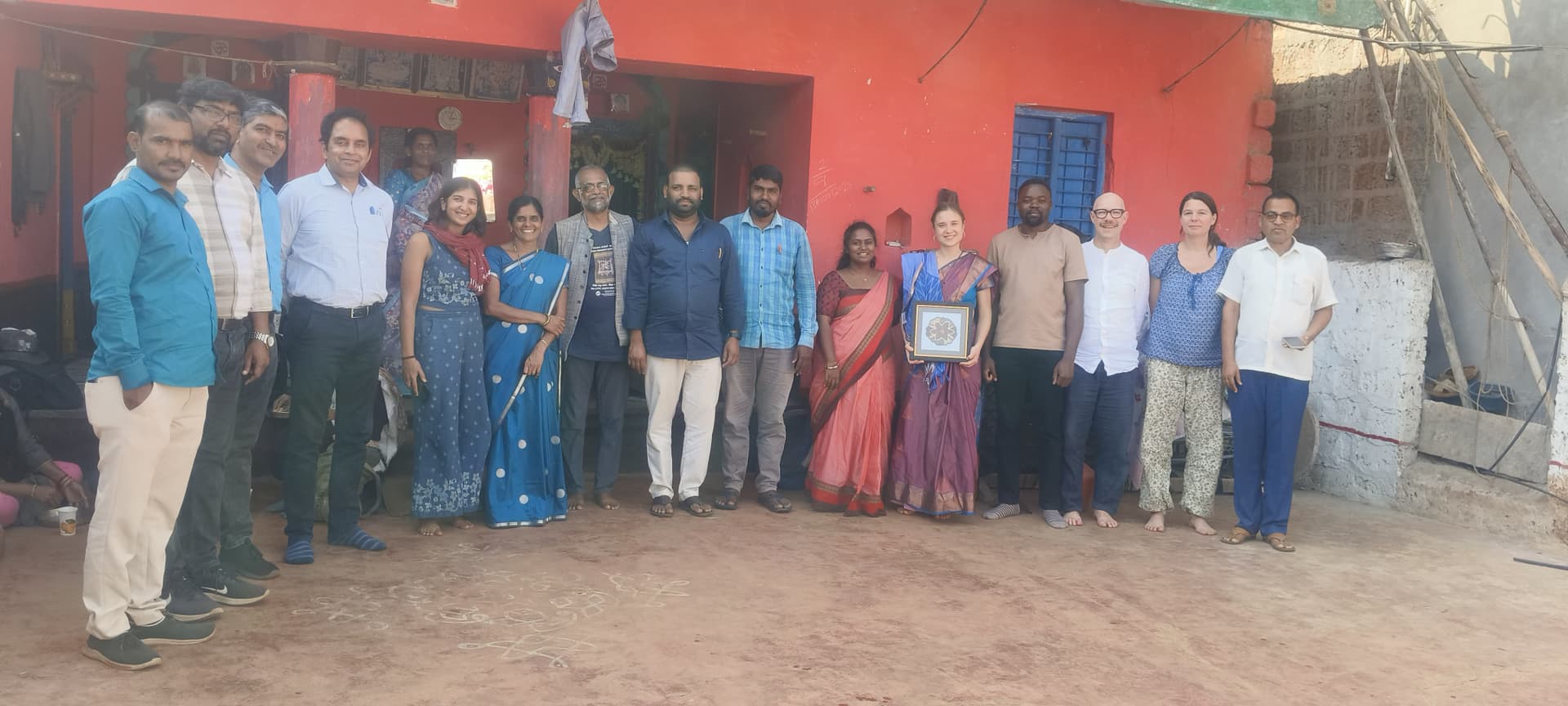
‘Designing for Life in Urban India’ course cohort at Sambhaavnaa Institute. 7 April 2026