At Janaagraha Centre for Citizenship and Democracy, our recent work brings together research, partnerships, and on-ground initiatives to strengthen how cities are financed, governed, and experienced by citizens. From unpacking national fiscal reforms and state-level budget trends to advancing civic learning and inclusion, these efforts reflect our continued focus on building more accountable, capable, and responsive urban systems across India.
Read on to explore some of our recent work.
1. Janaagraha’s Analysis of XVI Finance Commission Grants for Urban India
The Sixteenth Finance Commission—and the unprecedented allocations to Urban Local Governments—has been the conversation of the moment. For experts, emerging urban practitioners, and policy students alike, it offers a real-time opportunity to examine how fiscal frameworks translate into change on the ground.
In our national webinar held on February 25, “Understanding the XVI Finance Commission’s Urban Grants: Implications, Reforms, and Implementation Pathways”, around 1,700 participants joined our panellists and speakers to unpack what this shift means in practice.
The discussion underscored that while the scale of funding is historic, the real challenge lies in strengthening institutional capacity, improving project planning frameworks, ensuring transparency, and aligning grants with local priorities and measurable outcomes.
Speakers included:
-
Soumya Kanti Ghosh, Member, XVI Finance Commission
-
D Thara, Ministry of Housing and Urban Affairs
-
SM Vijayanand, Former Chief Secretary, Government of Kerala; Chairperson, Kerala’s Sixth State Finance Commission
-
Nitin Kareer, Former Chief Secretary, Government of Maharashtra; Chairperson, Maharashtra’s Sixth State Finance Commission
-
Astha Agarwal, Chairperson, Pilibhit Municipality
-
Tikender Panwar, Former Deputy Mayor, Shimla Municipal Corporation
-
Avani Kapur, Founder Director, Foundation for Responsive Governance
The session was moderated by Prabhat Kumar, Director – Public Finance, Janaagraha.
Watch the webinar: Link
Read our analysis: Link
2. Pre-Budget Analysis: Odisha’s Urban Development Financing
Ahead of the FY 2026–27 budget, Janaagraha Centre for Citizenship and Democracy has released a pre-budget brief examining trends in the budgetary allocations of the Housing and Urban Development Department (HUDD) in Odisha from FY 2019–20 to FY 2025–26.
The brief analyses patterns across state and centrally sponsored schemes, fund flows, the role of parastatals and Urban Local Governments in service delivery, and emerging practices in fiscal reporting and transparency. As most public financing for urban areas is routed through HUDD, the department’s budget offers a comprehensive view of the state’s evolving priorities in urban development.
Our analysis finds that the growth in HUDD’s budget has been largely driven by schematic expenditure, particularly state schemes. While overall budget credibility remains strong, greater visibility is needed on how funds flow across implementing agencies, including parastatals and Urban Local Governments.
As the next budget cycle approaches, the brief highlights the need to move beyond tracking allocations toward understanding outputs, improving transparency in fund flows, and enabling more granular reporting to better assess sectoral priorities within schemes.
Janaagraha continues to partner with the Housing and Urban Development Department (HUDD), Government of Odisha, to advance the state’s urban transformation agenda under the Atal Network for Knowledge, Urbanisation and Reform (ANKUR).
3. Strengthening Civic Learning: Kurukshetra MoU
Janaagraha Centre for Citizenship and Democracy has signed a two-year MoU with the Kurukshetra District Administration, the Department of Education, and the District Institute of Education and Training.
What began as a pilot to strengthen civic learning in select government schools has, over three years, evolved into a district-owned model embedded within Kurukshetra’s government school system.
With the support of 350 educators, civic learning has moved beyond textbooks into classrooms, Bal Sabhas, neighbourhoods, and conversations with local government institutions. Since 2022, through the Civic and Social Action Programme (CSAP), 23,800 students have led more than 180 projects on water conservation, waste management, climate change, health, and gender inequality.
The programme demonstrates a model for institutionalising civic education through curriculum integration, teacher capacity building, district leadership, and sustained community partnership.
Read more in CSAP’s 2022–2025 impact report: Link
4. Women in Public Finance
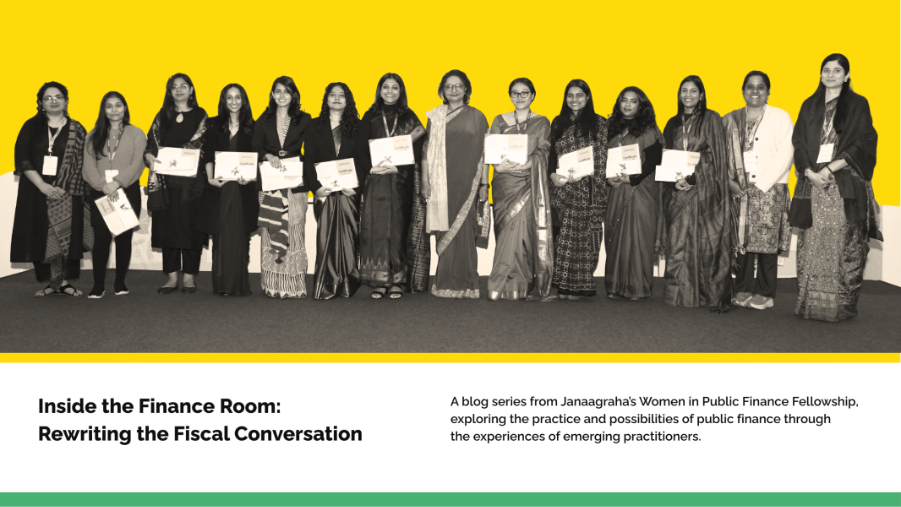
This Women’s Day (and everyday), we celebrate communities and spaces that help our cities become more inclusive. Through the Women in Public Finance (WPF) Fellowship, a new generation of women is stepping into public reform, working with governments to strengthen the institutions and financial systems that underpin our cities.
Read more: Link to Article