December 5th and 16th: WRI India assists JSCL in land demarcation process for Kala Sanghian Drain Rejuvenation- Phase II

WRI India team and JSCL officers discussing key issues and requirements with Nurpur panchayat members

Vision plan for the site of Nurpur Pond
In providing continued support to Kala Sanghain Drain Rejuvenation process, the WRI India team assisted JSCL during the ongoing land demarcation exercise site visits. With the canal boundary demarcated, the next phase of the rejuvenation process focuses on enhancing the integration of blue-green infrastructure and developing potential public spaces along the drain. For demarcated stretch under this Smart City mission project, four potential sites have been identified, with two prominent sites—Nurpur Pond and Kalia Colony—being advanced by JSCL for further development.
Our team visited the Nurpur pond site with JSCL officials and Panchayat members from the Nurpur village in order to understand the local context and current condition of the site. While a basic conceptual vision was developed to facilitate these conversations, JSCL has kickstarted the process for DPR prep for the site. Additionally, a field visit to Kalia Colony has been conducted to take site measurements and draft plans for a recreational park that will include spaces for non-motorized transport (cycling and walking), while also exploring opportunities to incorporate nature-based solutions (NBS) into the drain’s design.
10th-13th December: Internal team Workshop for streamlining Existing Situation & Land Suitability Analysis for Bodoland Territorial Region


Internal team workshop to discuss insights from Existing Situation Analysis & streamlining Land Suitability Analysis model
Our team recently conducted a weeklong internal workshop and brainstorming sessions to analyze the existing situation in Bodoland, focusing on baselines and sectoral challenges across governance structures, financing mechanisms, regional connectivity, economy and livelihood, food and agriculture, cultural landscape and terrestrial ecosystems, climate vulnerabilities, housing, social development, and urban design. These workshops enabled the team to delve deeply into Bodoland’s unique characteristics, developing a comprehensive understanding of its sectoral strengths and challenges. The discussions centered on streamlining a dedicated Land Suitability Analysis by integrating thematic insights with spatial analytics. Next steps for preparing collaborative workshops with the Bodoland Territorial Council (BTC) were outlined.
December 16th: WRI India Felicitated by Bodoland Territorial Region Government on Fourth Anniversary for Contributions to Sustainable Development


WRI India, represented by Michael Islary, felicitated during the fourth-anniversary celebration of the Bodoland Territorial Region (BTR) in Kokrajhar
The government of the Bodoland Territorial Region (BTR) celebrated its fourth anniversary on Sunday with a grand event in Kokrajhar that highlighted the contributions of individuals and organizations toward the region’s development.
As part of the celebration, WRI India was felicitated by the BTR government for its dedicated efforts toward fostering sustainable growth and development in the region. Representing WRI India, Michael Islary, from the Thriving Eco-City Regions initiative, accepted the recognition on behalf of the organization. The honor underscored WRI India’s pivotal role in supporting sustainable regional planning in Bodoland.
During the event, the BTR government also expressed gratitude to various development partners for their contributions to the region’s progress. Among the organizations felicitated were Agastya International Foundation, Azim Premji University, Vyomika Space Academy (VSA), SELCO Foundation, THF India, CINI, CEGIS, UNICEF India, Bharat Rural Livelihoods Foundation, TRI, CRISP, ARIAS Society, CSB, Shishu Sarothi, KHPT, Piramal Foundation, Janaagraha, Symbiotic Food Pvt. Ltd., KILA, Sunbird Trust, Assam Veterinary College, NAFPO, DCAC, PUM, and the College of Horticulture & FSR, Nalbari.
December 19th: Subzar Bashir from the Thriving Eco City-regions team writes on ‘Regional Planning for Climate Vulnerable Geographies: Understanding the Case of Kashmir Valley’

Subzar Bashir published a blog on the challenges of urbanization in the Kashmir Valley, focusing on the region’s unique geographical and ecological constraints. With Srinagar at its heart, the valley has historically relied on agriculture and its waterways. However, rapid urban expansion, unplanned land use, and increasing flood risks over time have changed settlement density and patterns, highlighting the urgent need for sustainable urban planning. Subzar emphasized the importance of integrating ecological considerations into the planning process to preserve the region’s fragile environment while fostering balanced economic growth. The blog urges for a Regional Planning Framework that considers climate vulnerabilities, especially in the face of the region’s changing weather patterns and the loss of vital wetlands.
December 19th and 23rd: WRI India Team Meets with State PMU (IQVIA) to Review Progress on Akankshi Nagar Yojana (Aspirational Cities)
On 19th and 23rd December 2024, the State PMU (IQVIA) convened a review meeting led by the Deputy Director of DULB Lucknow, bringing together all knowledge partners, including WRI India, to present updates on the Akankshi Nagar Yojana (Aspirational Cities) initiative. During the meeting, WRI India presented its progress on the “UP Handbook: Illustrated Best Practices on Urban Services for Small Cities,” highlighting the status and actions undertaken. Key discussions focused on the findings from the perception survey, addressing issues, challenges, and opportunities in the urban service scenario within smaller cities, particularly the aspirational towns of Uttar Pradesh.
24th December: WRI India Requested by MCJ as Knowledge Partner to Facilitate Collaboration with Saahas on Solid Waste Management Initiatives
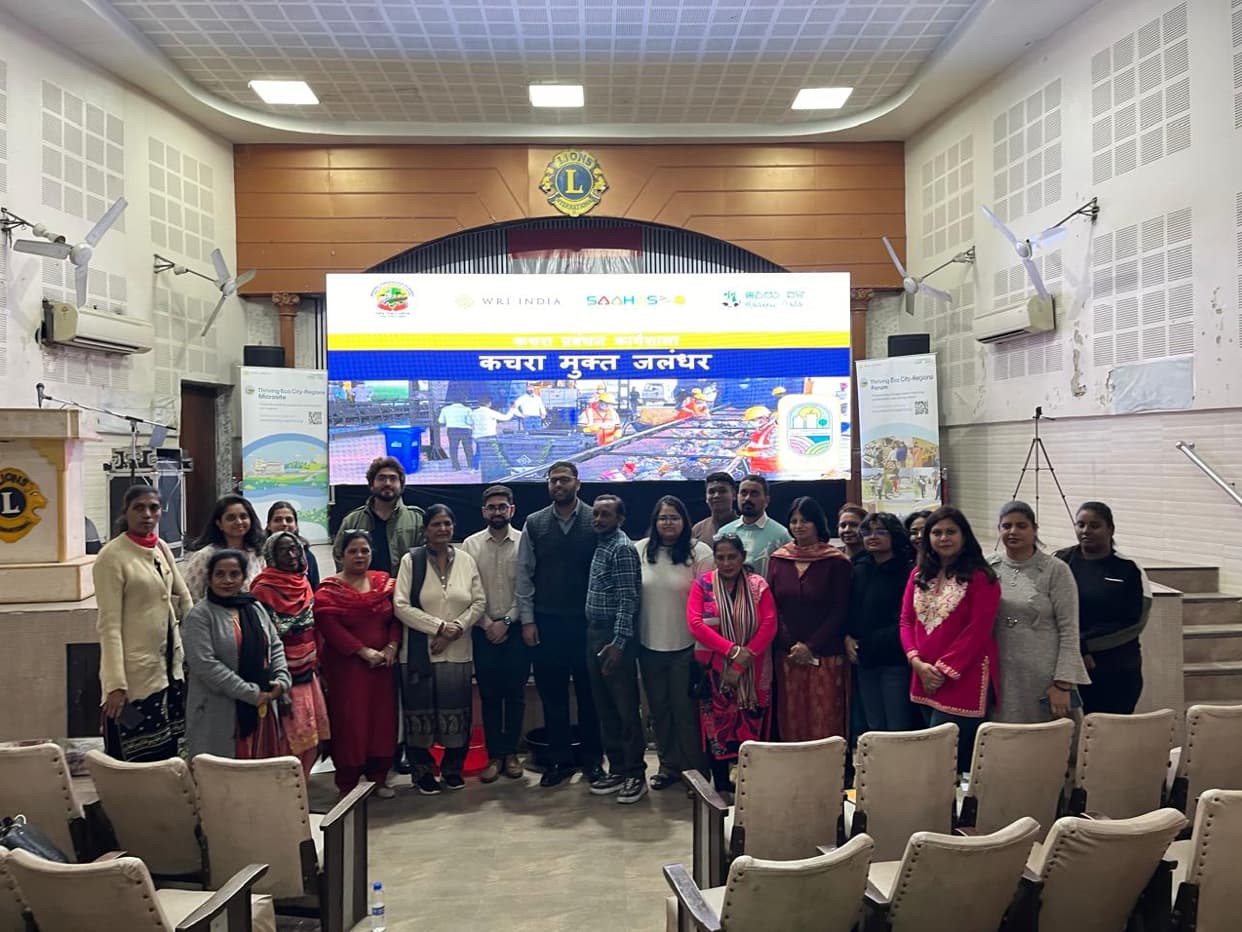
Municipal Commissioner, Mr. Gautam Jain (IAS) with SWM workshop team from WRI India, Saahas and Hasiru Dala along with Health Department officials and Community workers in Jalandhar
Municipal Corporation Jalandhar (MCJ) extended gratitude to the team at WRI India for organizing the recent Solid Waste Management (SWM) Capacity Building Workshops in November 2024, under the aegis of the ECR Forum.
Following the successful workshop, MCJ has invited Saahas to collaborate on enhancing SWM infrastructure planning and develop implementation guidelines that foster a circular economy in Jalandhar. The proposed collaboration can aid in conducting land suitability analyses for SWM infrastructure, including Material Recovery Facilities (MRF) and transfer stations; route mapping and optimization for MSW collection vehicles; drafting proposals and policies for efficient waste disposal; performing feasibility checks for the shared action plan; and exploring additional interventions as necessary. This development is a crucial win towards nudging city-regions in adopting eco city-region based approaches in their outlook and implementation and making strides towards extending their capacity and institutional arrangements.