4th-9th November: WRI India team conducts a field visit to Bodoland to support co-creation of the Regional Spatial Strategy (RSS) process for Bodoland Territorial Region (BTR)

The Thriving Eco City-Regions team engaged with key leaders driving ecological conservation efforts in the region

The team engaged with the Manas Maozigendri Ecotourism Society (MNES) to explore ongoing ecotourism initiatives and future opportunities

To understand the region’s economy and livelihoods, the team visited families involved in sericulture, practicing it at a household level

The team also engaged with key government officials from relevant departments to support the co-creation of the regional spatial strategy for the area
In early November, the WRI India team visited Bodoland to collect on-ground data and deepen our understanding of the region’s economy, ecosystems, and communities. As part of the Thriving Eco City-Regions initiative, the team is working to shape a regional spatial strategy for Bodoland, aiming to enhance ecological resilience, foster a thriving economic landscape, and improve social well-being.
During the visit, the team engaged with a wide range of stakeholders, including government officials and local community members. Interactions revealed how community-based organizations near Manas National Park are driving conservation efforts, engaging youth in ecotourism, and strengthening livelihoods. Conversations with agriculture specialists and cooperatives shed light on indigenous inter-cropping and climate-sensitive farming techniques, while insights into the sericulture value chain—from silkworm rearing to fabric production—underscored the region’s rich cultural and economic fabric. In Boldi village, Chirang, we observed the labor-intensive silk production process at the household level, showcasing how traditional techniques bring communities together through shared livelihoods. The team also gained valuable knowledge of local governance and development initiatives through discussions with officials and members of line departments from the Bodoland Territorial Council (BTC).
15th-16th November: WRI India takes part in the first Bodoland Mohotsav in Delhi

Celebrating the vibrant culture, heritage, and tourism potential of Bodoland at the 1st Bodoland Mohotsav in Delhi

Key leaders including PM Shri Narendra Modi inaugurating First Bodoland Mohotsav
WRI India’s Thriving Eco-City Regions team attended the 1st Bodoland Mohotsav, a two-day mega event celebrating the local language, literature, and cultural practices that make up a vibrant Bodo society. The event was conducted on November 15-16, 2024 in New Delhi. Attended by PM Shri. Narendra Modi, CEM Shri Pramod Bodo and several key national and regional leaders, the festival marked a historic moment for the region, reflecting the transformative impact of the 2020 Bodo Peace Accord. With a theme of “Peace and Harmony for Prosperous Bharat,” the event showcased the region’s cultural and ecological richness through exhibitions and sessions on Bodo art, literature, and traditions.
Highlights included discussions on promoting mother tongue education under the National Education Policy 2020, strategies for leveraging culture and tourism to build a vibrant Bodoland, and exhibitions of GI-tagged crafts like Aronai and Dokhona. The festival celebrated the integration of indigenous communities across Assam, West Bengal, and beyond, while emphasizing the potential of Bodoland’s biodiversity and tourism to drive sustainable development and prosperity.
19-20th November: WRI India Conducted a two-day Workshop on Solid Waste Management in Jalandhar with Municipal Corporation of Jalandhar (MCJ)

WRI India team with urban local body Officials from Health Department, MCJ

MCJ Commissioner inspecting protective gear demonstrated by Hasiru Dala to Capacity Build the Informal Waste Workers
WRI India, in collaboration with Municipal Corporation of Jalandgar, organized a two-day workshop on sustainable solid waste management (SWM). The event was attended by over 250 participants, including health and sanitation officials, informal waste workers, safai karamcharis, and community motivators. Sectoral experts from Saahas and Hasiru Dala led sessions, providing actionable insights and fostering discussions on integrated SWM solutions.
Key sessions included:
-
Sustainable SWM Frameworks for Cities by Sonia Garga, focusing on building efficiency and alignment with national goals.
-
Inclusive Systems for SWM by Nalini Shekar, sharing Bangalore’s experience in integrating informal waste workers.
-
Health, Safety, and Disease-Free SWM Practices by Hasiru Dala, with a focus on personal protective equipment (PPE), union building, and microfinance opportunities.
-
Best Practices in Health and Safety by Saahas, with interactive waste segregation games for safai karamcharis.
The workshop led to notable outcomes, including a directive from the Commissioner to procure safety gear for ground-level SWM workers and catalyzed efforts to clean and rejuvenate Nurpur Pond. These initiatives highlight the vital link between waste and water management in fostering sustainable urban development.
This workshop marks the inaugural event of the Eco-City Regions Forum, furthering collaborative efforts to transition Jalandhar into a thriving eco-city region. For more details, visit www.ecocityregions.org/forum.
20th November: WRI India team visits Nurpur pond for site analysis, engages with stakeholders


WRI India team visited the pond near Bulandpur and Nurpur villages as the land demarcation process was ongoing and interacted with JSCL officials, horticulture specialists and Panchayat members to explore the needs of the local communities and understand their challenges and aspirations for the location. Through the visit, the team also noted the presence of multiple insect and bird species which were nested in and around the pond site. The insights helped in developing ideas for concept designs and adding momentum for next steps on government end.
21st November: WRI India Attends THINC: CITIES Seminar in Lucknow

WRI India participated in the sixth edition of The Indian Express’s THINC: CITIES seminar series, presented by Omidyar Network India, held in Lucknow on Thursday.
The seminar featured a keynote address by Amrit Abhijat, Principal Secretary, Urban Development Department, Government of Uttar Pradesh. This was followed by a panel discussion with speakers including Paramjeet Chawla (Program Manager and Urban Economist, WRI India), Bornali Bhandari (Professor, National Council of Applied Economic Research), Geeta Thatra (Associate Director, Research and Training, Work Fair and Free), and Smita Agarwal (Chairperson, CII Uttar Pradesh).
The discussions focused on urban development, skill enhancement for youth, and strategies for addressing employment challenges in Uttar Pradesh.
28th November: WRI India Submits the Existing Situation Analysis (ESA) Report to Tamil Nadu State Planning Commission (SPC)

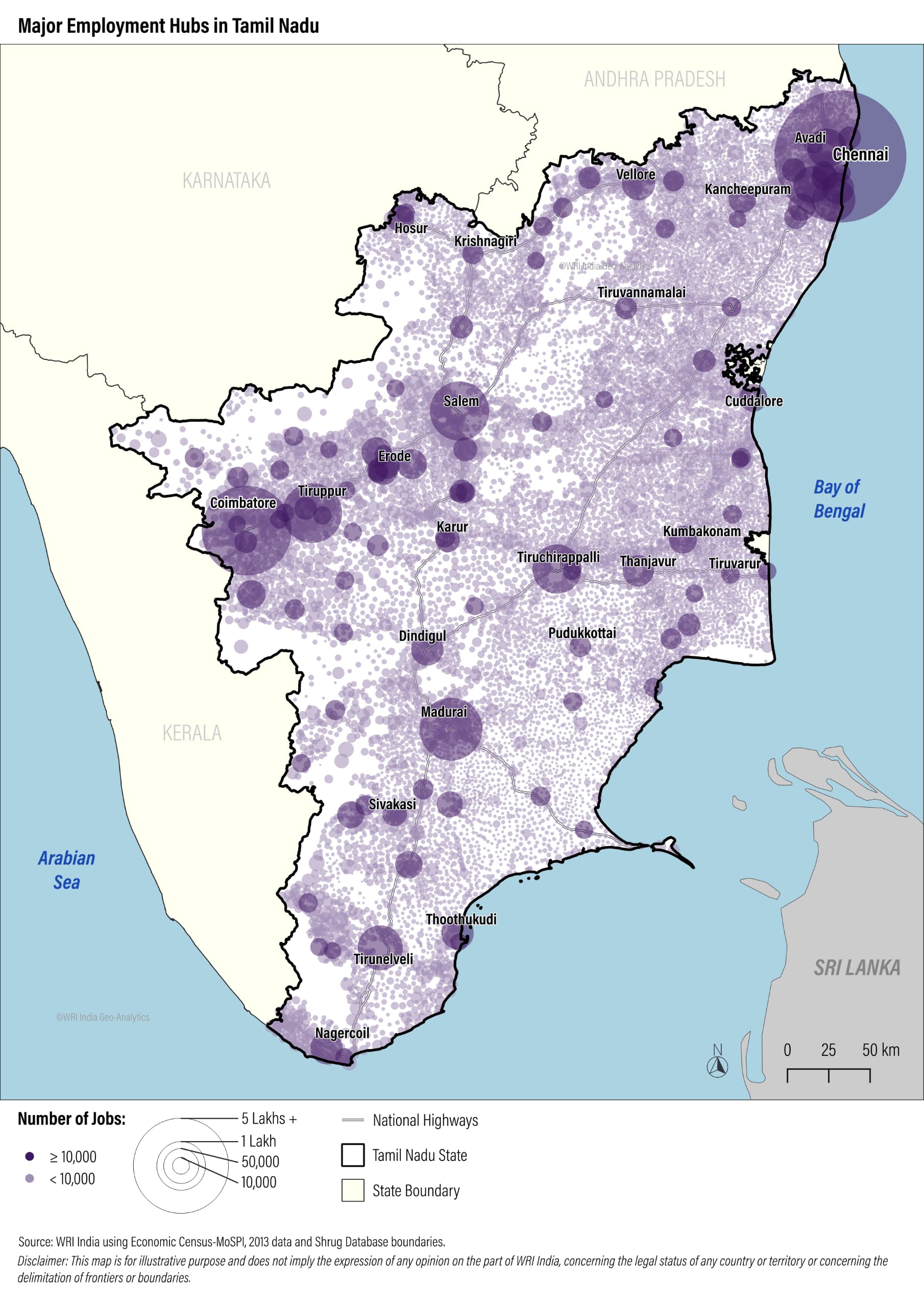
Spatial analysis conducted for Tamil Nadu to support the co-creation of the Existing Situation Analysis Report
The WRI India team reached a significant milestone this month by submitting the Existing Situation Analysis (ESA) Report to the Tamil Nadu State Planning Commission (SPC), marking the second promised deliverable midway through the project. The report offers a detailed examination of peri-urban areas through a comprehensive literature review, an analysis of governance structures, a comparative study of Tamil Nadu’s urbanization trends in the national context, and an assessment of growth patterns across all 38 districts in the state. In addition to the submission, the peri-urban team engaged with the SPC in a review meeting, presenting key findings and discussing the next steps to advance the development of a sustainable urban management framework for Tamil Nadu’s peri-urban areas.
WRI India participated in the sixth edition of The Indian Express’s THINC: CITIES seminar series, presented by Omidyar Network India, held in Lucknow on Thursday.
The seminar featured a keynote address by Amrit Abhijat, Principal Secretary, Urban Development Department, Government of Uttar Pradesh. This was followed by a panel discussion with speakers including Paramjeet Chawla (Program Manager and Urban Economist, WRI India), Bornali Bhandari (Professor, National Council of Applied Economic Research), Geeta Thatra (Associate Director, Research and Training, Work Fair and Free), and Smita Agarwal (Chairperson, CII Uttar Pradesh).