13th and 14th August: Online training sessions for UP Aspirational Cities Fellows to undertake perception surveys across 100 small cities in Uttar Pradesh

Screenshots of Virtual workshop on perception Survey Administration for 100 CM Fellows of Aspirational cities Programme
A virtual training session was held on August 13 and 14, to introduce survey tools and methods for undertaking a multi-sited perception survey across Uttar Pradesh. The survey results will inform the structure and content of Illustrated Handbook that can be used for ensuring sustainable and resilient development across emerging small cities in UP. The session led by WRI India team engaged the Aspirational Cities Programme team and 100 CM Fellows, effectively preparing them for data collection and ground scenario observations in 100 aspirational cities. The team also discussed best practices and research ethics with the cohort to ensure due protocols are followed during data collection
27th August: Stakeholder meeting with the Government of Uttar Pradesh (GoUP) to discuss the Uttar Pradesh Greening Policy
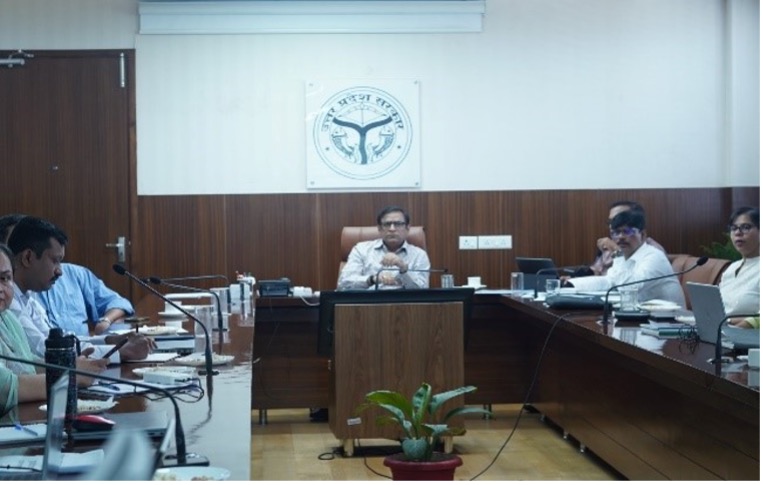

WRI India presenting the Review of Uttar Pradesh Urban Greening Policy to Government of Uttar Pradesh (GoUP)
On August 27, a multi-stakeholder meeting was convened to discuss the Uttar Pradesh Greening Policy, with Shruti Maliwar and Saurabh Verma from WRI India presenting a detailed policy review and recommendations for building an ecosystems-based approach to greening across the state. The gathering brought together representatives from both the Government of Uttar Pradesh (GoUP) and civil society. Key officials in attendance included Principal Secretary Amrit Abhijat (IAS), Special Secretaries Dharmendra Pratap Singh (IAS) and Satya Prakash Patel (IAS), Additional Director of Urban Local Bodies Ritu Suhas (IAS), and NBRI Senior Scientist KK Saxena.
The meeting focused on refining the draft Uttar Pradesh Greening and Park Development Policy and identifying opportunities for urban greening partnerships. The GoUP aims to finalize and release the policy by October 2, 2024, with bi-weekly online meetings scheduled to monitor progress.
23rd August: Submission of the Draft Stormwater Drain Policy to the Government of Uttar Pradesh

Submission of the final draft to Shri Satya Prakash Patel (IAS), Special Secretary, UDD, GoUP
On August 23, 2024, the draft stormwater drain policy was officially submitted to Principal Secretary Amrit Abhijat (IAS) and Special Secretary Satya Prakash Patel. This submission follows a thorough review and incorporation of feedback from the Government of Uttar Pradesh (GoUP) and other key stakeholders. The next phase involves preparing a comprehensive presentation to secure final approval from the Principal Secretary and other relevant parties, ensuring the policy aligns with the state’s goals for sustainable stormwater management.
11th and 12th September: WRI India hosts its annual flagship event, Connect Karo in New Delhi
WRI India’s annual flagship event, Connect Karo, brought together Indian and global leaders and policymakers, peer organizations, donors, and stakeholders to discuss critical issues related to sustainable cities, clean energy, food, land and water and climate action. A vibrant dialogic space, this is a platform that allows policymakers, investors, philanthropists and business leaders to engage with practitioners and researchers to seek out nuanced, contextualized solutions to the most urgent challenges of our time.
This year, Connect Karo offered a diverse range of sessions, including expert panel discussions, interactive workshops, and keynote addresses from renowned speakers. The two-day conference explored themes like transformative urbanization and green development, with sessions on climate action, clean energy transition, financing clean energy, food loss and waste, building healthy public spaces and streets, water security, heat mitigation, green skilling, eco-city regions, transit-oriented development, and much more. Connect Karo was held on September 11-12 at the India Habitat Centre in New Delhi with the theme "For People, Nature and Climate.”
11th September: Roundtable Discussion on Building Thriving Eco City-Regions at Connect Karo 2024


Snapshots from the Roundtable on Building Thriving Eco-City Regions
At WRI India’s annual flagship event Connect Karo 2024, the Eco-City Regions team convened a roundtable session that brought together government partners, policymakers, experts, peer organizations, and changemakers to discuss pathways of building more resilient and inclusive Eco City- regions. The panel featured Ms. Mandeep Kaur (IAS), Commissioner Secretary of the Housing and Urban Development Department, Government of Jammu and Kashmir; Mr. Akash Deep (IAS), Principal Secretary of the Bodoland Territorial Region; Ms. Sudha Ramen (IFS), Member Secretary of the State Planning Commission, Government of Tamil Nadu; and Rejeet Mathews, Program Director for Urban Development at WRI India.
The session began with a context-setting presentation by Neha Lal, followed by a moderated roundtable discussion. The panelists explored the complex intersections of urbanization, blue-green infrastructure, agriculture, forests, the economy, and governance, highlighting the diversity of local narratives across regions.
Ms. Mandeep Kaur emphasized Jammu and Kashmir’s status as an ecologically sensitive region, with diverse water conditions and languages changing every few miles, which creates unique economic priorities. She stressed the importance of promoting decentralized decision-making and empowering local bodies to enhance governance. Mr. Akash Deep highlighted the critical need to balance infrastructure development and income growth with sustainable resource management, particularly in relation to forests and land while Ms. Sudha Ramen spoke about the new challenges emerging highly urbanized regions like Tamil Nadu through peri urban growth.
Our experts from governance, law, planning and urban services emphasized the need for a strong participatory approach in planning and design. Engaging experienced planners, using mixed methods, devising solutions alongside local stakeholders are key to understanding their aspirations on growth and development and balancing it with preservation of ecosystems.
The session also featured changemakers like Kirat Brahma, founder of Zankla Studio, a social enterprise from Bodoland that produces sustainable, handmade soft toys inspired by the cultural heritage of the Bodo community in Assam. Using locally sourced materials, these toys are crafted by community weavers and artisans, aiming to provide sustainable livelihoods while preserving and celebrating the region’s cultural heritage through the stories behind each toy.
11th September: Thriving Eco City-regions microsite and forum launch during the Plenary on Managing at the frontlines of urbanization – Perspectives from the states


Thriving Eco City-regions microsite and forum launch during the Plenary at Connect Karo 2024
On September 11th, during the Plenary session at Connect Karo 2024, titled Managing at the Frontlines of Urbanization – Perspectives from the States, the Thriving Eco City-Regions team and plenary speakers officially launched our microsite and forum. The plenary session brought together senior government officials from various Indian states to share their insights, experiences, and strategies to explore how to harness the opportunities of rapid urbanization while addressing its complex and growing challenges. The Thriving Eco City-Regions initiative facilitates the transformation of urban areas in India into green, inclusive, and resilient city-regions. Our work spans six key regions—Delhi, Punjab, Uttar Pradesh, Jammu & Kashmir, Bodoland, and Tamil Nadu.
To disseminate the nature of work we do across our six city regions and to foster collaboration with like-minded change makers, we launched the ‘Thriving Eco City-Regions’ Forum. The Eco City-Region Forum will facilitate collaboration, peer-to-peer learning, inclusive policy dialogue, and immersive learning experiences, bringing together officials, civil society, and experts to address local challenges and explore innovative solutions. The Eco-City Region Microsite showcases our work and its learnings, serving as an online repository for knowledge resources and a portal to access upcoming events for all. It also serves as the digital footprint of the ECR Forum to enable awareness, capacity building, networking and broadcasting of events and masterclasses.
Visit our microsite and forum here: https://ecocityregions.org/